

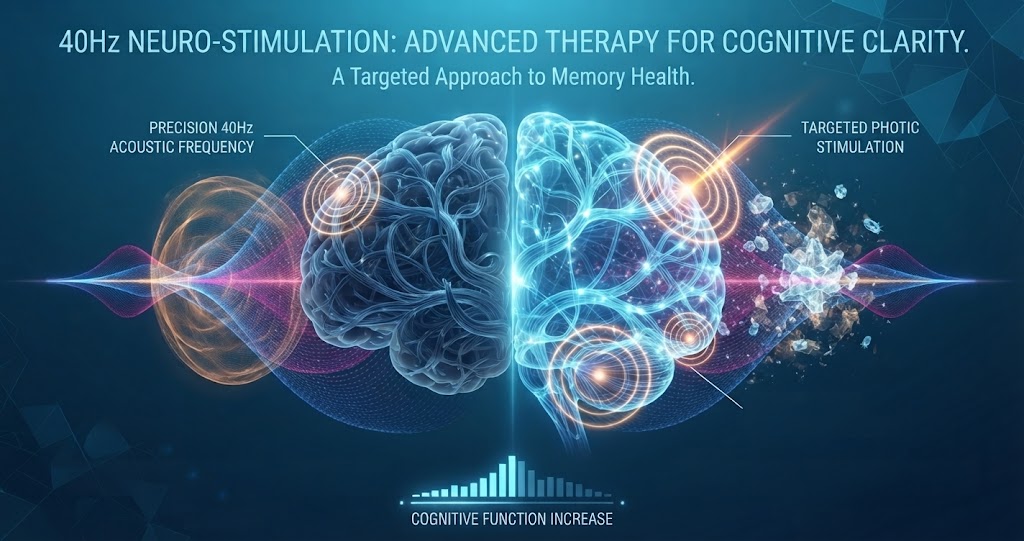
Researchers at the Massachusetts Institute of Technology (MIT) have reported promising early findings from a two-year study examining whether rhythmic light and sound stimulation could help slow the progression of Alzheimer’s disease.
The study followed five people with mild Alzheimer’s who continued using an experimental treatment known as GENUS — short for gamma entrainment using sensory stimuli. The noninvasive therapy delivers light and sound at a frequency of 40Hz, with the aim of stimulating brain activity associated with memory and learning.
Three participants with late-onset Alzheimer’s showed better results on several cognitive measures than comparable patients in national Alzheimer’s databases. All three were women.
Two of the late-onset participants also provided blood samples. Researchers found significant reductions in phosphorylated tau 217, or pTau217, a biomarker closely associated with Alzheimer’s-related brain pathology. Levels of the biomarker fell by 47 percent in one participant and 19.4 percent in the other.
The researchers stressed that the findings are preliminary because the study involved only five participants. However, they said daily 40Hz audiovisual stimulation appeared safe and feasible over two years and could potentially slow cognitive decline and changes in Alzheimer’s biomarkers.
MIT’s 40Hz approach
The treatment emerged from research at MIT’s Picower Institute for Learning and Memory, where scientists have investigated the role of gamma-frequency brain activity in Alzheimer’s disease.
Earlier animal studies suggested that exposing the brain to 40Hz light and sound can strengthen and synchronize gamma waves. Researchers found evidence that the stimulation could influence processes linked to Alzheimer’s, including amyloid and tau proteins, while helping preserve connections between brain cells.
MIT launched an early-stage human trial in 2020 involving 15 people with mild Alzheimer’s. Participants used an LED light panel and speaker system for approximately one hour each day.
Although the original trial was disrupted by the COVID-19 pandemic, researchers reported potentially beneficial changes after three months. The latest study examined five participants who continued using the devices after the initial trial.
Researchers assessed cognitive performance, brain-wave responses, MRI scans, sleep and circadian rhythms. They also compared the participants’ results with data from thousands of Alzheimer’s patients contained in three national databases.
Not everyone benefited
The results were not uniform. The three women with late-onset Alzheimer’s generally experienced either improvement or slower decline across most cognitive tests. They also showed stronger brain-wave responses to the stimulation and improvements in some measures of circadian rhythms.
The two other participants, both men with early-onset Alzheimer’s, did not show significant improvements in cognitive scores after two years. Their brain-wave responsiveness to the stimulation also declined.
Researchers suggested that the difference may reflect biological distinctions between early- and late-onset Alzheimer’s rather than the participants’ sex. They said future studies should investigate whether genetic and pathological factors can predict treatment response.
MRI findings were also mixed. While the initial MIT trial suggested that 40Hz stimulation could help preserve brain volume after three months, that effect was no longer statistically significant at the 30-month assessment.
The researchers emphasized that the study does not prove GENUS can treat or slow Alzheimer’s disease. Larger randomized clinical trials will be needed to determine whether the findings can be reproduced.
A nationwide clinical trial is now evaluating the treatment through Cognito Therapeutics, an MIT spin-off company. Researchers are also studying whether 40Hz stimulation could have a preventive role before Alzheimer’s symptoms appear.
For now, the MIT findings provide a potentially important scientific lead — but one that remains to be tested in much larger groups of patients.

