

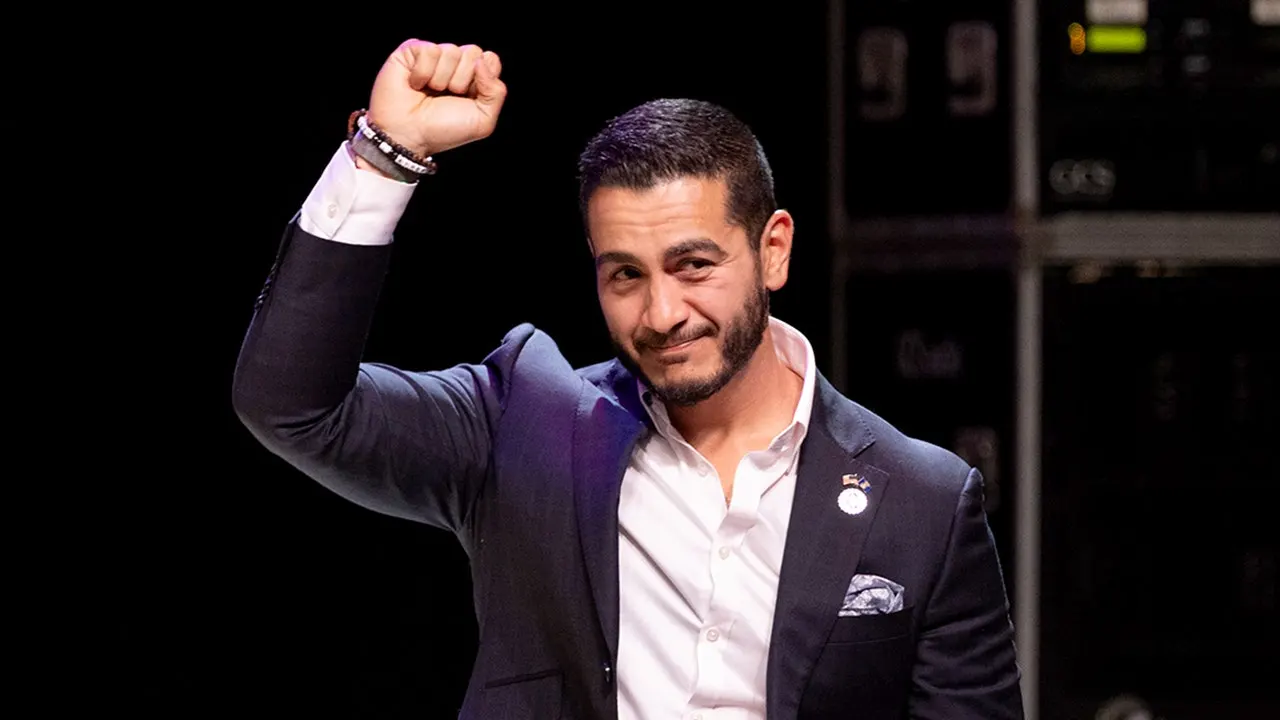
LAHORE MIRROR-Democrat Abdul El-Sayed has made history by winning Michigan’s closely watched US Senate race, defeating Republican Mike Rogers to become the first Muslim American elected to the United States Senate.
El-Sayed’s victory adds to the Democrats’ decisive gains in the November 3 midterm elections, as the party secured control of the Senate and delivered a major electoral setback to President Donald Trump and his political agenda.
The 42-year-old doctor and former public health official declared victory early Wednesday at Michigan Democrats’ headquarters in Detroit. Addressing supporters, he thanked voters who had welcomed him into their homes and communities during an 18-month campaign across Michigan.
“You welcomed me in your homes, your churches, your synagogues,” El-Sayed said.
He credited the grassroots movement behind his campaign, saying voters had given him strength during difficult moments.
His election marks a historic milestone for Muslim Americans, who have never before had a representative elected to the US Senate.
Islamophobic Attacks Become Major Campaign Issue
The Michigan contest was marked by repeated attacks on El-Sayed’s Muslim identity, with Trump and his Republican allies making his religion and background central issues in the campaign.
Trump called the Democratic candidate a “jihadist” and a “communist” and made remarks suggesting he would need to pass through a metal detector to enter the Senate.
Republican attacks also attempted to associate El-Sayed with the Egyptian Muslim Brotherhood, allegations that became part of a broader effort to portray him as a security threat.
In his victory speech, El-Sayed accused his opponents of choosing division instead of addressing the economic difficulties facing ordinary Americans, particularly the rising costs of fuel and groceries.
“They want an America that is too small for some of us,” he said. “We know that America is big enough for all of us.”
Healthcare, Economy and Israel Policy at the Centre of Campaign
El-Sayed built his campaign around the cost of living, healthcare affordability and reducing corporate influence in American politics.
He advocated for Medicare for All, a proposal aimed at establishing universal healthcare coverage, and argued that public money should be invested in domestic priorities, including schools, healthcare and infrastructure.
His foreign policy position also distinguished him from many mainstream Democrats. He called for an end to US military assistance to Israel and criticised American support for its military campaign in Gaza.
During his victory speech, he said: “We want our taxes spent here, for schools here, and healthcare here, and infrastructure here. We don’t want our money sent to do apartheid, or genocide, or war.”
His position on Israel attracted support among progressive voters but also generated opposition from some Jewish voters.
The pro-Israel lobby American Israel Public Affairs Committee (AIPAC), through its Super PAC United Democracy Project, reportedly spent approximately $30 million during the Democratic primary in an effort to defeat El-Sayed. The Guardian described the expenditure as a record for a single race.
Meanwhile, advertising spending by both parties in the general election exceeded $220 million by mid-October, according to AdImpact.
Defeats Democratic Establishment Favourite in Primary
El-Sayed’s path to the Senate was not straightforward. He first had to overcome opposition from within his own party.
During the Democratic primary, he defeated Representative Haley Stevens by approximately one percentage point, despite Stevens receiving support from prominent Michigan Democrats, including Governor Gretchen Whitmer and outgoing Senator Gary Peters.
His nomination exposed divisions within the Democratic Party over its political direction and the growing influence of progressive candidates.
Stevens later reversed her position in the closing days of the general election campaign and endorsed Republican Mike Rogers, despite initially indicating that she would support the Democratic ticket.
El-Sayed nevertheless secured the nomination and went on to defeat Rogers.
Rogers Struggled to Distance Himself from Trump
Rogers, a former Republican congressman, entered the race with Trump’s endorsement and campaigned as a close ally of the president.
He had previously lost the 2024 Senate election to Democrat Elissa Slotkin by approximately 0.3 percentage points.
During the 2026 campaign, Rogers supported Trump’s aggressive tariff policies and the US war with Iran. However, in the final weeks, he attempted to distance himself from the president on both issues, calling for an end to the US-Canada trade dispute and a swift conclusion to the Iran conflict.
Rogers had also opposed the Affordable Care Act, defended the Trump administration’s immigration enforcement policies and repeated Trump’s false claims about widespread fraud in the 2020 presidential election.
Republicans attempted to portray El-Sayed as too progressive for Michigan, a state that remains a crucial electoral battleground.
An August Fox News poll found that 54% of Michigan voters considered El-Sayed’s positions too extreme. At the same time, 51% said Rogers was too closely aligned with Trump.
A New National Platform for El-Sayed
El-Sayed previously served as director of public health departments in Wayne County and the city of Detroit. He first entered electoral politics in 2018, when he unsuccessfully ran for governor of Michigan.
His Senate victory now gives him a national platform as Democrats prepare for the next presidential election cycle in 2028.
The result also carries significance beyond Michigan. El-Sayed’s election represents a historic breakthrough for Muslim political representation in the United States, while his campaign highlights the growing influence of progressive voices within the Democratic Party.
His victory comes at a time when American politics is witnessing renewed debates over immigration, religious identity, economic inequality, healthcare and the country’s foreign policy, particularly its support for Israel.

