

Lahore Mirror: The Trump administration has suspended new and pending green card applications involving Microsoft, Adobe and six major IT services companies, including major Indian IT firms, widening its crackdown on skilled-worker immigration. The US Department of Labor says the move aims to combat alleged fraud and protect employment opportunities for American workers.
US Labor Department official Keith Sonderling announced the action on Thursday, October 8, declaring that the government was “cutting off the head of the snake” to protect American workers.
We’re cutting off the head of the snake and protecting American Workers.
Beginning today, @USDOL is SUSPENDING Microsoft and Adobe among other companies from the permanent visa program. After a pipeline of systemic fraud has flooded our country for years with foreign labor, we’re putting an end to it today.
We are taking action under the direction of @POTUS and with the leadership of @VP and @USLaborIG on the @WHFraudTF—DELIVERING for the American People, protecting their money, and punishing fraudsters. 💪 🇺🇸
— Secretary Keith Sonderling (@Sonderling47) October 8, 2026
The suspension covers applications under the Permanent Labor Certification Programme, known as PERM, a key step in the employment-based green card process. The affected IT services companies include India’s Tata Consultancy Services (TCS), Infosys, Wipro and HCL Technologies, as well as US-based Cognizant and France’s Capgemini. Software giants Microsoft and Adobe are also affected.
Sonderling said the department would neither accept new applications nor process pending PERM applications involving the named companies.
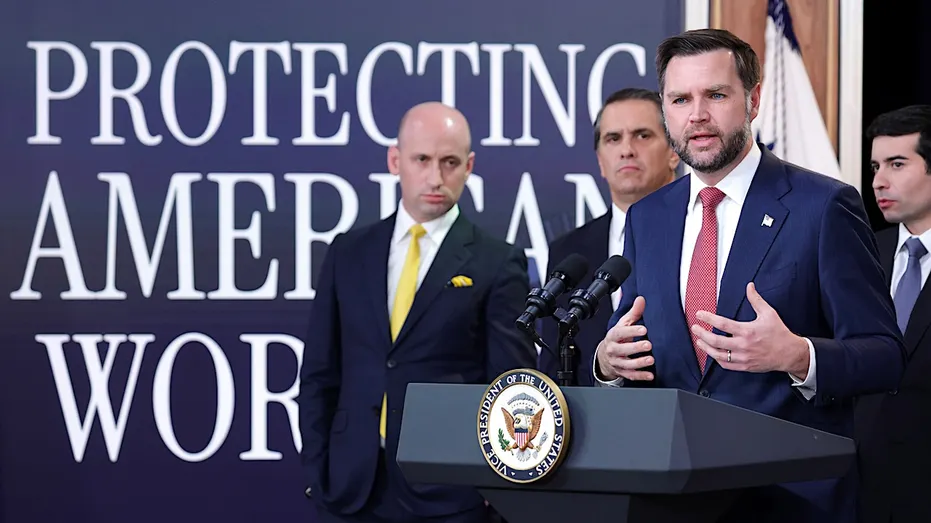
On the H-1B Visa application process fee Vice President JD Vance said, “The thought there is very clear, if you’re actually bringing a truly elite genius level super specialized person to the United States of America, you’re going to be willing to pay a little bit extra to bring that person into your company. But if you’re just bringing in somebody who’s going to undercut the wages of the American worker, which is what most H-1Bs are today, then you shouldn’t bring that person in, we should actually prioritize our workers first.”
Vance Accuses Microsoft of Abusing the System
US Vice President JD Vance singled out Microsoft, accusing the company of exploiting the immigration system while laying off American workers.
“There has been no company in the United States, unfortunately, that has abused the system more than Microsoft,” Vance said.
VP JD Vance puts Microsoft on notice, telling the tech giant it cannot lay off American workers only to replace them with foreign labor.
VP JD Vance puts Microsoft on notice, telling the tech giant it cannot lay off American workers only to replace them with foreign labor.
“We are the biggest boosters of your industry,” Vance says, making clear that the administration wants American technology companies to thrive, but expects them to hire Americans in the process.
“You’re a great American company, but you’ve got to hire great American workers.”
— Fox News (@FoxNews) October 8, 2026
He claimed Microsoft laid off 6,000 American workers last year while benefiting from 6,300 H-1B temporary worker visas and nearly 3,000 green cards.
Microsoft disputed the implication that its use of foreign workers undermines American employees. The company said about 80% of its H-1B applications in the previous fiscal year involved extending or changing the status of existing employees rather than recruiting new workers. It also said H-1B employees receive the same pay as other employees performing comparable work.
Microsoft announced plans in July to cut 4,800 jobs, representing about 2.1% of its global workforce.
Indian IT Companies Face Green Card Uncertainty
According to Sonderling, the affected companies had sought permanent residency for almost three million foreign workers since 2009. They had also received more than 230,000 H-1B visa approvals and over 100,000 permanent labour certifications, he said.
The figures cover the companies collectively and do not establish that all the applications involved fraud.
The restrictions could create uncertainty for Indian technology professionals seeking permanent residency through their employers. However, the suspension does not automatically cancel existing H-1B visas. Its immediate focus is the PERM certification process, which employers generally must complete before proceeding with many employment-based green card applications.
India’s IT industry body, Nasscom, said Indian technology companies in the United States had significantly reduced their reliance on H-1B visas, with relatively few employees seeking green cards through PERM.
Vice President Vance said the suspensions would remain in place for as long as necessary, putting pressure on the affected companies to change their hiring practices.
Crackdown Extends to Universities
The administration has also opened investigations into nine leading US universities, including Harvard, Yale, Stanford, Brown and the Massachusetts Institute of Technology.
Vance said the investigations would examine alleged misuse of exchange-visitor visas to undercut American wages. Labour Inspector General Anthony D’Esposito said subpoenas had already been issued.
Investigators will also examine whether foreign influence, improper financial relationships or visa abuse have compromised federally funded research.
The university investigations add another dimension to the administration’s immigration restrictions, which have already affected international students and academic institutions.
The latest action follows the launch of the Labor Department’s Project Firewall enforcement initiative in September 2025. It also comes after a White House proclamation introduced a one-time $100,000 fee on new H-1B petitions for workers hired from abroad.
Together, the measures signal a broader effort by the Trump administration to tighten skilled-worker immigration and scrutinise employers that rely on foreign professionals. The duration of the suspensions and their ultimate impact on technology companies and workers seeking permanent residency remain uncertain.

