

As artificial intelligence rapidly automates jobs and reshapes entire industries, JP Global host and AI commentator Karim debate whether the technology will create unprecedented opportunity—or deepen inequality and human control.
Artificial intelligence is moving far beyond chatbots and digital assistants, raising fundamental questions about the future of work, wealth and even human society.
In a wide-ranging discussion on JP Global, host Ayaz Khan Lohani spoke with Business Intelligence Analyst Kareem Shehadeh-Rifai about the accelerating AI revolution, the threat of job displacement, automation, human greed and the possibility that increasingly powerful technology could transform the balance of power across the world.
The discussion began with the long-standing prediction of an AI-driven “job apocalypse.” Lohani noted that in countries such as Pakistan, many people using AI are experiencing an increase in their workload rather than losing their jobs.
Karim explained that AI’s immediate impact is likely to be uneven. Repetitive office-based tasks can increasingly be automated, while new professions—including AI and data engineering—are emerging. He pointed to automated systems capable of collecting huge amounts of business information and using it to conduct personalized communication at a scale that would previously have required teams of employees.
Physical work presents a different challenge. Karim argued that humans remain considerably more agile than robots when dealing with unpredictable tasks. While a robot can perform a precisely programmed operation, adapting to changing circumstances remains considerably more difficult.
The conversation then examined why companies are so interested in replacing human workers.
According to Karim, machines can offer businesses a major economic advantage because they do not require salaries, healthcare, sick leave or other employment-related costs. Once purchased and deployed, automated systems can provide predictable output while allowing companies to monitor performance in unprecedented detail.
This, he argued, reflects a broader transformation driven by modern capitalism, where efficiency and profit often determine which parts of a production process remain human and which are automated.
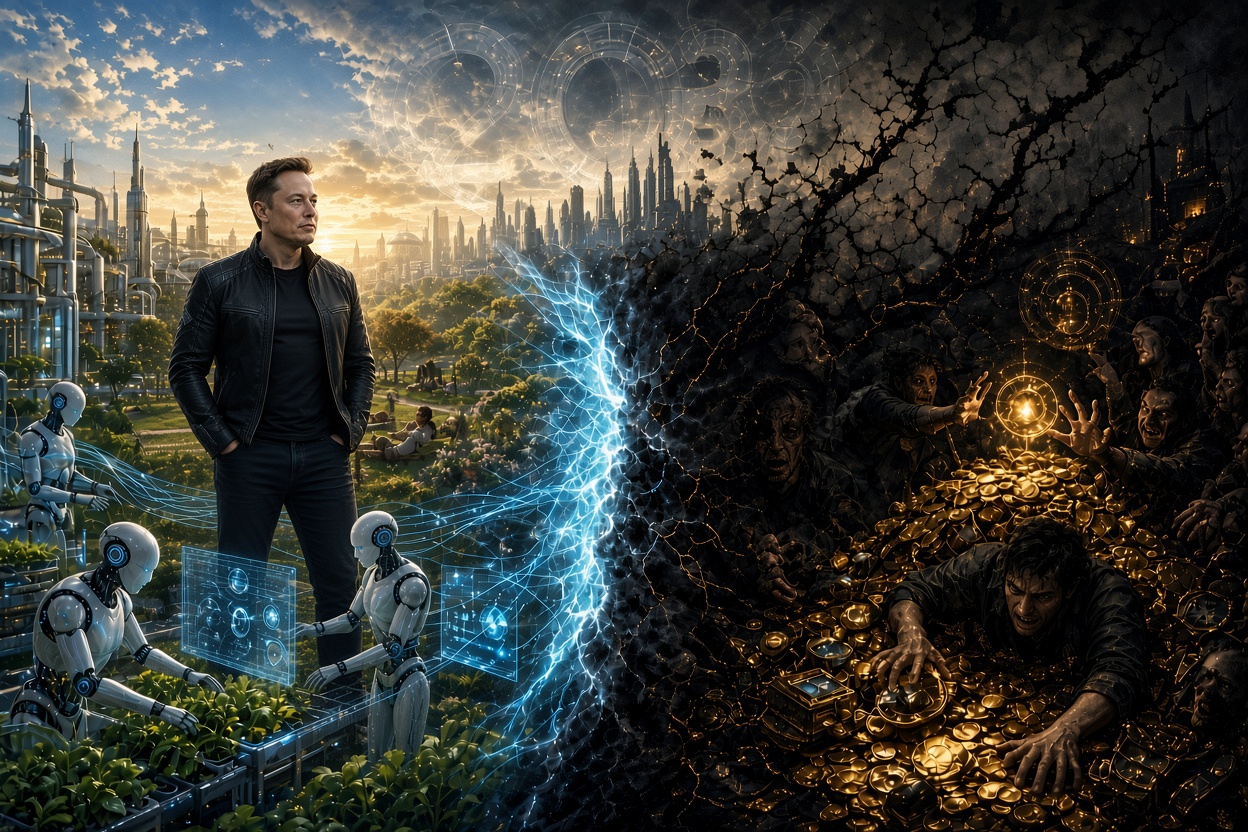
The speakers also discussed Elon Musk’s vision of a future in which AI and robotics could create such abundance that traditional employment and even money might become unnecessary.
But Karim questioned whether such abundance would automatically benefit ordinary people. He warned that control over advanced technology and resources could remain concentrated among a relatively small group, potentially widening existing inequalities.
The discussion became more speculative as Lohani raised the possibility of increasingly advanced AI influencing human beliefs, social divisions and collective behavior.
Karim argued that AI’s ability to process enormous amounts of information could eventually give those controlling it extraordinary influence. Algorithms already determine much of the information people encounter online, potentially shaping perceptions of society and political or social issues.
Both speakers ultimately returned to one central factor: human nature.
Lohani argued that human creativity and human greed could determine how AI is ultimately used. The same technology capable of accelerating medical research and education could also be used to accumulate wealth, increase surveillance or concentrate power.
Karim offered a more optimistic conclusion. He argued that AI gives individuals unprecedented access to education, automation and problem-solving tools. Those who develop a “creator mindset”—rather than simply consuming technology—could use it to build new solutions and compete globally.
The debate therefore goes beyond whether AI will take jobs.
The bigger question is who will control the technology, who will benefit from its productivity, and whether humanity can develop fast enough to manage the power it is creating.

