

By Dan Qayyum
In December 2003 a twenty-year-old in Lahore uploaded one song. Singers across the subcontinent are still trying to sound like him.
In October 2024, a young man from Amritsar named Lakshya Mehta auditioned for Indian Idol. He sang Tum Kya Mile and then Pehli Nazar Mein. Somewhere in the second song, Vishal Dadlani stopped him. The contestant was copying the original singers’ inflections, Dadlani said, first Arijit Singh’s and then Atif Aslam’s. “You cannot become an Indian Idol singing in someone else’s style.” He went on in Hindi: these were great artists, and the day a singer starts imitating them is the day he condemns himself to singing in hotels and restaurants for the rest of his life.
Shreya Ghoshal was sitting next to him on the panel. Nineteen years earlier she had sung on an uncredited Bollywood copy of Aadat.
Aadat had gone online in December 2003, uploaded by a twenty-year-old in Lahore.
I heard it the way most people did, as an MP3 with no picture attached. That same year I moved to Dubai, and many of the friends I made there were Indian. They are still among my closest. I played them the file a year before Mumbai had heard of Atif Aslam, and from then on he was on every playlist we shared. For years, in offices, at dinners and on long drives down Sheikh Zayed Road, he was the one singer nobody needed to argue about. He was simply ours.
What happened in that audition room had been happening for twenty years, in bedrooms, college canteens and wedding stages from Karachi to Kolkata. One song, one voice and one way of singing became the template for a generation of young male singers across South Asia. The contestant was only the latest to try it on.
Fifty dollars
Atif Aslam was born in Wazirabad in March 1983 and spent most of his school years wanting to take wickets. “I was planning to become a professional cricketer; I was an athlete,” he has said. He skipped classes, “catering to my interest in taking wickets,” until his parents told him fast bowling had no scope, and he gave it up.
Music came to him through an older brother. The first album he remembers hearing, at twelve or thirteen, was Nusrat Fateh Ali Khan with Michael Brook. At college in Lahore he met a guitarist, Goher Mumtaz, and they started writing songs together. They had no money for a studio. Atif’s father had given him fifty dollars for a college trip, so Atif skipped the trip and paid for the recording.
He has always told the next part briefly. “I recorded my first song Aadat out of my pocket money. It took me a few seconds to upload it on the internet, when there was nothing like WhatsApp. People started loving it and led to the making of a music video. The rise of my career began from that moment.”
The upload went live in December 2003, more than a year before YouTube existed. “At that time, there was no Facebook or YouTube,” Goher remembered. “We could not advertise our songs and never had that kind of budget, so we just uploaded the song online.”
For months the song travelled without a face. People wanted to see who was singing, and the music video got made because enough of them asked. A few months after the release, a friend rang Atif from a shopping mall in Karachi. A group of college students had sat down outside with a guitar, and when the friend walked over they were playing Aadat. “That was the first time I realized that this song was going to be something very special for the Pakistani youth,” Atif said.
Some of the established musicians who heard it early were less impressed. “Most of them started commenting that it was a really bad, nonsense song,” Atif recalled of the members of Noori. “Some called it cheap.”
Ten years later, Faizan-ul-Haque, who had been a VJ on Indus Music when the video first aired, gave a fairer verdict. “Critically speaking, Aadat was not the best song of its time, but it is one that the young public connected with the most,” he said. It turned Atif, “who was hardly a Shafqat on melodies or an Ali Noor or Ali Azmat in terms of image, into an icon.” Then he reached for a bigger word. “Looking back now, Aadat seems to be nothing short of genesis.”
The guitarist Faraz Anwar explained the mechanics, and he wasn’t happy about them. The song ran on “one minor chord and two major chords.” Anyone with a guitar could learn it in an afternoon, and a great many people did. It “gave the music industry a formula to follow,” Anwar said. “It’s their short-cut to success that gives them so many followers.” The guitarist Asad Ahmed, who heard it before release, put it next to the two songs every Pakistani already knew by heart. “All the game changers of Pakistani pop music have been very simple, be it Dil Dil Pakistan, Dekha Na Tha by Alamgir or Aadat.”
The title means habit, and the song is about a love the singer can’t shake. The chords took an afternoon to learn. Copying the voice would keep a generation of young men busy for the next twenty years.
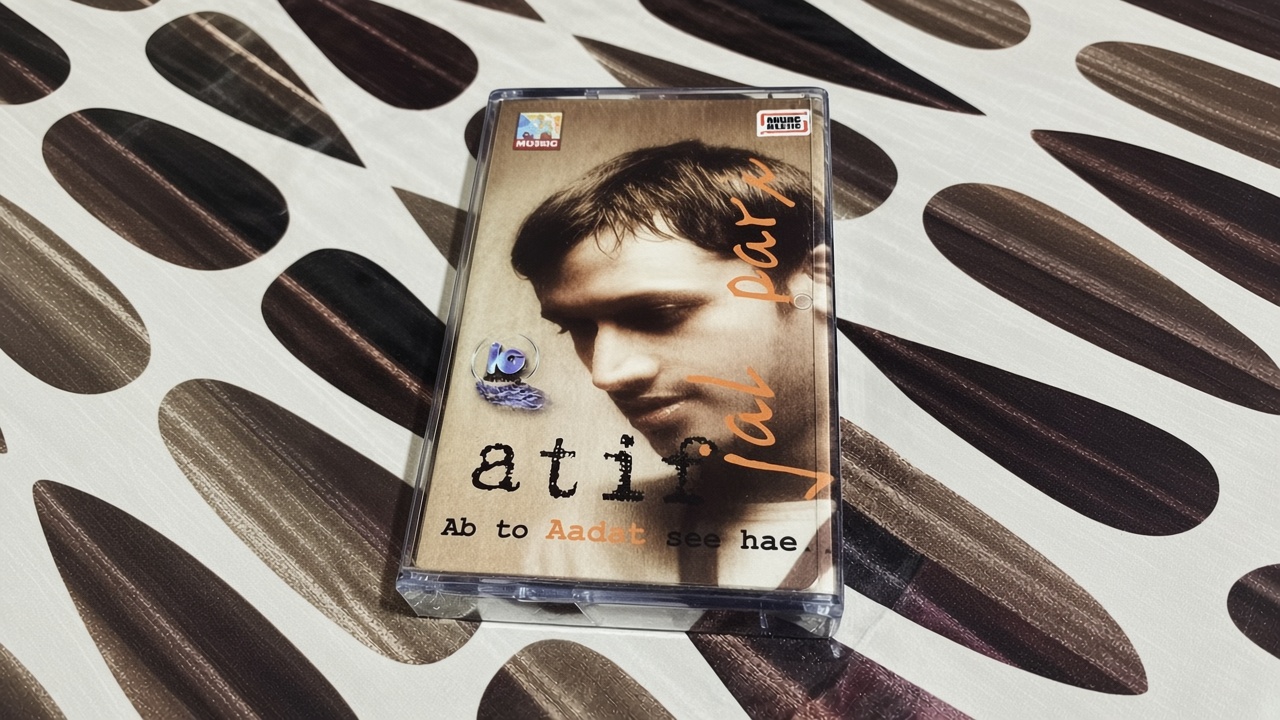
The band that recorded it, Jal, didn’t survive it. By the end of December 2003 Atif had left over what both sides called musical differences. Jal hired Farhan Saeed, re-recorded Aadat and named its 2004 debut album after it. Atif put his own version on his first solo album, Jal Pari, that same year, and Goher took the dispute over the rights to court. The friendship outlasted the case. In 2024 Goher described how it was mended. “Atif came up to me and apologised, mentioning that he got carried away by the questions,” he said. “This was the time when we were frequently meeting up, playing cricket together. We’re no longer teenagers.”
Mumbai copies, then pays
In 2005 the song crossed the border twice.
The first time came without permission. The soundtrack of Chocolate carried Zahreeli Raatein, sung by KK and Shreya Ghoshal and credited to Pritam, and anyone who had the Lahore MP3 recognised the melody straight away. Lahore got no credit. Pritam later said the track had been added to the album without his knowledge.
The second time came with a contract, from the Bhatt family’s Vishesh Films. In March their film Zeher used Woh Lamhe, a Jal-era song rearranged by Mithoon, and Atif was nominated for Filmfare’s best male playback award in his first year in Indian cinema. In December, Kalyug used Aadat itself. The same soundtrack opened with Rahat Fateh Ali Khan’s Jiya Dhadak Dhadak Jaye and also carried songs by Najam Sheraz and Abrar-ul-Haq, which made four Pakistani acts on a single Bollywood album.
Zahreeli Raatein and the Kalyug version of Aadat were both picturised on Emraan Hashmi. Within a single year he lip-synced the uncredited copy and then the licensed original.
By then my friends in Dubai had been singing it for a year.
The voice
What Bollywood paid for was the voice.
It had a rasp. It went for notes slightly beyond its range and committed to them anyway, and it let itself crack where a trained singer would have smoothed the line over. Atif has said that the first time he hit a high note as a teenager it frightened him, and he backed away. Years later, already famous, he said he had “never claimed to be a great singer with any classical training.”
For decades the Hindi film hero had been sung by voices from the Rafi and Kishore school, polished further by Kumar Sanu, Udit Narayan and Sonu Nigam: trained, smooth and always in tune. Atif sounded like a student singing at two in the morning after being dumped. Bollywood’s romantic leads were mostly written as that student.Some of the established names took against him. Asha Bhosle and Sunidhi Chauhan were reported to have named him Bollywood’s most over-hyped singer. Atif’s reply: “I love it. I love all the negative publicity and it shows that they are insecure about my success. Imagine their reaction if I were to be properly trained too. I would be unstoppable.”
The film work kept coming: Tere Bin, Pehli Nazar Mein, Doorie. In 2009, Tu Jaane Na and Tera Hone Laga Hoon made Ranbir Kapoor a star, as his sister Riddhima once told Atif directly. India’s best-known film family launched its next leading man on a voice from Wazirabad. When Atif sang Tera Hone Laga Hoon at Pakistan’s Independence Day parade in New York in 2018, some Pakistanis were furious that he had chosen an Indian film song for a national celebration. Shafqat Amanat Ali defended him publicly. “Music is not Indian or Pakistani.”
Three recordings, fourteen years apart, show what the voice could do.
Aadat is three chords and a twenty-year-old who hasn’t yet learned to protect his voice. He takes the chorus to the top of his range, the note frays, and he leaves it frayed. Two decades of imitators have tried to reproduce that fraying on purpose, which is roughly where Vishal Dadlani’s patience runs out.
“Imagine their reaction if I were to be properly trained too. I would be unstoppable.”
Tajdar-e-Haram is the voice turned towards God. His 2015 Coke Studio rendition of the Sabri Brothers’ qawwali became the first Pakistani video to pass a hundred million views on YouTube. Atif said he had never seen his father cry until his father heard it.
Dil Diyan Gallan is the voice under full control. It was recorded for Tiger Zinda Hai in 2017, a year after India’s film industry began shutting out Pakistani artists, and it went into a Salman Khan blockbuster regardless. The rasp from Aadat is still there, though by now he rations it. It became one of the most-played songs of his career, released at a time when he was not supposed to be working in Bollywood at all.
Atif by the numbers
Filmfare nomination for Woh Lamhe, his first year in Indian cinema
2006: Plays Dhaka, the start of two decades of return visits
2008: Tamgha-e-Imtiaz, one of the youngest Pakistanis to receive it
2011: Acting debut in Shoaib Mansoor’s Bol, whose soundtrack is still among Pakistan’s most-streamed albums
2015: Tajdar-e-Haram, the first Pakistani video to pass 100 million YouTube views
2019: Star on the Dubai Walk of Fame
2021–2023: Most-streamed Pakistani artist in Pakistan on Spotify, three years running
The imitators
After 2003, boys across Pakistan taught themselves to sing from an MP3. They studied the catch in the throat, the climb into the upper register and the crack saved for the line about heartbreak. They practised in bedrooms and college canteens, at mehndis and talent nights, and eventually in front of television judges. A generation grew up imitating him, and across the border the same thing was happening in the same years.
He had learned it from someone too. “Atif’s style of singing was very much inspired by Ali Azmat,” Faraz Anwar said. Behind Ali Azmat sat the man on the white sheet in Faisalabad, whose album an older brother once played to a twelve-year-old in Wazirabad. The line runs from Nusrat to Ali Azmat to Atif, and from Atif to the boy in Amritsar.
In Pakistan, every young male pop voice of the past twenty years has been measured against Atif’s. It started inside his old band. Goher Mumtaz has said that Farhan Saeed, the man hired to replace Atif and re-sing Aadat, “wanted to be Atif Aslam by going to Bollywood and all that stuff.” Two decades later, Asim Azhar, one of the biggest names of the streaming era, pointed to Atif’s move from music into acting as the path he means to follow.
Twenty-odd years at the top of South Asian music is long enough for most careers to pick up a scandal. His hasn’t. The headlines he has made off stage have been of another kind, like the night in Karachi in 2017 when he stopped a concert mid-song and had a woman who was being harassed brought out of the crowd. His audience hasn’t aged out either. The millennials who wore out the MP3 now have children, and the children know the songs. A few years ago my son, then nine, went with his cousin to a wedding in Islamabad where Atif was among the guests. He came back with a photograph of the two of them. His favourite song at the time was Dil Diyan Gallan. He had been a fan for as long as he could remember, and so had I. Few Pakistani public figures can be handed down from father to son without a caveat, and Atif is one of them.
His devotional records set a pattern of their own. When Asim Azhar released a devotional track in 2022, listeners heard it as following Tajdar-e-Haram and Wohi Khuda Hai. Once Spotify arrived in Pakistan, the streaming numbers caught up: Atif was the most-streamed Pakistani artist in the country in 2021, 2022 and 2023.
In 2025, at the finale of Pakistan Idol, he sang Aadat again, two decades after he first uploaded it, on a stage built for young singers who had grown up on that sound.
Across the border, people inside the industry said it plainly. In 2022 the Indian rocker Palash Sen, frontman of Euphoria, said: “The one singer-musician who has made the maximum impact on Bollywood’s music and most singers over the last 15 years, is this man. The awesome Atif Aslam. He has style, panache and that nasal twang that most singers in Bollywood tried to imitate. And his music is still copied by some leading music directors.” Pressed on it, he spelled out the cost. “Atif did make a big impact, hence Bollywood forgot our own talent and everyone started following his way of singing.”
A group of Indian composers including Amaal Mallik, Tanishk Bagchi and Jasleen Royal acknowledged in 2019 that Atif had been the singer to imitate a decade earlier. Mallik later described what composers in Mumbai were up against: “Today, most young singers go nasal, gimmicky or try to sound like Arijit Singh or Atif Aslam.”
“That nasal twang that most singers in Bollywood tried to imitate.”
In 2005, the year Woh Lamhe was playing across India, an eighteen-year-old from Jiaganj in West Bengal entered a reality show called Fame Gurukul. He was classically trained and had joined mainly because Shankar Mahadevan was a judge. He finished sixth. His name was Arijit Singh. Six years later, the same Bhatt camp that had brought Atif to Mumbai gave Arijit his first film song, Phir Mohabbat, in Murder 2. Within a few years he was the biggest playback voice in India, and he was measured against Atif from his first hit.
“If you look closely, almost every singer who came after Atif tried to sing like him,” Palash Sen said in 2026. “Even the biggest singer in our country today, Arijit Singh, if you listen to his earlier songs, he was also trying to sound like Atif. Later, he developed a style of his own.”
A few months later the Pakistani singer Rafaqat Ali Khan called Arijit an extension of Atif Aslam.
The fans turned it into a war. After Aashiqui 2 in 2013, the online fighting got bad enough that Arijit stepped in himself. “My dear brothers and sisters, I request you all to stop fighting over me and atif aslam. I respect that man as I do every individual musician and artist. And these talks over boundaries don’t suit us anymore. We are young people of India and Pakistan. Keep calm and enjoy the music.”
Asked in 2016 which of the two was better, Atif didn’t hesitate. “Of course… Arijit!” He added in Urdu: “Arijit ko izzat mili hai.” Arijit has earned his respect. A year later the two sang together for the first time, on Musafir. Its composer, Palash Muchhal, summed them up: “I have grown up listening to Atif and I love Arijit’s voice. Both express pain.”
The judge who gave it zero
Abhijeet Bhattacharya, who sang for Shah Rukh Khan through the nineties, never made peace with any of this.
In 2008, judging Zee’s Ek Se Badhkar Ek, he heard a contestant sing Pehli Nazar Mein and gave the performance zero. A song whose voice comes from “equipments ya software” is no song at all, he said. Its singer was a man “jiske aawaj ko machines se sur mein kiya jaata hai,” whose voice is put in tune by machines. “Please ye stage pe kisi gud ya besure singer ka gaana mat gaana.” Don’t sing the songs of a tuneless singer on this stage.
The contestant had picked the song nearly every young singer in India was picking that year.
Abhijeet kept at it. After the Uri attack in 2016, he went after the Khans, Karan Johar and the Bhatts for hiring Pakistani artists, Atif among them, and tweeted: “I said kick these Paki bstrds #ActAgainstPak ..shame @karanjohar @MaheshNBhatt for breeding feeding them.” In an interview clip that later resurfaced, he went further. “They are beggars; they should stick to their Coke Studio. Had I been among those who invited Pakistani singers, I would have hanged them or would have physically hit them.”
Atif took the advice. Coke Studio records its sessions live, in a room, with the band playing. There was no machine to tune him. The man Abhijeet said could not hold a note without software stood in that room and sang Tajdar-e-Haram, and a hundred million people pressed play.
Dhaka, Kathmandu, Kerala
That year the industry did what Abhijeet had been asking for. Indian films shut Pakistani artists out. Songs were re-recorded with Indian voices, names disappeared from credits, and the offers stopped. A year later Salman Khan put Dil Diyan Gallan in Tiger Zinda Hai anyway, and the audiences kept listening.
Atif played Dhaka in January 2006 and has gone back many times since. In November 2024, at the Bangladesh Army Stadium, the power failed about twenty seconds into his set because the crowd was pressing against the cables. When he reached Aadat, he did what Dhaka expects and handed the sargams and alaaps to the crowd. He sang in Bengali that night as well, including a song the audience shouted for by name. A year later a public concert in Dhaka, expected to draw more than thirty-five thousand people, was cancelled over security clearance, and he played private shows instead.
In 2012 he sang at the Dasarath Rangasala stadium in Kathmandu, and he returned to Nepal for two nights in 2024. That April he signed on to sing for the Malayalam film Haal, his first Indian film in seven years. Its lead actor, Shane Nigam, posted a photograph with him and listed the songs closest to his heart: “Aadat, Woh Lamhe, Tere Bin and almost all your songs.” Aadat came first.
The man behind the voice
I met him once, in 2010. We were working on a project that needed a short video message from him. He gave us all the time we needed and was unhurried and courteous throughout. Since then I have listened to him from a distance, like everyone else, until my son came home from Islamabad with a photograph.
Faith runs through the way he talks about his career. Stepping away from Bollywood, he said, was “God’s way of giving me a chance to return to who I had been before, the Atif Aslam who inspired the youth and made them believe that they could pursue a career in music.”
He has tried to pass that chance on. As a judge on Pepsi Battle of the Bands, he said he hoped “the kids who weren’t encouraged to make music shall start doing music now.” In 2025 he launched Borderless World, a programme for young musicians, and explained it with a line from Denzel Washington. “In the first phase of life you learn, then you earn and then you return.”
The habit
Atif is forty-three, and it is too early to settle his place. The critics still hear the nasal twang, the purists will never forgive the lack of training, and a rapper has already taken his Spotify crown. Talha Anjum, the voice now leading Pakistani music, sounds nothing like him.
For about a decade, though, one untrained voice from Wazirabad was the default sound of heartbreak for young men across the subcontinent. A generation of boys learned to sing by imitating him. Indian cinema copied him, paid him, banned him and kept coming back. In Dhaka the crowd still sings the alaaps back to him.
In May 2026, Arijit Singh played the Etihad Arena in Abu Dhabi. Partway through his set he sang Pehli Nazar Mein, then stopped. “I have a question for you all. This might be controversial but I do not care. I do not follow the news as much, but is playing Pakistani songs still banned in India?” Then he answered something nobody had asked him. “Atif Aslam is one of my favourites.”
The arena is an hour and a half down the road from Dubai, where in 2004 I played my friends an MP3 nobody in Mumbai had heard yet.
Dan Qayyum is the editor of The Pakistan Playbook, a media strategist, and long-standing advisor to government institutions and media organizations across the region. His work explores the intersections of geopolitics, military doctrine, and regional transformation. His upcoming book, The Other Side of Endurance, examines his own journey through crisis, resilience, and reinvention.

