

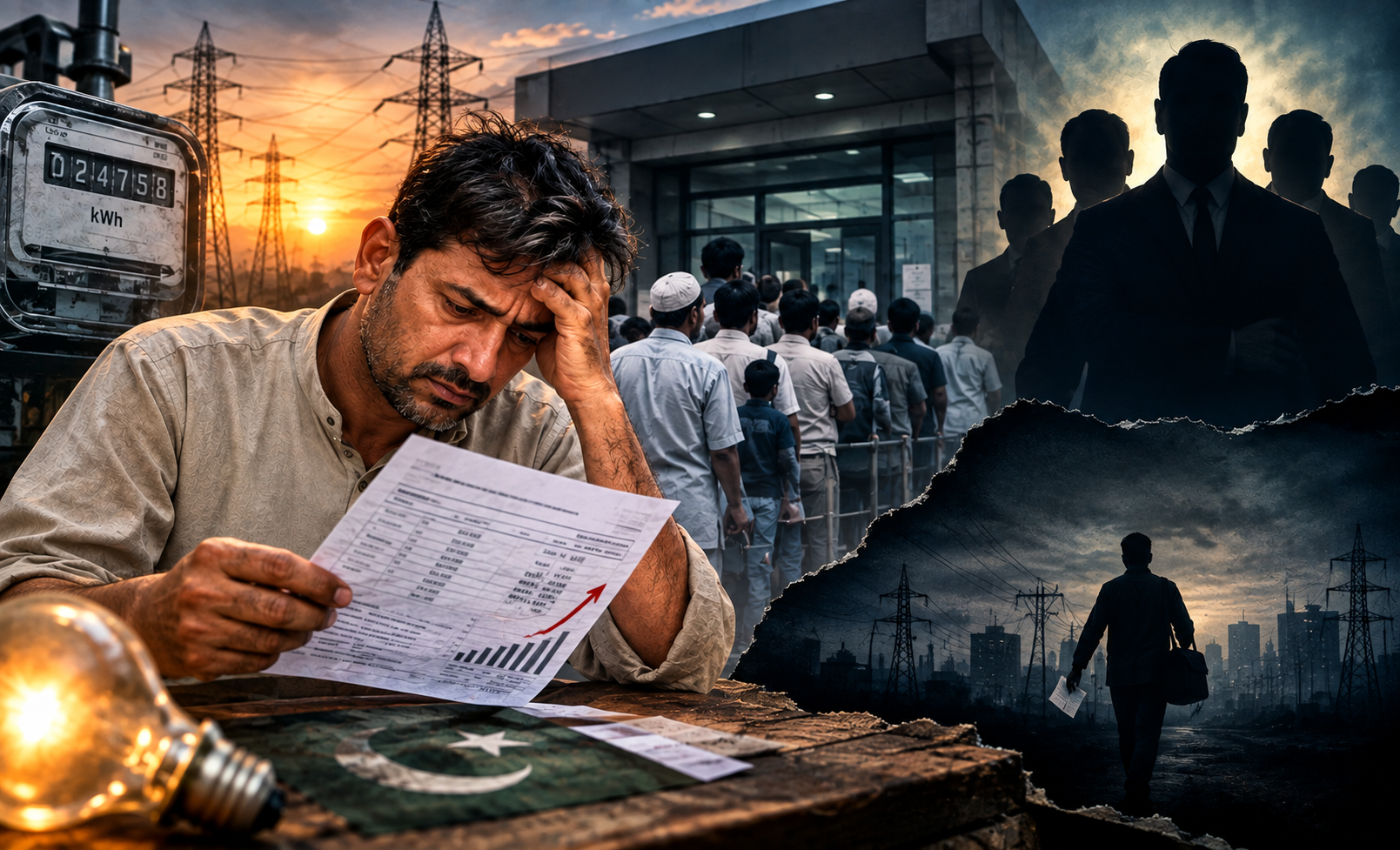
When the common man is burned by a disputed electricity bill, who exactly is he supposed to fight?
There is a strange rule in Pakistan:
The powerful can challenge the system. The common man has to negotiate with it.
Give an ordinary citizen a bill that suddenly jumps to double, triple or four times his normal consumption, and watch what happens.
He does not simply complain.
He enters the maze.
First the meter.
Then the reader.
Then the office.
Then the queue.
Then the in-charge.
Then another officer.
Then another visit.
And somewhere between the counter and the complaint, the citizen learns the first lesson:
Knowing your rights is not the same as being able to exercise them.
This is where the real problem begins.
The citizen may be right.
He may have used fewer units.
He may have a genuine billing dispute.
But can he prove it?
Can he get someone to listen?
Can he get the matter resolved quickly?
And can he challenge the decision without spending days, money, connections and emotional energy?
That is the question nobody wants to answer.
The Common Man Is Not an Engineer
Electricity billing is technical.
Meters are technical.
Tariffs are technical.
Adjustments, readings, detection bills and consumption calculations are technical.
The ordinary consumer is not expected to be an electrical engineer.
Yet when something goes wrong, the ordinary person can feel as though the burden has suddenly been placed on him to understand the entire machine.
Why?
If the bill is correct, show the evidence.
If the reading is correct, show the reading.
If the consumption is genuine, show the history.
If an adjustment has been made, explain it.
Simple.
A citizen should not need a reference from an influential person to understand his own electricity bill.
The Real Power Is Not the Meter
The real power is the ability to make the citizen wait.
A powerful institution does not always need to shout.
Sometimes it only needs to say:
“Come tomorrow.”
Tomorrow becomes another day.
Another day becomes another visit.
Another visit becomes another application.
And eventually the citizen asks himself:
“Is fighting this worth it?”
That is how ordinary people become silent.
Not because they agree.
Because they are exhausted.
This Is How a System Becomes Untouchable
The issue is bigger than one employee, one officer or one office.
It is about a structure in which the citizen can feel hopelessly smaller than the institution he is challenging.
A person with limited money, limited time and no connections is expected to navigate a powerful bureaucracy.
And if he pushes too hard, the fear begins:
What if the matter gets worse?
What if another problem appears?
What if the complaint becomes a personal battle?
What if the system remembers the person who challenged it?
Whether every such fear is justified is not even the central point.
The fact that citizens can feel this way is itself a governance problem.
Why Should Justice Need a Reference?
This is the question.
Why should a citizen need to know someone to get a straightforward complaint heard?
Why should influence make a simple administrative process easier?
Why should an ordinary person feel that money, connections or personal recommendations are necessary to move a file?
A public service should work because the citizen has a right to the service.
Not because the citizen knows the right person.
Otherwise, we are not talking about equal access.
We are talking about a hierarchy of citizens.
The Government Can Change Rules. Can It Change the Culture?
Policies can be changed.
Circulars can be issued.
Committees can be formed.
Digital complaint systems can be announced.
But the real test is brutally simple:
What happens when a nobody walks into the office?
Not a minister.
Not a bureaucrat.
Not an influential businessman.
Not someone carrying a recommendation.
Just an ordinary Pakistani with an electricity bill in his hand.
Does he get evidence?
Does he get respect?
Does he get a decision?
Does he get it quickly?
And if the department is wrong, does the system have the courage to say:
“We made a mistake.”
That sentence should not be revolutionary.
The Citizen Is Not the Enemy
A consumer questioning a bill is not attacking the electricity system.
He is asking the system to prove itself.
That is legitimate.
That is necessary.
That is healthy governance.
The answer to a disputed bill should never be intimidation, exhaustion or endless delay.
It should be:
Evidence. Verification. Correction.
Nothing more.
Nothing less.
Break the Silence
Pakistan does not need a citizen who remains silent because the institution is powerful.
It needs a citizen who can ask questions without fear.
It needs a system where the weakest person can challenge a decision through a process that is transparent, independent and time-bound.
Because today it may be someone else’s electricity bill.
Tomorrow it could be yours.
And when the ordinary citizen finally reaches the office carrying a bill he cannot understand and a complaint nobody wants to hear, there should be one simple answer waiting for him:
“Let’s check it.”
Not:
“Who do you know?”
That is the line between a public service and a public burden.
And until that line is understood, the common man will continue to pay—not only his electricity bill—
but the price of silence.
By Faisal Waqas
Faisal Waqas is an MPhil in Mass Communication, a senior journalist and digital media specialist, with more than 14 years of experience covering current affairs, governance and social issues. His writing focuses on public interest, accountability and the everyday realities of Pakistanis. He is also a visiting faculty member at the University of the Punjab.

