

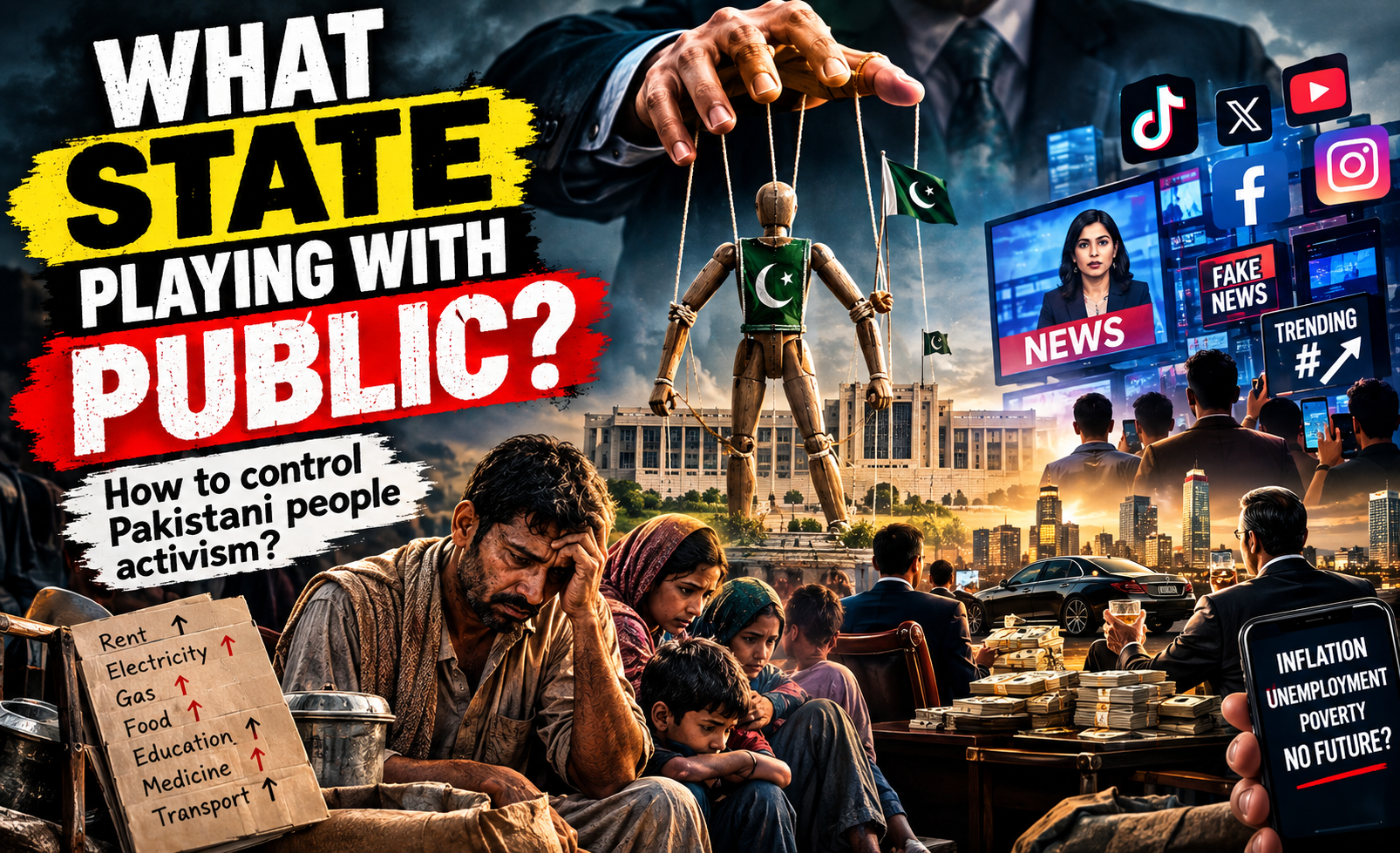
Is an economically exhausted public easier to govern? In Pakistan, the question is no longer merely political. It is becoming a question of survival.
A hungry household does not have the luxury of debating constitutional reform. A father struggling to pay rent does not have the time to attend a political rally. A mother calculating the month’s electricity bill is unlikely to spend her evening arguing about the country’s political future. And a young person working two jobs to keep a family afloat has little energy left to fight over who controls the national narrative.
This is where the real danger lies.
When citizens become permanently occupied with earning, paying bills, arranging school fees, buying medicines and keeping the household running, politics gradually becomes a privilege of those who can afford to participate in it.
Pakistan’s economic pressures are not imaginary. The World Bank has reported that poverty increased after 2020 amid inflation, floods, economic shocks and weak growth, while significant gaps remain in education, health and basic public services.
But the deeper question is this: what happens to democracy when survival consumes the citizen?
The new battlefield is attention
There was a time when a handful of television channels, newspapers and influential journalists could play a major role in determining which issues dominated public discussion.
That world has changed.
Social media has broken the old monopoly over information. A smartphone can now turn an ordinary citizen into a publisher, commentator or political influencer. Gen Z, in particular, is far less dependent on traditional media for information.
But this freedom has created another problem.
Misinformation, disinformation, manipulated videos, manufactured trends and competing political narratives can overwhelm genuine public-interest issues.
The battle is no longer simply over what people think.
It is increasingly over what people pay attention to.
And attention is a limited resource.
If citizens spend their days worrying about electricity bills, petrol prices, food, rent, school fees and medical expenses, there is little time left to scrutinise policies, question institutions or demand accountability.
That does not require a grand conspiracy.
Economic pressure itself can produce political silence.
When the working citizen has no time left
Consider a low-paid security guard earning around Rs35,000 a month and paying Rs18,000 in rent.
Before food, electricity, gas, transport, children’s education, medicines and other necessities are even fully accounted for, much of his income is gone.
What remains is not disposable income. It is survival money.
The question is not whether such a person cares about politics.
He may care deeply.
The question is whether he can afford to participate.
This distinction matters.
A citizen who is exhausted by economic insecurity may still have political opinions, but the ability to turn those opinions into organised civic action becomes increasingly difficult.
Meanwhile, families in the middle class face a different version of the same squeeze. Rising household costs, education expenses, healthcare bills and transport costs can consume income that once provided some financial security.
The World Bank has highlighted high out-of-pocket health spending and continuing weaknesses in education and public services. Its recent assessment also found that more than one-third of school-age children are out of school and that human-capital deficits remain a major challenge.
When private education and healthcare become necessities rather than choices, the household effectively begins paying twice: once through taxes and again through private expenditure.
The economy can become a political cage
This is perhaps the most uncomfortable part of the debate.
A financially secure citizen has more capacity to question authority.
A financially vulnerable citizen is forced to prioritise immediate needs.
The difference is enormous.
When every family member must contribute to household income simply to maintain a basic standard of living, political participation can become secondary.
The household’s first question becomes:
“How will we survive this month?”
Not:
“What is happening to our institutions?”
Not:
“Who should be held accountable?”
And certainly not:
“How do we reform the system?”
That does not mean poor people are politically unaware. It means economic insecurity can narrow the space available for political action.
This is why poverty should never be viewed merely as an economic statistic.
Poverty can also become a democratic problem.
Who controls the narrative?
The old model of opinion-making was relatively straightforward: newspapers, television channels, influential anchors and political commentators shaped much of the national conversation.
The digital era has disrupted that system.
But disruption has not necessarily produced clarity.
Now the public faces an endless stream of content — some factual, some misleading, some deliberately manipulated and much of it designed simply to capture attention.
Political parties, media organisations, influencers, businesses and anonymous accounts all compete for the same thing:
the public’s attention.
At the same time, traditional media organisations remain financially dependent on advertising and other revenue streams, while digital platforms operate in an environment where reach and engagement can determine commercial success.
The result is a complicated information ecosystem in which public-interest journalism competes against sensationalism, propaganda, misinformation and entertainment.
The citizen is surrounded by information — yet may struggle to determine what deserves trust.
The rich can afford politics. The poor can barely afford tomorrow.
Pakistan’s economic divide makes this problem even more serious.
For wealthy households, political participation may involve time, travel, networks and resources.
For a worker struggling to pay rent, participation may mean losing a day’s wages.
That difference is rarely discussed.
We often ask why ordinary people do not come onto the streets.
Perhaps the more important question is:
What would it cost them to do so?
A daily-wage worker cannot casually sacrifice a day’s income.
A shopkeeper cannot easily close his business.
A private employee may fear losing his job.
A parent cannot abandon household responsibilities.
A young person supporting his family cannot simply stop working.
The political system therefore operates in an unequal environment: those with greater economic security generally have greater capacity to devote time and resources to public affairs.
The danger of an exhausted middle class
The middle class has traditionally been an important force for political participation, civic engagement and institutional accountability.
But what happens when the middle class itself begins living from salary to salary?
When education, healthcare, housing, transport and energy consume most of household income, financial security disappears.
A family may still look “middle class” from the outside while internally operating on the edge.
One medical emergency can destroy years of savings.
One job loss can turn a manageable household into a debt crisis.
One sustained period of inflation can push a family from comfort into vulnerability.
The World Bank’s recent assessments show how economic shocks and weak public services can translate into increased poverty and reduced economic mobility.
This is not simply an economic failure.
It is a failure of social resilience.
The state must not mistake silence for consent
This is where governments need to be particularly careful.
A quiet population is not necessarily a satisfied population.
A citizen who does not protest may simply be working.
A family that does not attend a rally may be paying school fees.
A young person who does not join a political campaign may be trying to find employment.
Silence can represent exhaustion, not approval.
And there is a dangerous temptation in any political system to interpret public disengagement as public acceptance.
It is not.
If people are increasingly concerned with food, fuel, electricity, rent, healthcare and education, the answer cannot be to make public debate harder or to simply drown citizens in competing narratives.
The answer must be to reduce the economic insecurity that prevents citizens from fully participating in national life.
The real test of governance
Good governance is not merely the ability to manage a crisis.
It is the ability to create conditions in which ordinary citizens have enough security to think beyond tomorrow.
A state that wants an informed and politically engaged population must invest in affordable education, accessible healthcare, decent employment, effective social protection and transparent institutions.
Read More: The Middle Class is being Squeezed to Death
The World Bank has itself stressed the importance of directing public resources towards schools, clinics and local communities and improving the quality of service delivery.
Because a citizen who is financially secure has something a desperately poor citizen often lacks:
the freedom to participate.
And that may be the most important political resource of all.
The question, therefore, should not simply be:
“How do governments control people?”
The bigger question is:
“Why should any government need to control an informed citizenry in the first place?”
A functioning democracy does not require a population too exhausted to speak.
It requires citizens who can afford to speak — and institutions strong enough to listen.
By Faisal Waqas
He is an MPhil in Mass Communication, senior journalist and digital media specialist.
With over 14 years of experience, he covers current affairs, governance and social issues.
His writing focuses on public interest, accountability and the everyday realities of Pakistanis.

