

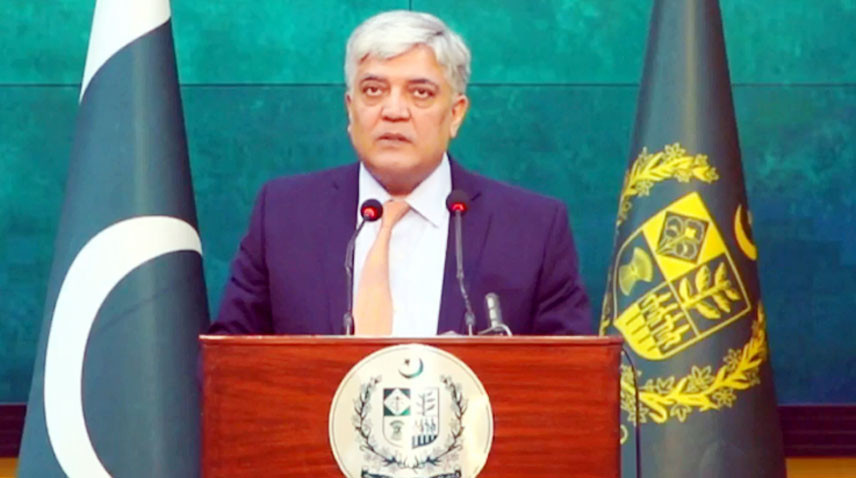
ISLAMABAD: Foreign Office spokesperson Tahir Andrabi has said Field Marshal Asim Munir’s recent visit to Iran was not undertaken on behalf of US President Donald Trump or the United States, but as part of Pakistan’s ongoing diplomatic efforts to mediate in the regional crisis.
Speaking at the weekly briefing in Islamabad, Andrabi said the visit was made purely in the context of Pakistan’s role as a mediator.
He said Field Marshal Asim Munir held discussions with Iranian officials on ways to reduce regional tensions and find a negotiated solution to the crisis.
Andrabi said Pakistan remained in contact with brotherly countries as part of sincere and concerted efforts to ease tensions and address the wider crisis in the Middle East and the Gulf.
He said Pakistan’s diplomatic efforts were also aimed at promoting regional peace and stability and paving the way for the reopening of the Strait of Hormuz. Iranian leaders, he added, had appreciated Pakistan’s role in the diplomatic process.
Pakistan to assume SCO Chairmanship
The spokesperson said Pakistan would assume the chairmanship of the Shanghai Cooperation Organisation (SCO) for a one-year term following the two-day SCO Council of Heads of State Summit in Bishkek, Kyrgyzstan.
He said Prime Minister Shehbaz Sharif would visit Bishkek to attend the summit and hold bilateral meetings with the Kyrgyz leadership.
Andrabi said the highlight of Pakistan’s SCO chairmanship would be the organisation’s summit, which Islamabad is scheduled to host next year.
Pakistan open to state-level dialogue with Kabul
Responding to a question about Afghanistan, the spokesperson said Pakistan had noted the interim Afghan government’s interior minister’s proposal for a dedicated bilateral mechanism to address contentious issues.
He said Pakistan remained open to state-level dialogue, but stressed that the sustainability of any mechanism would depend on tangible actions rather than assurances.
Andrabi said Kabul must honour its international commitments, including those under the Doha framework, and ensure that Afghan soil was not used by hostile proxies, particularly the Tehreek-e-Taliban Pakistan (TTP) and Balochistan Liberation Army (BLA), against Pakistan.
He said Pakistan was ready for institutional coordination provided it resulted in tangible and verifiable counter-terrorism measures and effective border management.
Pakistan defends trade with Iran
On trade with Iran, Andrabi said Pakistan was implementing bilateral trade agreements with Tehran in accordance with its international obligations and international law.
He said Pakistan was not obliged to comply with unilateral sanctions imposed on Iran and had consistently opposed unilateral coercive measures, particularly sanctions imposed outside the United Nations framework.
Such measures were generally counterproductive, he said, adding that Pakistan-Iran trade had remained largely robust and Islamabad wanted to expand economic ties with Tehran.
Andrabi expressed hope that a broader settlement of the US-Iran standoff would eventually address the associated economic issues.
FO rejects Indian claims over Kirana Hills
The spokesperson also categorically rejected what he described as self-contradictory and retrospective claims by India’s former Chief of Defence Staff regarding Kirana Hills near Sargodha.
He said Pakistan’s layered air defence system had effectively thwarted India’s military objectives during Marka-e-Haq, while Pakistan’s subsequent response under Operation Bunyan-um-Marsoos demonstrated its ability to impose costs across the conflict spectrum.
Andrabi said no strategic asset or sensitive infrastructure had been compromised in Pakistan.
He added that attempts to retrospectively reshape events through selective narratives or dramatised productions could not alter the verifiable operational record of May last year.
“History is established by facts and evidence, not by Bollywood-style retrospective claims,” he said.

