

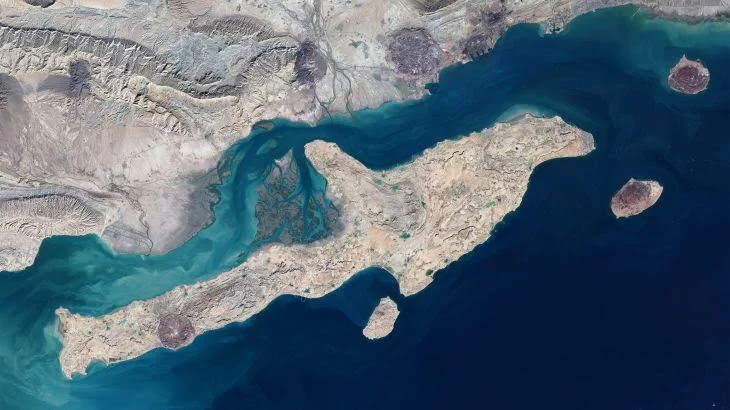
LAHORE MIRROR EXCLUSIVE: The Wall Street Journal, citing US officials, reported that Washington carried out limited strikes on Qeshm Island. However, Quincy Institute’s Trita Parsi says Iranian sources blame Israel, while a senior American source reportedly denied US involvement. Meanwhile, Iran’s Revolutionary Guard claims to have intercepted American reconnaissance drones in the area.
The United States reportedly struck Iran’s strategically important Qeshm Island on Monday, November 2, according to The Wall Street Journal, which cited unnamed American officials.
The reported strikes came as Washington and Tehran continued diplomatic efforts to reach an agreement, while President Donald Trump publicly suggested that a deal with Iran remained possible.
However, a competing account has complicated the picture. Trita Parsi, co-founder and executive vice president of the Quincy Institute for Responsible Statecraft, has suggested that Israel could be responsible for the explosions, citing conversations with Iranian sources and a senior American source.
The conflicting accounts have raised questions about whether the reported attack was an American military operation or an Israeli action that could undermine the diplomatic process.
Explosions Reported Across Iran’s Southern Coast
Iranian state-affiliated Fars News Agency reported several explosions on Qeshm Island during the early hours of Tuesday morning, local time.
The blasts were also reportedly heard by residents of nearby Hengam Island and the port city of Bandar Abbas, both located near the Strait of Hormuz.
Iran’s state news agency IRNA had earlier reported multiple explosions on Qeshm Island. Witnesses reportedly saw aircraft flying over the island during the incident.
The explosions came amid heightened military activity in the region.
Over the past week, Iran has claimed that its forces targeted several American drones operating in the region. On Monday, the Islamic Revolutionary Guard Corps (IRGC) claimed that it had shot down two US reconnaissance drones over or near Qeshm Island.
However, it remains unclear whether the alleged drone incidents were directly connected to the reported American strikes.
American officials have disputed some of Iran’s earlier claims about downed US aircraft. ABC News, citing a US official, reported that Iran’s claims concerning two reconnaissance drones were false.
The competing accounts have added another layer of uncertainty to the military situation around the Strait of Hormuz.
Why Qeshm Island Matters
Qeshm Island occupies a strategically important position in the Persian Gulf, approximately 14 miles from Bandar Abbas and close to the entrance of the Strait of Hormuz.
The island is central to Iran’s ability to monitor and influence maritime traffic through the strategic waterway.
Before the war, approximately 20 million barrels of oil passed through the Strait of Hormuz every day, making it one of the world’s most important energy corridors.
Any military escalation around Qeshm Island therefore carries implications far beyond Iran’s southern coastline. Disruption to shipping through the strait could affect international oil prices, energy supplies and global trade.
The United States has previously targeted military facilities on the island during the war. The latest reported strikes suggest that Qeshm remains an important focus of the military confrontation.
Washington Says It Was a Defensive Strike
The American account has gained support from several US media outlets.
The Wall Street Journal, citing American officials, reported that US forces carried out limited strikes on Qeshm Island as part of a series of military operations Washington had kept largely undisclosed in recent weeks.
According to officials cited by the newspaper, the latest operation was defensive and did not represent a return to major combat operations.
Fox News, citing officials, said the strikes were carried out in response to Iran firing at an American aircraft.
The Associated Press also quoted a US official as saying that American forces had conducted defensive strikes against Iranian targets in the Strait of Hormuz after Iranian forces used surface-to-air missiles against US assets.
ABC News separately reported that two American officials confirmed the strikes on Qeshm Island.
The US Central Command had not publicly provided a detailed explanation of the operation when the reports emerged.
Trita Parsi Raises the Possibility of Israeli Involvement
Despite reports identifying the United States as the attacker, Trita Parsi presented a different account.
In a post on X, Parsi said that just as prospects for a diplomatic breakthrough between Washington and Tehran appeared to be improving, explosions began hitting Iranian targets.
BREAKING: Just as a glimmer of hope emerges between the US and Iran, someone starts bombing Iranian radar sites. I suspect Israel.
I posted a few days ago that a glimmer of hope had emerged in the US-Iran talks mediated by Qatar. Over the past few days, progress has increased to the point that sources and officials on all sides have privately expressed a degree of optimism, and both JD Vance and Trump himself did so publicly just a few hours ago.
Then, suddenly, things started to blow up on the Iranian island of Qeshm, as well as near the cities of Bandar Abbas and Ahvaz in southern Iran.
The Iranians tell me that they are certain the attacks were conducted by Israel, and not the US. A senior US source tells me it wasn’t the American side.
I posted last weekend that Israel had breached Iranian airspace. Tehran, however, opted not to respond, suspecting that Israel wanted to goad Iran into a trap by responding harshly, as that could help Netanyahu in the elections and force Trump’s hand in terms of turning to war.
It would be completely in line with a decades-long pattern of Israeli sabotage of US-Iran diplomacy that Netanyahu would begin kinetic action on the eve of a potential breakthrough in US-Iran talks – which incidentally appears to include a Chinese dimension – in order to sabotage it. Israel has opposed every US-Iran deal, including Trump’s MOU from this past summer.
Read more: https://t.co/9tnL7TyUic
— Trita Parsi (@tparsi) November 2, 2026
He recalled that he had reported several days earlier that a glimmer of hope had emerged in negotiations mediated by Qatar.
According to Parsi, discussions had made significant progress, with sources and officials on all sides privately expressing optimism. He also pointed to public statements by Vice President JD Vance and Trump expressing confidence that an agreement could be reached.
But the diplomatic optimism was suddenly overshadowed by explosions on Qeshm Island and reports of blasts near Bandar Abbas and Ahvaz in southern Iran.
Parsi claimed that Iranian sources were convinced Israel had carried out the attacks rather than the United States.
More significantly, he said a senior American source had also told him that the US was not responsible.
Parsi further recalled his earlier claim that Israel had breached Iranian airspace. Tehran had reportedly refrained from responding because it suspected Israel wanted to provoke an Iranian retaliation.
According to his analysis, such a response could have created pressure on Trump to abandon diplomacy and return to military confrontation, potentially benefiting Israeli Prime Minister Benjamin Netanyahu politically.
Parsi argued that Israeli sabotage of US-Iran diplomacy would fit what he described as a decades-long pattern. He also suggested that the emerging negotiations involved a Chinese dimension, making the potential diplomatic breakthrough particularly significant.
His allegations, however, have not been independently established and conflict with multiple reports citing US officials who confirmed American military involvement.
Iran Warns of a Forceful Response
The reported strikes have also prompted strong warnings from Tehran.
Iranian Parliament Speaker Mohammad Baqer Qalibaf said on Tuesday that the responsibility for moving negotiations forward rested with Washington after Tehran submitted what he described as a strong and rational response to the American proposal.
Qalibaf warned that Iran would not surrender under military pressure.
“The enemy seeks to force the Iranian nation into submission through threats and military action, but they are sorely mistaken. Iran will not submit,” he said.
He added that any American miscalculation would trigger an unpredictable Iranian response that would not be restricted by geographical boundaries.
A senior Iranian official separately told Reuters that Tehran would respond forcefully to American strikes, both within the region and beyond.
Diplomatic Efforts Continue, but No Deal in Sight
The reported attack came at a particularly sensitive moment for regional diplomacy.
According to Reuters, Qatari mediators travelled to Tehran on Monday night to discuss a revised version of a draft agreement between Washington and Tehran. The proposal had reportedly been under negotiation for approximately eight days.
A senior Iranian official told Reuters that mediators were working hard to narrow differences between the two sides.
However, Tehran has made clear that reopening the Strait of Hormuz depends on Washington accepting its conditions.
The Iranian official said nuclear negotiations could only begin after the dispute over the Strait of Hormuz was resolved. Tehran also rejected what it described as excessive American demands.
Iran’s diplomatic position centres on reopening the strategic waterway and addressing the US naval blockade of Iranian ports.
On Monday, Trump suggested that an agreement remained possible. Writing on Truth Social, he said:
“Oil Prices are dropping like a rock, down almost $10 a Barrel, a record, because people feel that there will not be a war with Iran. Iran wants a settlement, as soon as possible. It could happen!”
Trump had previously hinted at renewed military action after the November 3 US midterm elections. However, he subsequently played down the prospect of launching another major military campaign.
Vice President JD Vance also expressed optimism about progress in negotiations.
Nevertheless, Tehran and Washington remain divided over the conditions for a settlement, particularly the Strait of Hormuz, the naval blockade and the nuclear issue.
Who Really Attacked Qeshm Island?
The strongest publicly reported official account currently points towards an American operation. The WSJ, Reuters, CNN, ABC News and the Associated Press have all reported US military involvement based on statements from American officials.
Parsi’s alternative account introduces the possibility of Israeli involvement, but his claims remain unverified and have not displaced the multiple American official accounts.
Iran’s reports of explosions and alleged drone interceptions provide further context, but do not independently establish who carried out the strikes.
The bigger question is whether the Qeshm Island attacks will remain a limited military episode or become another obstacle to an already fragile diplomatic process.
With Qatar attempting to bridge differences between Washington and Tehran, further escalation could jeopardise negotiations over the Strait of Hormuz, the nuclear issue and the future of the wider Middle East.

