

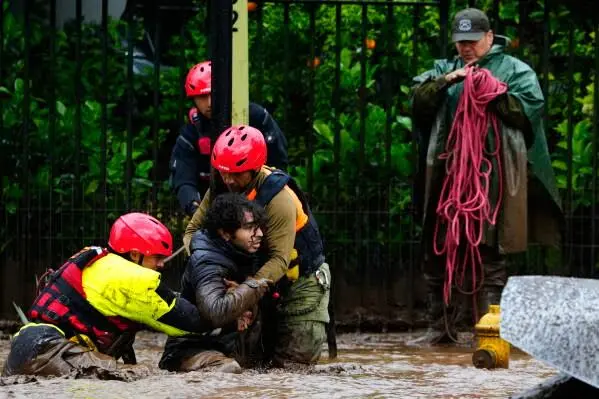
Every emergency contains an interval in which the system has not reached you yet. The ambulance is still on another road, the phone network is overloaded, the hospital is filling, or flooding has made a familiar route impassable. The emergency plan may be sound and the responders highly capable, but organized help still has to travel through time and space.
Inside that interval, the first person able to help may live next door.
A neighbor may know which elderly resident lives alone, who depends on powered medical equipment, which family has no car, or where children are likely to gather after school. Someone nearby may be a nurse, know first aid, own a generator, speak several languages, or simply notices that a normally active household has gone unusually quiet. None of this appears on a map of roads, hospitals or emergency shelters, yet during a crisis it can become as consequential as the infrastructure we routinely measure.
We have become very good at mapping physical systems. Cities know where power lines, water mains, hospitals, evacuation routes and fire stations are located. Far less attention is given to the human infrastructure living among them: the skills, relationships, trust and local knowledge that determine what happens before formal assistance arrives.
This matters because no centralized response system, however competent, can reach everyone at once. A flood may affect thousands of homes within minutes. Extreme heat can place an entire city under stress simultaneously. An earthquake can sever roads and communications before emergency services understand the full extent of the damage. A blackout can become a medical emergency for someone dependent on refrigeration, oxygen or mobility equipment.
These are not necessarily failures of government. They are limits of scale.
Professional response remains indispensable, but the larger the emergency, the more important the layer immediately beneath it becomes. That layer is the community already present when everything changes.
Global health offers a useful way to understand this. Health does not begin at the hospital door. It is shaped long before that moment by housing, water, nutrition, information, social support, transportation and the ability to recognize danger early. Emergency resilience works in much the same way. What happens during a crisis depends partly on what existed before it.
A warning, for example, is only useful if people receive it, understand it and trust it. An evacuation plan means little to someone who cannot physically leave. A shelter may technically be open but functionally inaccessible to a family without transportation. A city may have an excellent emergency communications system while still failing residents who do not speak the language in which the instructions arrive.
The weakness is often not the absence of a formal system. It is the distance between the system and the life it is trying to protect.
Preparedness is still commonly presented as an individual checklist: water, batteries, medication, food, flashlights and emergency numbers. All of that is sensible, but households do not experience disasters in isolation. The better question is not only whether each family is prepared, but whether a neighborhood possesses enough shared knowledge and capacity to respond when ordinary services are interrupted.
That does not require turning residents into amateur emergency workers. It means recognizing the value of information that already exists locally. Who has medical training? Who may need assistance with stairs? Which residents speak the languages used in the community? Who has a vehicle? Which local businesses have refrigeration or backup power? Which schools, mosques, churches, temples, sports clubs or community centers could function as trusted gathering points?
These are simple questions, yet answering them before a crisis could shorten the time between need and meaningful help.
There is an important boundary here. Community resilience should never become a convenient excuse for governments to shift responsibility onto citizens. A neglected neighborhood cannot be told to compensate for inadequate infrastructure with goodwill. Rural communities should not be praised for self-reliance while being denied reasonable emergency access. Elderly or low-income populations cannot be expected to improvise around gaps that public systems have the resources and responsibility to address.
Real resilience is not government or community. It is government and community.
Public institutions bring resources, expertise, coordination and scale. Communities bring proximity, trust and knowledge that cannot be replicated from a distant command center. The strongest systems connect the two rather than waiting for catastrophe to force the relationship.
That connection is becoming more important as modern risks grow more interconnected. A heat wave is not only a weather event if the electrical grid fails. A flood is not only a water problem if it closes access to hospitals. A communications outage can make functioning emergency services difficult to reach. Disease outbreaks become harder to contain when public trust is weak. Displacement becomes more dangerous when people do not know where vulnerable neighbors have gone.
The disaster is often not one thing going wrong. It is several ordinary systems failing at once.
This is why community itself deserves to be understood as infrastructure. The word is usually treated sentimentally, as though community is mainly about belonging or social cohesion. Those things matter, but relationships also have practical value. Trust moves information. Familiarity reveals vulnerability. Local knowledge reduces uncertainty. A person who knows that an elderly neighbor has not opened the curtains by noon possesses information no centralized database is likely to generate quickly.
Modern life has gradually made much of this knowledge less common. People can share walls, elevators and parking lots for years without knowing one another’s names. Technology has made it easier to summon services while reducing the everyday necessity of depending on those physically closest to us.
Most of the time, that independence feels like progress. During a crisis, proximity becomes valuable again.
The best-trained responder several kilometers away may ultimately provide the care that saves a life. But the person five meters away may be the one who reaches the door first.
Preparing communities for that reality would not require elaborate bureaucracy. Voluntary neighborhood networks, basic first-aid education, stronger connections between local institutions and emergency agencies, and better identification of residents who may need additional assistance could make existing systems more effective rather than replacing them. The objective is not to create parallel emergency services. It is to reduce helplessness during the period before professional response reaches full strength.
That period deserves far more attention because it is where preparedness becomes human.
Before the press conference, the damage assessment or the emergency funding, someone is making an immediate decision. A person knocks on a door, brings water, checks an apartment, translates an instruction, carries a child or helps another person reach safety. These actions rarely become the official story of a disaster, yet they happen in almost every one.
They reveal something important about how resilience actually works.
We often imagine preparedness as equipment, infrastructure and plans. Those are essential. But preparedness also exists in relationships created long before anyone knows they will be needed.
A society cannot prevent every fire, flood, earthquake, outbreak or blackout. Nor can any government eliminate the interval between danger and response. But we can decide whether people enter that interval surrounded by strangers or by communities that recognize one another.
There will always be a moment before help arrives.
The measure of a resilient society may be what is already there when it does.

