

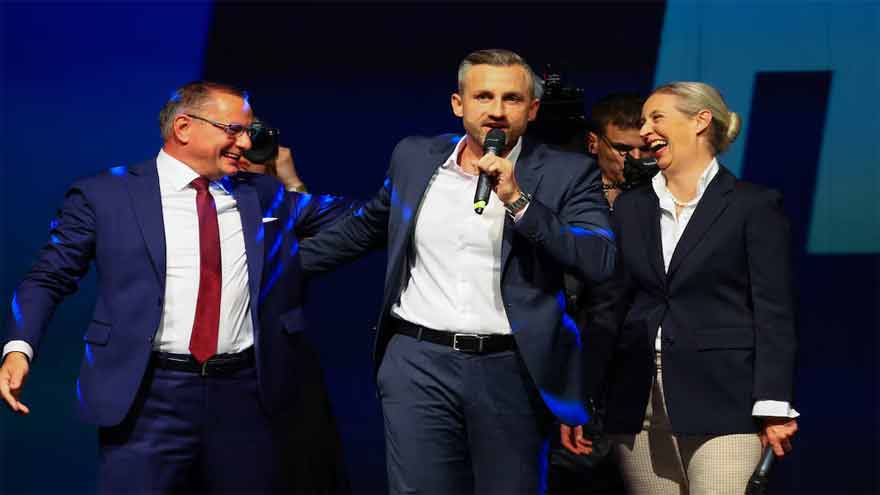
BERLIN: German Chancellor Friedrich Merz has ruled out cooperation with the far-right Alternative for Germany (AfD) after the party secured a major electoral victory in the eastern state of Saxony-Anhalt, saying the result had shaken his conservative party “to its very foundations”.
The AfD won nearly 44 per cent of the vote in Sunday’s state election, emerging as the largest party and dealing a major blow to Merz’s ruling coalition.
Despite its strong performance, the AfD fell short of an outright majority, winning 39 of the state legislature’s 83 seats. The party is now seeking support from individual lawmakers from Merz’s conservatives to form a government.
Such a move would mark the first time a far-right party takes power at state level in postwar Germany.
The result has also renewed debate over Germany’s longstanding political “firewall” against cooperation with the AfD. Mainstream parties, including Merz’s Christian Democrats (CDU), have traditionally refused to form alliances with the party.
AfD national co-leader Tino Chrupalla appealed to CDU lawmakers to help create what he called a “centre-right conservative majority” in Saxony-Anhalt, arguing that political divisions should be put aside.
Merz, however, rejected any prospect of cooperation and said he would continue with his government’s reform agenda. He also dismissed suggestions that he might resign despite his coalition facing record-low approval ratings.
“We are all deeply shocked,” Merz said at a press conference, describing the result as his party’s worst election performance in decades.
The AfD’s victory has drawn concern beyond Germany, with politicians in France and Poland warning about the growing strength of the European far right.
The party campaigns on a hardline anti-immigration platform and has called for an end to German military support for Ukraine and a restoration of closer ties with Moscow.
Merz said the election result would not alter his position on Russia or Ukraine, insisting that Germany must continue supporting Kyiv.
“I will not deviate by even a millimetre from my fundamental conviction that we must defend our freedom, especially now, against Russia,” he said.
The populist left-wing Sahra Wagenknecht Alliance (BSW) is the only German party that has indicated a willingness to work with the AfD. The two parties share opposition to mass immigration and Germany’s support for Ukraine, as well as criticism of sanctions against Russia.
The AfD’s success reflects growing dissatisfaction with established political parties, particularly in parts of eastern Germany. The party has also sought to capitalise on concerns over immigration, economic insecurity and declining trust in traditional political institutions.
The party performed particularly strongly among men, with around half of male voters backing it, compared with 39 per cent of women, according to voter data.
AfD co-leader Alice Weidel described the result as a milestone and said the party aimed to win at least 40 per cent of the vote in Germany’s next national election, scheduled for 2029.
The AfD has been classified as right-wing extremist by the local office of Germany’s domestic intelligence service, a designation the party rejects.
The election result was welcomed by several far-right figures across Europe, while French Finance Minister Roland Lescure described it as a “very, very worrying signal”.
He said the result demonstrated the scale of the challenge posed by a growing populist wave in Europe and beyond.
Source: Reuters

