

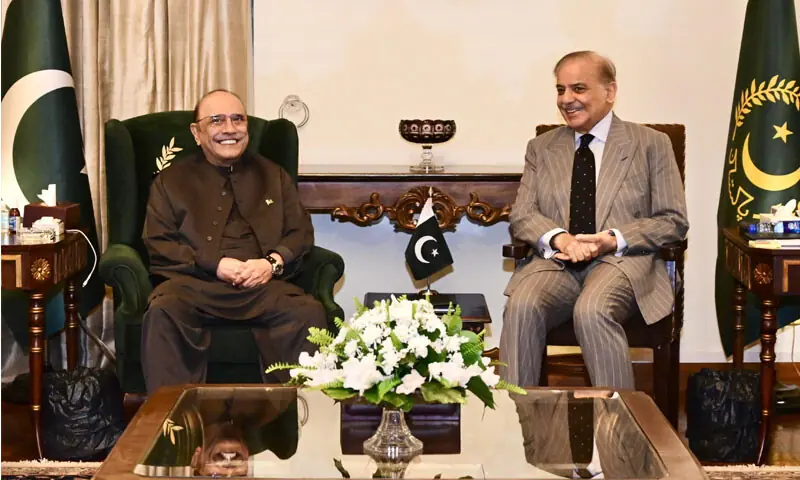
Lahore Mirror: Pakistan’s federal government has imposed an emergency and governor’s rule in Khyber Pakhtunkhwa after President Asif Ali Zardari approved recommendations by the federal cabinet, escalating tensions with the Pakistan Tehreek-e-Insaf (PTI)-led provincial government.
The decision was taken at an emergency cabinet meeting chaired by Prime Minister Shehbaz Sharif on Sunday, October 11, following a briefing on the province’s security situation. The government cited what it described as the provincial administration’s “deliberate disengagement from the fight against terrorism”.
The measures were approved under Articles 232 and 234 of the Constitution, which deal with the proclamation of an emergency and the imposition of governor’s rule, respectively.
The federal government also appointed Dr Muhammad Fakhr Alam Irfan, a Grade-22 Pakistan Administrative Service officer previously serving as secretary of the Power Division, as Khyber Pakhtunkhwa’s chief secretary. The appointment took immediate effect.
Centre and PTI clash over security policy
The move follows months of disagreements between the federal government and the PTI-led administration of Chief Minister Sohail Afridi over counterterrorism policy, military operations and engagement with Afghanistan.
The Centre has criticized the provincial government’s approach to tackling militancy and its position on dialogue with the Afghan Taliban. PTI, meanwhile, maintains that the federal government has excluded the province from key security decisions and opposes military operations without adequate consultation.
The dispute contributed to the breakdown of negotiations between the two sides on October 4, according to the additional account provided by Arab News. The disagreement unfolded amid wider tensions over PTI’s political demands and security arrangements in the province.
The federal government had sought to avoid a major opposition mobilization but linked negotiations over PTI’s demands to an agreement on security measures in Khyber Pakhtunkhwa. Among the protesters’ demands was access to former prime minister Imran Khan by his doctors.
Khan has been in prison since August 2023 and faces multiple charges, including corruption, treason and inciting violence. His legal team rejects the allegations as politically motivated and intended to undermine his popularity.
Zulfiqar Bukhari, a senior PTI member, strongly criticised the federal government’s decision.
“The only legitimately elected government of Pakistan has been overthrown,” Bukhari told Arab News when asked about the party’s response to the emergency.
Security restrictions reported in Peshawar
Following the announcement, KP Information Minister Shafi Jan claimed that Chief Minister Afridi had been taken into custody. Police had not confirmed the claim at the time of reporting.
Internet disruptions were reported in parts of Peshawar, alongside a heavy police deployment and the placement of shipping containers on some routes. Telecommunications sources said mobile networks and data services had been restricted in selected areas, although there was no province-wide internet shutdown.
The tensions come after repeated disagreements over the provincial government’s role in counterterrorism operations.
In July 2024, the KP Assembly passed a resolution calling for consultation with the provincial government before launching a new military operation. Lawmakers warned that proceeding without provincial consent could undermine an operation’s effectiveness.
In December that year, the assembly unanimously opposed a potential military operation in parts of Khyber and Bannu districts. A subsequent provincial grand jirga, attended by Governor Faisal Karim Kundi and representatives of political parties, called for prioritizing negotiations with Afghanistan and consulting the provincial government on Afghan policy.
Constitutional provisions and political fallout
Article 232 allows the president to proclaim an emergency when Pakistan’s security is threatened by war, external aggression or internal disturbances beyond a provincial government’s capacity to control. For an emergency based on internal disturbances, the Constitution requires a resolution from the provincial assembly.
Article 234 provides for governor’s rule when the constitutional machinery of a province fails. A proclamation must be presented to a joint sitting of Parliament and expires after two months unless approved. It may be extended for further periods of up to two months at a time but cannot remain in force for more than six months.
Article 233, which concerns the suspension of certain fundamental rights during an emergency, was not mentioned in the summary signed by President Zardari.
PTI Chairman Gohar Ali Khan condemned the decision as undemocratic and warned that peace could not be established by weakening provincial autonomy.
He urged the federal government to withdraw the measure, respect the province’s political mandate and pursue negotiations. Gohar maintained that while there was no disagreement over the need to eliminate terrorism, counterterrorism efforts should not become a pretext for suppressing public opinion or limiting constitutional authority.
PTI Central Information Secretary Sheikh Waqas Akram said the party would consider challenging the decision in court, boycotting legislative proceedings and organizing peaceful protests. The party’s political committee would make the final decision.
The Tehreek-i-Tahafuz-i-Ayin-i-Pakistan, an opposition alliance that includes PTI, also described the move as unconstitutional and said it would announce a joint response. Jamiat Ulema-i-Islam–Fazl chief Maulana Fazlur Rehman convened an emergency meeting of his party’s central core committee to discuss the developing political situation.
Governor warns against unrest
Governor Kundi defended the decision, saying it was intended to restore peace, protect residents and advance development in the province.
He urged the public to avoid violence, incitement and rioting, warning that authorities would take strict action against those who disrupted law and order or took the law into their own hands.
Kundi also called on political leaders to set aside their differences and work towards lasting stability.
PM links political dispute to economic stability
Addressing the cabinet, Prime Minister Shehbaz Sharif said his government would not allow the PTI-led provincial administration to destabilize Pakistan’s economy. He highlighted the continuing toll of militancy on civilians, police personnel, security forces and families.
Sharif said Pakistan had repeatedly urged Afghanistan to prevent militant groups from operating against Pakistan but had yet to secure the desired response.
The prime minister also discussed the recent staff-level agreement with the International Monetary Fund, expressing hope that Pakistan would unlock a $1.2 billion tranche before the end of the year.
He credited the country’s political and military leadership with advancing fiscal discipline and referred to Pakistan’s diplomatic efforts in the Middle East.
The imposition of emergency and governor’s rule sets the stage for a wider constitutional and political confrontation. While the federal government argues that extraordinary measures are necessary to address security concerns, PTI maintains that the decision undermines democratic representation and provincial autonomy.

