

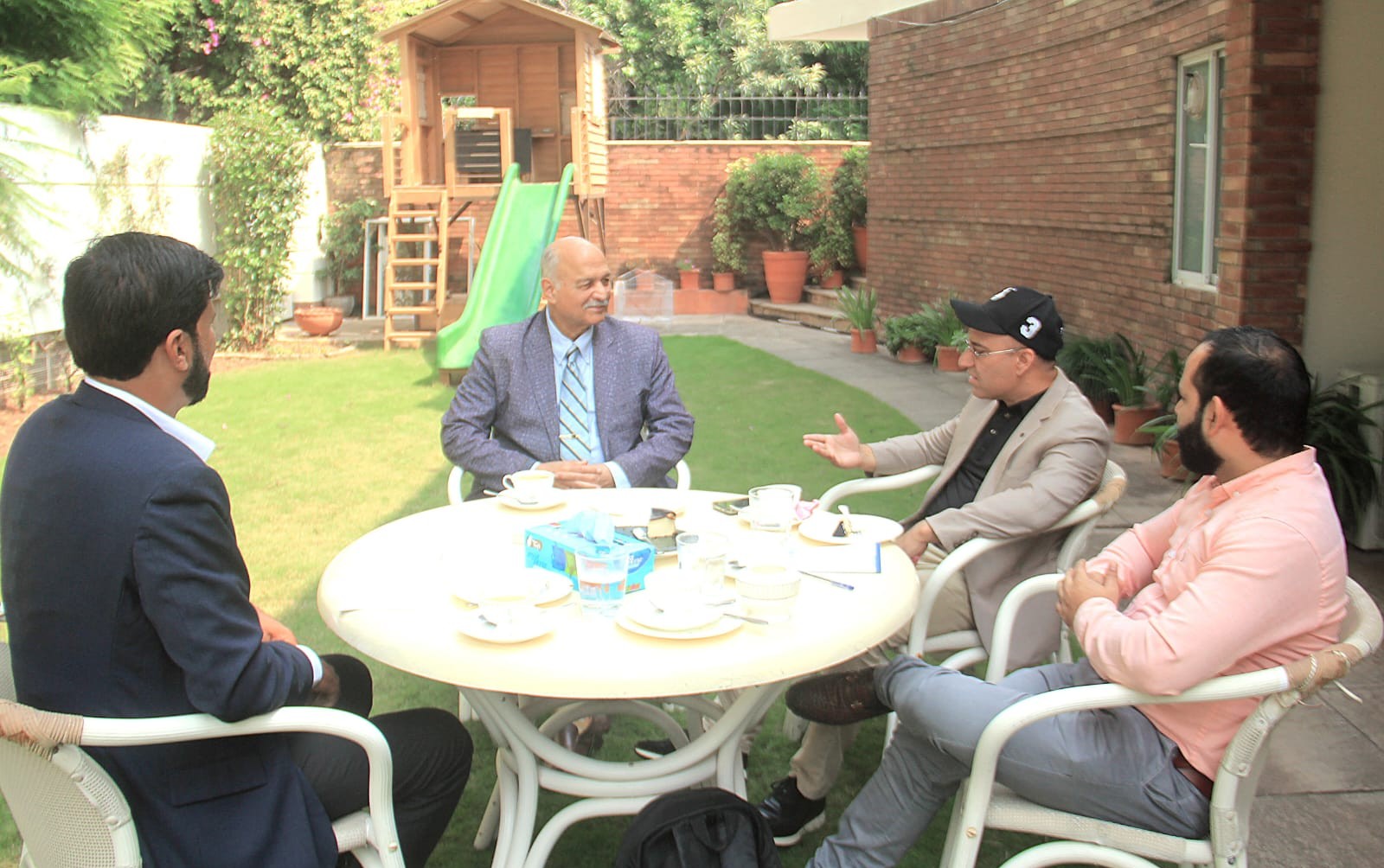
By Sardar Siraj Mohammad, Mudassar Azam and Mohammad Asim Jilani
Former senator Mushahid Hussain Sayed is a veteran politician, journalist, author and foreign-policy commentator. He has served as federal minister for information, culture, tourism, sports and youth affairs, as well as special assistant to the prime minister for strategic communications and head of the prime minister’s task force on Central Asia.
A graduate of Government College Lahore, he holds a master’s degree in international relations from Georgetown University’s School of Foreign Service in Washington, DC. He has also received an honorary doctorate from the Royal Academy of Sciences, Cambodia, in recognition of his services to Asian solidarity.
He has led Pakistan’s delegation to the UN Commission on Human Rights in Geneva and played a role in initiating Track II diplomacy between Pakistan and India while serving as editor of The Muslim in 1984.
His parents were active workers of the Pakistan Movement. His father, Col Amjad Hussain Sayed, was associated with the Muslim Students Federation and attended key sessions of the All-India Muslim League. His mother, Samin Sayed, was active in the Muslim League Women’s organisation and was inspired by Fatima Jinnah.
Mr Sayed is currently associated with the International Conference of Asian Political Parties (ICAPP) and chairs the Pakistan-China Institute. He is also the founder of several think tanks, including the Islamabad Policy Research Institute, Pakistan-China Institute and Pakistan Africa Institute for Development and Research. In May 2000, Amnesty International declared him a “prisoner of conscience” after he had spent 440 days in detention without being charged.
In an interview, Mr Sayed spoke about Pakistan’s political situation, governance, foreign policy, relations with China and Afghanistan, regional developments and the challenges facing the country.
‘Creating new provinces will not fix Pakistan’s systemic problems’
Q: Voices are growing in favour of creating new provinces, and some senior federal ministers are also supporting the idea. Can Pakistan’s systemic shortcomings be addressed by creating new provinces?
Mushahid Hussain Sayed: There are many shortcomings in Pakistan’s system, but creating new provinces is not the solution. These shortcomings need to be addressed instead.
The proposal for new provinces is an American plan. We should not follow a path designed by outsiders. We must manage the affairs of Pakistan according to our own requirements and avoid what I believe are conspiratorial designs against the country.
Some influential people in government are advocating new provinces without considering ground realities. They do not understand the country’s internal and regional circumstances. At a time when the regional situation is tense, why create another source of unrest within the country?
There are several examples of Muslim countries being divided under planned arrangements. Indonesia and Sudan are examples of large Muslim countries that were subsequently divided.
Pakistan is a beautiful federation comprising Punjab, Sindh, Balochistan, Khyber Pakhtunkhwa, Azad Kashmir and Gilgit-Baltistan. Three of these areas are facing insurgencies, which can be controlled. We should therefore avoid getting involved in the issue of new provinces and instead strengthen the federation.
‘Accountability and merit are the two biggest weaknesses’
Q: What, in your view, are the two major shortcomings that need to be addressed to put the system right?
Mushahid Hussain Sayed: The two major weaknesses of Pakistan’s system are the absence of accountability and the undermining of merit.
If we overcome these two shortcomings, the country can move towards progress. Merit is routinely ignored and the culture of favouritism has become so entrenched that, in some provinces, people are allegedly given positions in exchange for money.
If deputy commissioners, commissioners, police officers and others are appointed on recommendations rather than merit, what results can we expect from them? We need merit-based decisions and must eliminate the culture of favouritism and bribery.
The second major problem is the absence of accountability. People pay money to get things done, while influential individuals involved in wrongdoing often remain beyond accountability.
If these two problems are addressed, 70 per cent of the other shortcomings in our system will disappear automatically.
‘Eighteenth Amendment devolved powers, but local governments remain weak’
Q: If new provinces are not created and powers are also not being devolved to the grassroots level, how can the lives of ordinary people be made easier?
Mushahid Hussain Sayed: The 18th Amendment devolved important powers to the provinces. Article 140-A of the Constitution also places responsibility on the provinces to devolve political, administrative and financial authority to local governments.
Unfortunately, this has been turned into personal rule and powers have not been transferred to the grassroots. Chief ministers have also become increasingly centralised in their exercise of authority and are unwilling to devolve powers.
Even today, if people in a remote area of a province face a problem, they often have to travel to the provincial capital. The thinking appears to be that if powers are devolved to the grassroots, the authority of the provincial leadership will be weakened.
This is unfortunate.
Former president Pervez Musharraf devolved powers to the local level and empowered nazims, which enabled many public problems to be resolved closer to people’s doorsteps.
Today, courts and the Election Commission call for local government elections, but elections are still delayed and one obstacle or another emerges.
‘Bureaucracy is the biggest obstacle’
Q: Countries such as China have lifted millions of people out of poverty, with their leadership and bureaucracy playing important roles. Why does Pakistan continue to face these problems?
Mushahid Hussain Sayed: The biggest problem is the bureaucracy, which has effectively become a law unto itself. Those who exercise enormous administrative authority often face little accountability.
The tragedy is that political leaders also depend heavily on the bureaucracy, and matters relating to national development are lost in red tape.
Countries that have progressed did not allow every matter to become trapped in bureaucratic procedures. China is an example. There, a person can establish a company and open an account within a relatively short period.
In Pakistan, instead of providing investors and businesspeople with genuine one-window facilities, we involve them in complicated procedures. As a result, investors leave and businesses suffer.
Today, China is frustrated with us, the Arab countries are frustrated with us and Europe is also frustrated. Yet the elite, political leadership and bureaucracy are making matters worse instead of correcting them.
‘Young people are Pakistan’s future’
Q: A large proportion of Pakistan’s population comprises young people, but talent is being wasted because of limited resources. Some young people have made the country proud through their own efforts, but talented youth are held back by favouritism. What should be done for young people?
Mushahid Hussain Sayed: Young people are the future of this country. They will eventually take responsibility for running it.
Our youth are patriotic and, without recommendations or political connections, have demonstrated their abilities in sports, science and technology, education, healthcare and other fields.
Many young people who have succeeded did so without influential backing and brought recognition to the country. Young cricketer Razaullah is one example. He demonstrated his ability in his very first match.
We should remove players who are selected through favouritism and give opportunities to talented young people. Unfortunately, such opportunities remain limited. Neither governments nor political parties provide sufficient space to young people.
We need to create opportunities for our youth in every field of life.
‘I am 80pc satisfied with Pakistan’s foreign policy’
Q: Are you satisfied with Pakistan’s foreign policy?
Mushahid Hussain Sayed: I am 80 per cent satisfied with Pakistan’s foreign policy.
In my life, I have witnessed three golden moments when Pakistan’s standing in the international community rose significantly.
The first was the 1974 Islamic Summit Conference hosted by Pakistan under Prime Minister Zulfikar Ali Bhutto, which was attended by leaders of Muslim countries.
The second was in 1998, when the government of Prime Minister Nawaz Sharif conducted nuclear tests. When news came on May 11, 1998, that India had conducted nuclear tests, I was the first to advise Prime Minister Nawaz Sharif to conduct Pakistan’s nuclear tests.
The third golden moment was what I describe as Pakistan’s success in the recent conflict. Following that, Pakistan gained a position in the world that was unprecedented, and its relations with the United States, Russia, Turkiye, Iran and Saudi Arabia, among others, improved.
However, I am not satisfied with Pakistan’s Afghanistan policy. The complaint that terrorism is originating from Afghanistan is legitimate, and Pakistan has the right to respond. But the Afghan people should not be punished for the actions of their leadership. The doors of education and healthcare should not be closed to them.
Afghanistan is not India. The future of Afghanistan is linked to Pakistan, just as Pakistan’s future is linked to Afghanistan.
We need to resolve the issue of terrorism. The United States remained in Afghanistan from October 7, 2001, to August 15, 2021. During those 20 years, it spent $2.2 trillion in Afghanistan, according to figures I have cited. Yet it did not achieve its objectives.
If Pakistan-Afghanistan relations are strained, Afghanistan is still trading with India, Iran and other countries. China and Russia have also recognised its government.
Afghanistan’s tilt towards India is increasing. At the same time, the RSS has been accused of violence against Muslims while the Taliban are developing relations with India. These contradictions need to be addressed.
‘Pakistan failed to fulfil its commitments under CPEC’
Q: Pakistan-China friendship is described as exemplary, and China launched CPEC as a project for development and prosperity. Has CPEC been implemented as it should have been?
Mushahid Hussain Sayed: We are grateful to China for CPEC.
I have seen China 50 years ago when it was poor and weak. I also witnessed its reform era and now its rise. China has remained a friend through our difficult and prosperous times.
China brought CPEC to Pakistan, while Pakistan also helped China emerge from isolation and facilitated reconciliation with the United States.
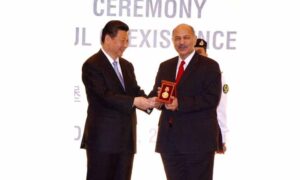
In recognition of my services towards CPEC, Chinese President Xi Jinping presented me with a special Friendship Award on April 20, 2015.
When CPEC was launched in 2015, 52 agreements were signed and, according to the figures I cite, $26 billion was invested. The projects included 8,000 megawatts of electricity generation, 600 kilometres of highways and motorways, and employment for around 250,000 people. Pakistani students have also studied and continue to study in China under related programmes.
In return for Chinese investment, Pakistan made two commitments.
The first was to establish one-window operations and ensure prompt approval of Chinese projects without unnecessary delays. We failed to deliver on this commitment, and responsibility rests with successive governments as well as the bureaucracy.
The second commitment was to provide foolproof security to around 20,000 Chinese engineers and other personnel working on CPEC projects and protect their lives and property.
However, there have been eight terrorist attacks against Chinese nationals and personnel over the past five years, in which 10 Chinese and 14 Pakistanis were killed, according to the figures I have cited.
The reality is that our system lacks the capacity to deliver.
If we say we will eliminate terrorism from its roots, why have we failed to do so? There is a contradiction between our words and actions, and that needs to end.
‘Pakistan gained rather than lost from the Iran conflict’
Q: What did Pakistan lose or gain from the Iran-US-Israel war?
Mushahid Hussain Sayed: Pakistan did not lose anything from the war between these countries; rather, it achieved gains.
The United States and Israel attacked Iran without justification, and Pakistan adopted what I consider a principled position in support of Iran.
Pakistan was the only country to officially observe mourning following the death of Iran’s supreme leader, he said.
He claimed that Israeli Prime Minister Benjamin Netanyahu gave US President Donald Trump misleading briefings and that the United States suffered what he described as its biggest defeat in modern history.
Iran fought what he described as a war for its survival, and Pakistan also fought for its survival.
Had the United States and Israel succeeded in their plans, he said, the US plan for a “Greater Israel” would have materialised and Israel would have reached the Taftan border.
He said the plan had failed.
Iran and the United States are adversaries, but both listen to Pakistan, he said, adding that after 47 years Pakistan had brought the two sides to the negotiating table.
He described this as a major diplomatic achievement that gave Pakistan a new standing internationally and said Pakistan had accomplished something the United Nations could not.
‘Pakistan-Saudi-Turkiye defence pact is historic’
Q: How do you view the defence agreement between Pakistan, Saudi Arabia and Turkiye?
Mushahid Hussain Sayed: The defence agreement between Pakistan, Saudi Arabia and Turkiye is a counter to the Abraham Accords. It is a historic agreement.
Everyone knows that their common enemy is Israel, and for the first time, Muslim countries have decided that they can make their own decisions about their defence.
There are US military bases and more than 40,000 troops in 16 Middle Eastern countries, but they could not protect those countries against Iranian attacks.
Following what I describe as the US failure in the Middle East, confidence in Washington has declined. A new order is emerging in the Middle East and everyone is looking towards Pakistan.
Within the next five to 10 years, there will be greater unity among Muslim countries under Pakistan’s leadership, he predicted, adding that more countries should be included in the agreement.
He also argued that the United States was no longer the sole superpower.
‘Political problems should be resolved through dialogue’
Q: The PTI announced a long march towards Islamabad but later postponed it. Similarly, Jamaat-i-Islami began a long march but stopped following a call from the government. Islamabad has effectively become a city of containers. What is your view?
Mushahid Hussain Sayed: The way the sanctity of homes and the privacy of families are being violated before the start of a long march, including the arrests of the sisters of PTI founder Imran Khan and others, is a sign of fear.
If someone has to be arrested, their family members should not be targeted.
No policy can be built on fear, and even if such policies are adopted, they cannot succeed.
The people who have been arrested are Pakistanis belonging to different political parties and holding different political views.
PTI had announced a long march for Sept 27 but later postponed it. That may have been a strategy or perhaps the party was not prepared.
Protest is everyone’s right, but it should remain within the Constitution and law. Public and private property should not be damaged.
Islamabad’s Red Zone was completely sealed with containers, which were also welded shut, while containers were placed at entry points across the city.
The closure of schools is also affecting children’s education.
PTI has now indicated another long march for Oct 4.
Problems should be resolved through negotiations. No one can be suppressed through force.
Jamaat-i-Islami also halted its long march following the prime minister’s call and is now waiting for a meeting with him. However, the government is not prepared to completely withdraw the petroleum levy, he added.
‘Imran Khan’s political future remains bright’
Q: What do you see as former prime minister Imran Khan’s political future?
Mushahid Hussain Sayed: As long as Imran Khan remains healthy, his future is bright. He has popularity among the people.
A political leader can only be removed politically; he cannot be eliminated through force.
Pakistan was founded on democratic principles. Quaid-i-Azam Mohammad Ali Jinnah was neither a feudal landlord nor a capitalist, bureaucrat or cleric. He believed in law and democracy.
Democracy, the rule of law and protection of human rights are part of Pakistan’s DNA.
Winston Churchill had said that when a general loses a war, he is no longer a general, but when a politician loses several battles, he can return.
The politics of sit-ins began more than a decade ago. The 2014 sit-in had no justification, he said, adding that the establishment had supported and financed it.
At the same time, CPEC was opening a path towards development. Then, in 2017, Nawaz Sharif was removed from office following the iqama case, with opposition parties supporting the move.
Five years later, Imran Khan was removed through Parliament with the support of the PML-N and PPP.
The 2024 elections were then held and, according to Mr Sayed, a government emerged on the basis of Form 47.
He argued that similar consequences would continue unless political forces found common ground.
Strong and popular political forces must sit together to resolve problems, he said. If talks can be held with the TTP and India, he asked, why can dialogue not take place with political opponents?
The foremost priority, he said, should be the Pakistan envisioned by Quaid-i-Azam Mohammad Ali Jinnah and Allama Muhammad Iqbal.
‘China is my most memorable journey’
Q: Which has been your most memorable journey?
Mushahid Hussain Sayed: My most memorable journey has been to China. I first travelled there during my college years and have witnessed three different phases of China’s development.
I saw China when it was a poor country, then its reform era and subsequently its rise.
China provided its people with food, clothing and housing and today stands among the world’s developed countries.
Whether it is a country, nation, society or individual, everyone has the ability either to move forward or go backwards.
Countries and societies that have progressed determined a direction and remained committed to it.
China, the countries of Southeast Asia, South Korea and even Cambodia are moving forward because of honest leadership and continuity in policies.
Healthcare and education are available to people, while women are provided opportunities to work.
In Pakistan, however, 26 million children are out of school and education and healthcare facilities remain inadequate.

We have everything: an army, police, civil service, mineral resources and a huge young population.
But the fundamental problem, he concluded, is that our leadership is not honest.

