

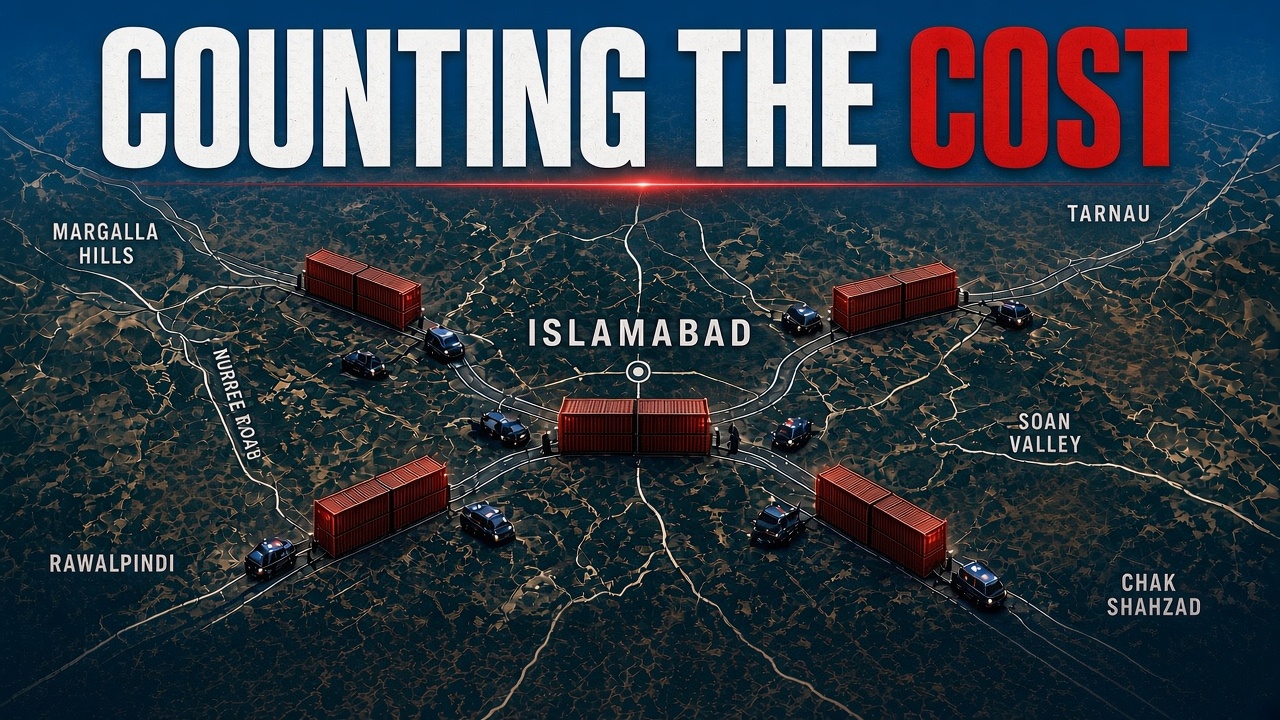
ISLAMABAD: The postponement of the Pakistan Tehreek-e-Insaf (PTI) march to Islamabad has come with a growing financial burden for the federal government, as containers remain deployed across the capital and security preparations continue despite the delay.
The government is paying Rs46.5 million a day to rent 1,550 containers arranged to block roads and counter the planned PTI protest. With the march now postponed from September 27 to October 4, the overall security bill reportedly could exceed Rs1 billion.
According to Reports, the Capital Police had initially requested Rs820 million for the operation, including container rentals, accommodation and meals for police personnel being brought in from Punjab and Sindh. The allocation was based on the expectation that the protest would be contained within about a week.
Containers alone cost millions
The All Pakistan Goods Alliance initially demanded daily rents of Rs40,000 for 40-foot containers and Rs20,000 for 20-foot containers. The demand was later revised to a flat Rs30,000 per container per day.
At that rate, the 1,550 containers cost Rs46.5 million every day. Keeping them for one week costs Rs325.5 million, while a two-week deployment would cost approximately Rs651 million.
Authorities have yet to decide whether to release the containers or keep them in place until the rescheduled protest.
Police deployment adds to the bill
The security operation extends well beyond the containers. Islamabad Police requested 16,000 personnel from Punjab and another 2,000 from Sindh.
The Sindh contingent has already reached Islamabad and is being accommodated at marquees at Police Lines Headquarters, Faisal Mosque and Community Centre G-13. Three meals a day are being provided to the 2,000 personnel at a cost of Rs600 per person, putting their food bill at Rs1.2 million a day, or Rs16.8 million over two weeks.
The 16,000-member Punjab contingent, meanwhile, had not reached Islamabad by Friday evening despite being scheduled to arrive ahead of the planned deployment. Its estimated food bill alone stands at Rs9.6 million per day, or Rs67.2 million for a week.
Transport and hotels add further costs
Police have also arranged around 70 coasters and 30 double-cabin vehicles to transport personnel between accommodation and duty locations.
The coasters cost Rs1.05 million per day, while the double-cabin vehicles cost another Rs300,000 daily. Hotel accommodation has also been arranged for senior police officers, with 175 rooms booked across 13 hotels.
The known cost of 157 rooms for officers from inspector to SP level is Rs754,500 per day, rising to more than Rs5.28 million for a week. The rental costs of buses and 18 additional rooms booked for DIGs and SSPs were not available.
Vehicles seized as security preparations intensify
The operation has also affected transport operators and commercial traffic.
According to the All Pakistan Goods Alliance, police in Islamabad and Punjab have taken custody of at least 2,700 vehicles along with their three-member crews. Around 400 vehicles and their crews were reportedly still missing, while the crews of the remaining vehicles were being kept at police stations.
The report says the drivers and crew members were not formally arrested but were prevented from leaving, while their mobile phones, vehicle documents and keys were confiscated. The vehicles were needed because moving large container trucks requires specially trained drivers.
The detained or seized vehicles were reported across Islamabad, Rawalpindi, Lahore, Jhang, Hasanabdal, Attock, Kamoke, Taxila, Jhelum, Mianwali, Chakwal, Faisalabad and Gujrat. Around 450 of the 2,700 vehicles were carrying commercial goods, including medicines, food and chemicals.
With the PTI march now shifted to October 4, the government faces a costly dilemma: release the containers and other resources and potentially repeat the operation next week, or continue paying millions of rupees a day to maintain the security blockade.
What began as a one-week security operation could therefore become a multi-million-rupee extension, with the overall cost potentially crossing the Rs1 billion mark.

