

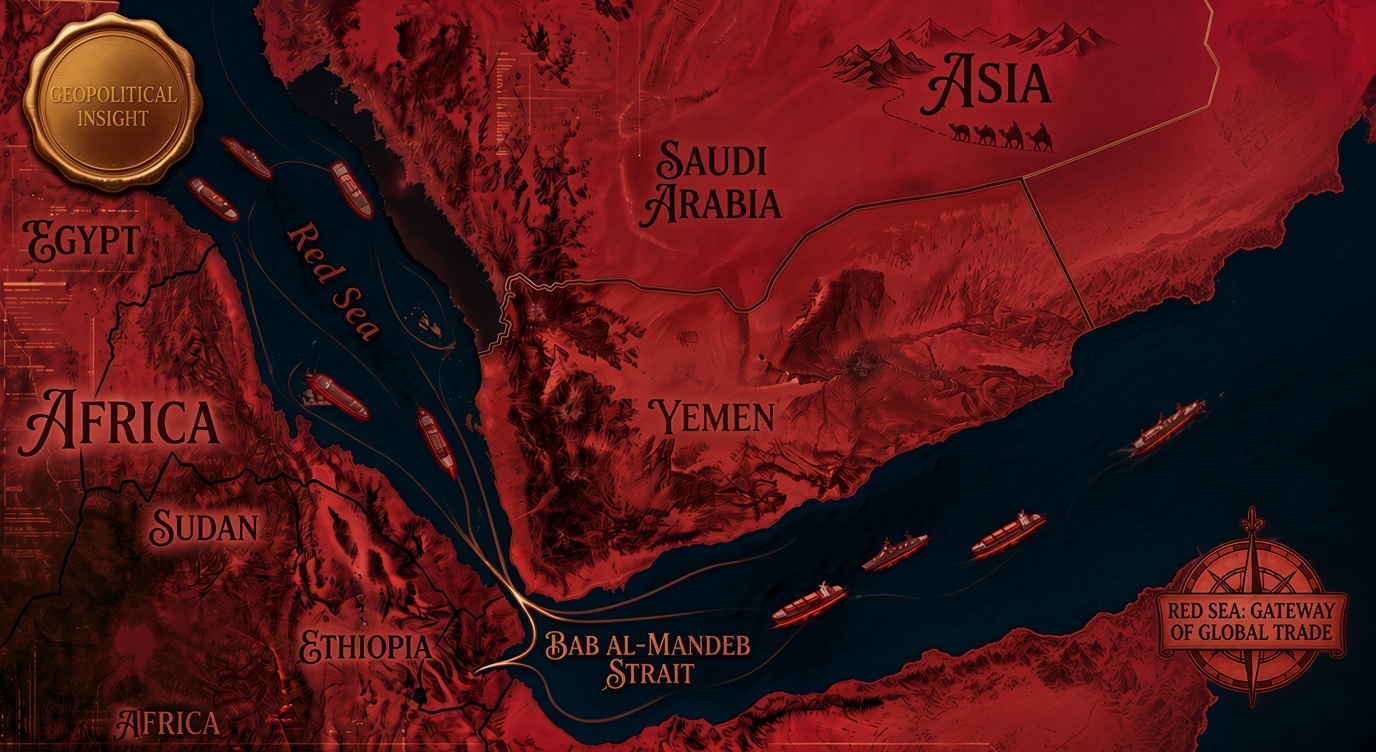
Yemen’s war has evolved from a long-running civil conflict into a wider regional crisis. The Iran-aligned Houthis control large parts of northern Yemen and have fought forces backed by Saudi Arabia and other regional actors. Their attacks have increasingly affected Saudi territory, energy infrastructure and shipping in the Red Sea, giving Yemen importance far beyond its borders.
The country’s location beside the Bab el-Mandeb Strait, a key route between the Red Sea and the Indian Ocean, has also made the conflict a global economic and security concern. With tensions involving Iran, the United States and Israel spreading across the region, JP Global host Ayaz Khan Lohani asked geopolitical analyst Jelina Novakov whether Yemen has now become another front in a much wider Middle East conflict.
Ayaz opened the discussion by pointing to the changing geography of the war. With the Strait of Hormuz already under severe pressure, he noted that another strategic chokepoint — the Bab el-Mandeb Strait — is emerging on the other side of the Arabian Peninsula.
The question, he asked, is how far the Yemen conflict could spread and what its consequences could be for the wider world.
Novakov: Yemen Is Part of a Wider War
Novakov’s response was clear: Yemen should not be viewed as an isolated conflict.
She described it as another front in a wider regional confrontation involving Palestine, Lebanon, Iran and now Yemen. In her view, geography makes Yemen particularly important because the country sits alongside one of the world’s most important maritime routes.
She also compared Yemen with Afghanistan, a comparison raised by Ayaz. Novakov argued that Yemen is different because its conflict is directly connected to several other regional theatres.
She stressed that Yemen has also suffered from prolonged political fragmentation, poverty and competing foreign influences. The result, she argued, is a conflict that cannot be understood only through the Houthi-Saudi confrontation.
Why Saudi Arabia Matters
Ayaz then turned to Saudi Arabia and the newly established Makkah Joint Defence Agreement involving Saudi Arabia, Pakistan and Türkiye.
His question was straightforward: if Saudi Arabia has new defence partners, why does the Houthi threat remain such a serious problem?
Novakov suggested that the issue is not simply military capability. Saudi Arabia’s economic model depends heavily on secure energy exports and maritime routes. A prolonged disruption around Yemen and the Red Sea could therefore create economic consequences far beyond the battlefield.
The renewed fighting has already raised concerns over shipping and Saudi energy infrastructure, while the Bab el-Mandeb’s strategic importance has grown as the Strait of Hormuz faces disruption.
The UAE, China and a Changing Gulf
The discussion then moved beyond Yemen to the changing Gulf balance.
Ayaz raised the relationship between Saudi Arabia and the UAE and questioned whether Abu Dhabi could pursue a different strategic direction.
Novakov argued that the UAE has its own economic and geopolitical interests. She suggested that the Gulf states could increasingly balance between China and Western powers rather than follow one fixed alignment.
China, she said, could have an important role through diplomacy and economic influence. However, she was cautious about the idea that Beijing would directly intervene as a mediator in the Yemen or Iran conflict.
Is Washington Losing Control of the Crisis?
Ayaz also questioned America’s role. If Washington could negotiate with the Taliban after years of war, he asked, why could a similar political approach not eventually emerge in Yemen?
Novakov argued that the United States may have underestimated the complexity of the wider regional conflict. She questioned whether Washington has a clearly defined end-state for the confrontation with Iran and Yemen.
Her broader argument was that military action can alter the battlefield, but it does not automatically produce a political settlement.
The Question of a Political Solution
The discussion ultimately returned to Yemen itself.
For Novakov, a military solution could carry significant risks because Yemen remains politically divided and deeply affected by years of conflict. She suggested that a lasting settlement would require negotiations and potentially international involvement.
That conclusion also reflects the changing reality on the ground. Recent Houthi advances toward the Bab el-Mandeb have increased the group’s leverage over a major maritime route, while Saudi-backed forces continue fighting to reverse those gains.
For Ayaz Khan Lohani and JP Global, the larger question is therefore not simply who controls Yemen.
It is whether Yemen has now become a strategic pressure point connecting the Red Sea, Saudi Arabia, Iran, the Gulf, global energy markets and the wider Middle East conflict.

