



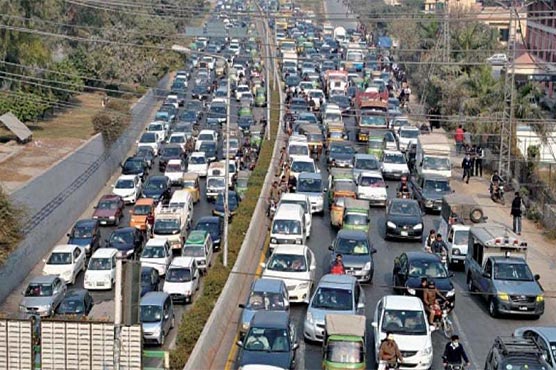

LAHORE: Severe traffic congestion brought several major roads in Lahore to a near standstill, leaving commuters stuck for long periods as bumper-to-bumper traffic continued at key points across the city.
Canal Road was among the worst-affected routes, with traffic crawling over long stretches. Heavy congestion was also reported between Thokar Niaz Baig and Muslim Town Mor, where lengthy queues continued to build up during busy hours.
The situation was particularly difficult around Muslim Town Mor and Campus Bridge, while motorists approaching from Thokar Niaz Baig faced substantial delays. At several points, traffic movement was almost paralysed, turning short journeys into lengthy waits.
Commuters said the situation was causing serious problems for people travelling to offices, educational institutions and other destinations. Many motorists complained that instead of actively managing the growing congestion, traffic wardens appeared more focused on stopping vehicles and issuing challans.
Citizens said wardens could be seen dealing with motorists over traffic violations, while their presence at major congestion points for regulating traffic remained limited. They questioned why more personnel were not being deployed to keep vehicles moving at known bottlenecks.
The lack of visible traffic management has added to frustration among motorists, particularly during peak hours when Canal Road and its connecting routes come under intense pressure. Commuters called for greater patrolling, better coordination and immediate intervention at congestion hotspots.
The situation has also raised questions over the implementation of directions issued by the Punjab government to improve Lahore’s traffic system. The persistent gridlock around Canal Road, Muslim Town Mor, Campus Bridge and Thokar Niaz Baig has put the effectiveness of existing traffic-control measures under renewed scrutiny.
Concerns over the priorities of Lahore’s traffic police are not new. In a report published on March 24, 2026, Dawn reported that traffic police operations had increasingly taken on a revenue-generating character, with enforcement teams setting up pickets and issuing fines on major roads. The report said more than Rs6.2 billion had been collected through traffic violation fines in two and a half months, raising broader questions about the balance between issuing challans and ensuring smooth traffic flow.

