

Ayaz Khan Lohani
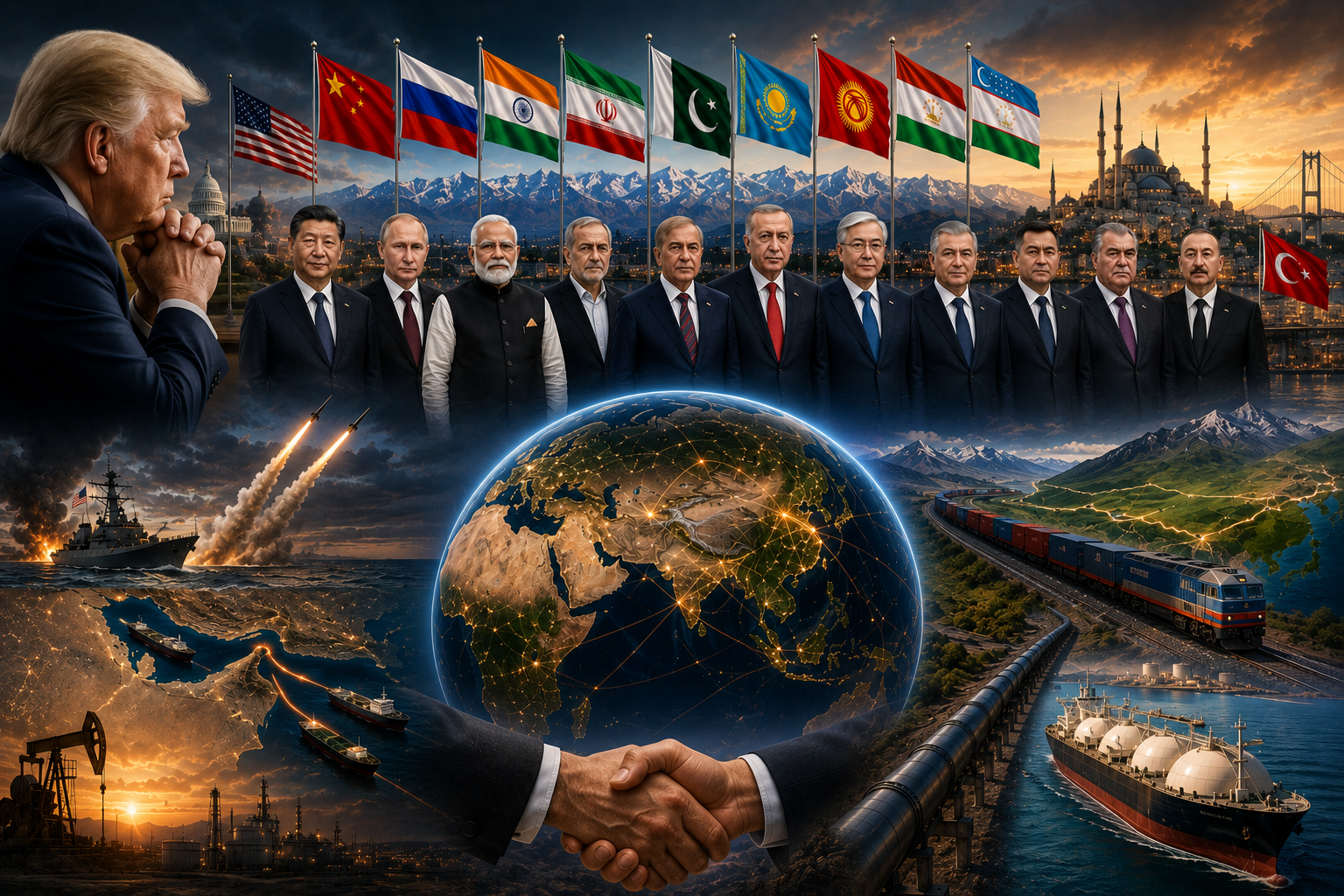
The diplomatic spotlight is turning toward Eurasia as leaders gather in Bishkek for the Shanghai Cooperation Organization (SCO) summit at precisely the moment when the United States and Iran have returned to exchanging military strikes, regional security arrangements are being reshaped, and traditional alliances are facing growing uncertainty.
What makes this moment particularly significant is that two major diplomatic and security developments are unfolding almost simultaneously: the SCO gathering in Bishkek and the first institutional meeting of the Makkah Joint Defense Agreement in Istanbul.
The two events are not formally connected. But together, they provide a revealing picture of how countries across Asia and the Middle East are responding to an increasingly uncertain international environment.
US-Iran confrontation returns to the centre
The latest escalation began when US forces struck Iranian rocket launchers on Larak Island in the Strait of Hormuz. Washington said the action was intended to prevent Iranian forces from launching rockets and deploying sea mines in the strategic waterway.
Iran responded with attacks targeting US positions in the region, including bases in Jordan, while the United Arab Emirates said it intercepted an Iranian drone. The exchange has once again placed the Strait of Hormuz at the centre of global security concerns because of its importance to international energy supplies. (Reuters)
The military escalation also carries an economic cost. Oil prices have risen and shipping through the Strait remains significantly below normal levels, increasing pressure on Asian economies that depend heavily on Gulf energy supplies.
This is precisely why the gathering in Bishkek matters.
Iranian President Masoud Pezeshkian is attending the SCO summit while his country is directly confronting Washington. China, Russia, India, Pakistan and the Central Asian states are all represented in an organization that increasingly provides a diplomatic space outside the traditional Western-led institutional framework.
Bishkek becomes a meeting point for competing powers
The SCO has evolved considerably since its establishment. It now brings together China, Russia, India, Iran, Pakistan, Belarus, Kazakhstan, Kyrgyzstan, Tajikistan and Uzbekistan.
But the organization is not a military alliance, nor is it a unified anti-American bloc.
Its members have competing interests and sometimes serious disagreements. India and China remain strategic rivals, Russia and China have their own calculations, and Central Asian states generally seek to avoid excessive dependence on any single major power.
Yet that diversity may actually be one of the SCO’s greatest strengths.
It provides a platform where countries that disagree on many issues can still cooperate on security, counterterrorism, trade, energy, transportation, digital connectivity and regional development.
And this year, the symbolism is particularly powerful.
Russian President Vladimir Putin and Chinese President Xi Jinping have developed an increasingly close strategic relationship, frequently emphasizing long-term cooperation and friendship. Their presence together in Bishkek demonstrates the importance of the China-Russia partnership within the broader Eurasian landscape.
For Moscow, the SCO is also an opportunity to demonstrate that Russia remains deeply engaged with major Asian powers despite its continuing confrontation with the West over Ukraine.
For Beijing, it provides another avenue to promote greater regional connectivity and its broader vision of a more multipolar international system.
For Iran, it offers diplomatic breathing space at a moment when its confrontation with Washington is intensifying.
And for Pakistan, the summit provides an opportunity to engage simultaneously with China, Russia, Iran, Central Asia and Türkiye.
Türkiye is at the centre of two developments
Perhaps no country illustrates the changing geopolitical landscape better than Türkiye.
President Recep Tayyip Erdoğan has arrived in Bishkek for the SCO summit, where he is expected to address the expanded-format meeting and hold bilateral discussions with other leaders, including Russian President Vladimir Putin.
Erdoğan’s presence is particularly significant because Türkiye is simultaneously participating in two different geopolitical processes.
In Bishkek, Ankara is engaging with Russia, China, Iran, India, Pakistan and Central Asia.
In Istanbul, Türkiye hosted the first meeting of the Strategic Political and Defence Committee established under the Makkah Joint Defence Agreement.
The committee brought together the foreign ministers, defence ministers and military chiefs of Türkiye, Pakistan and Saudi Arabia. Its agenda includes defence capabilities, military interoperability, defence-industry cooperation, joint production, research and development, counterterrorism and the creation of mechanisms to implement the pact. (Anadolu Agency)
This is important because the Makkah agreement is moving beyond a political declaration toward an institutional framework.
The agreement, signed by Türkiye, Pakistan and Saudi Arabia on August 7, stipulates that an attack against one signatory will be considered an attack against all three. It also emphasizes regional ownership of security and leaves open the possibility of participation by other countries that share its principles. (Anadolu Agency)
The Makkah Pact and the changing Middle East
The timing of the Istanbul meeting is difficult to separate from the broader transformation taking place in the Middle East.
For decades, the United States has been the dominant external security provider in the region. But repeated conflicts, the US-Iran confrontation and changing regional priorities have encouraged countries to develop additional security partnerships.
The Makkah pact should therefore not automatically be interpreted as an anti-American alliance.
Pakistan has described the agreement as defensive. Saudi Arabia is seeking greater regional security capacity, while Türkiye is pursuing a more independent strategic role.
The important development is that regional states are increasingly discussing security in terms of regional responsibility rather than relying exclusively on external guarantees.
Türkiye-Israel tensions add another layer
Erdoğan’s presence in Bishkek also comes as tensions between Türkiye and Israel over Syria are becoming increasingly serious.
Israel has warned against an expanding Turkish military presence in Syria, while Ankara has made clear that it will not accept what it sees as attempts to constrain its role there. Recent Israeli strikes on Syrian military infrastructure have further complicated the situation. (Al Jazeera)
This creates an additional strategic challenge for Erdoğan.
Türkiye is simultaneously working with Saudi Arabia and Pakistan through the Makkah pact, engaging Russia through the SCO, maintaining relations with China and Iran, and confronting increasing friction with Israel over Syria.
That makes the Erdoğan-Putin meeting particularly significant.
Both countries have substantial interests in Syria, while Russia remains an important actor in the region. Any escalation between Türkiye and Israel could therefore have consequences extending beyond their bilateral relationship.
What is Washington watching?
And then there is Donald Trump.
While leaders are gathering in Bishkek and the Makkah pact is taking shape in Istanbul, Washington is watching a geopolitical landscape that looks increasingly complicated.
The Trump administration is confronting Iran militarily and economically while simultaneously dealing with tensions over trade, energy and relations with multiple partners.
The latest US-Iran escalation demonstrates the difficulty of controlling events once military confrontation begins. A strike intended to prevent Iranian activity in the Strait of Hormuz immediately produced retaliation and renewed fears about global energy security. (AP News)
For Trump, the developments in Bishkek therefore carry significance beyond the SCO itself.
If China, Russia, Iran, Pakistan and Türkiye deepen their cooperation while Saudi Arabia and Türkiye develop new regional security mechanisms, Washington could face a world in which its influence remains powerful but is no longer as dominant as it once was.
That does not mean the US-led order is collapsing.
The United States remains the world’s most powerful military and financial actor.
But the nature of global power may be changing from dominance to competition among several centres of influence.
Is the SCO becoming the foundation of a new order?
This is perhaps the biggest question emerging from Bishkek.
It would be misleading to suggest that the SCO is about to replace NATO or the US-led international system. The organization lacks the political unity, institutional integration and military structure required for such a transformation.
But perhaps that is not what China and its partners are trying to achieve.
The more gradual strategy may be to create overlapping institutions and partnerships that make the international system less dependent on Washington.
The SCO provides one platform.
The Makkah pact provides another.
China-Russia strategic cooperation provides another.
Türkiye’s expanding diplomatic relationships provide another.
And together, these developments point toward a world where countries increasingly hedge their bets rather than choosing a single geopolitical camp.
A world of uncertainty
The Ukraine war continues. US-European relations remain complicated. The Middle East is experiencing renewed military confrontation. The Strait of Hormuz is under pressure. Türkiye and Israel are increasingly at odds over Syria. Trade tensions continue to disrupt the global economy.
Uncertainty has become the new status quo.
The central question is therefore not whether the SCO will suddenly create a new world order.
The more important question is whether organizations such as the SCO, together with emerging regional arrangements like the Makkah pact, will gradually build the institutions, economic relationships and security mechanisms necessary for a genuinely multipolar world.
Bishkek and Istanbul provide two important pieces of that puzzle.
The SCO is bringing together China, Russia, India, Iran, Pakistan and Türkiye at a moment of extraordinary geopolitical tension.
The Makkah pact is giving Pakistan, Saudi Arabia and Türkiye a new framework for regional defence cooperation.
And while all of this is unfolding, President Trump is watching closely as the architecture of global power evolves.
The question confronting the world is no longer simply whether the old order is ending.
It is whether a new one is already being built — quietly, gradually and across multiple centres of power.
Bishkek may not produce a new world order in one summit. But it could reveal what that emerging order is beginning to look like.

