

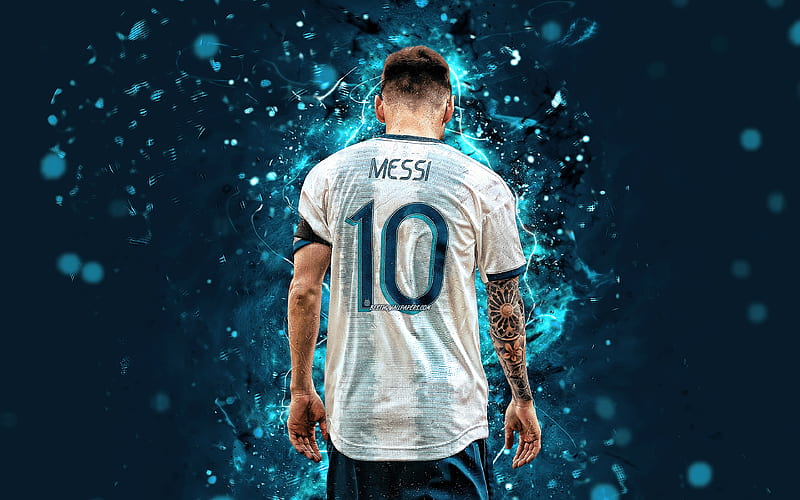
Buenos Aires: LIONEL MESSI has officially closed the chapter on his international career, announcing his retirement from Argentina duty at the age of 39 after more than two decades of extraordinary service to the national team.
For Argentina, it is the end of an era.
Messi leaves the international stage as the country’s most-capped player and its all-time leading scorer, having made 207 appearances and scored 125 goals for the national team. His career began in 2005, when a teenage Messi first pulled on the Argentina shirt, and ended with a legacy few footballers could ever hope to match.
His decision comes just weeks after Argentina suffered a heartbreaking 1-0 defeat to Spain in the 2026 World Cup final. Ferran Torres’ extra-time goal denied Messi and Argentina a second World Cup triumph and handed Spain the title.
For Messi, the defeat appeared to mark the emotional conclusion of a remarkable final chapter.
In a statement posted on Instagram, Messi said he had initially written his retirement message on July 21, two days after the World Cup final. He described the decision as painful but said he had ultimately accepted that the time had come to step away.
The death of his father, Jorge Messi, earlier this month further strengthened his decision.
Jorge was much more than Messi’s father. He was his son’s longtime agent and one of the most important figures throughout his football career, standing alongside him from his early development in Argentina and Barcelona to his later moves to Paris Saint-Germain and Inter Miami.
Following his father’s death, Messi had openly questioned how much longer he would continue playing.
His retirement therefore arrives at the intersection of sporting exhaustion, personal loss and the natural conclusion of an extraordinary international journey.
For years, Messi’s relationship with Argentina was complicated.
Despite his extraordinary success with Barcelona, international glory initially remained out of reach. Argentina suffered repeated disappointments, including defeats in major finals, while Messi faced intense criticism from supporters who expected him to reproduce his club success with the national team.
The narrative changed dramatically in the final years of his career.
Messi finally lifted the Copa América in 2021, ending Argentina’s long wait for a major senior international trophy. A year later came the ultimate prize.
At the 2022 World Cup in Qatar, Messi captained Argentina to the world title, scoring seven goals and winning the Golden Ball. The triumph transformed his relationship with the Argentine public and cemented his place among the greatest players in football history.
Argentina then successfully defended its continental crown at the 2024 Copa América, with Messi once again playing a central role.
His international trophy cabinet also includes the 2022 Finalissima, while he won the World Cup Golden Ball in both 2014 and 2022 and the Copa América’s top-player award in 2015 and 2021.
There were also painful moments.
Messi finished as a World Cup runner-up in 2014 and again in 2026. Argentina also lost the Copa América final in 2007, 2015 and 2016.
But those defeats now form part of a larger story — one in which perseverance eventually delivered the trophies that had eluded him for so long.
Messi’s retirement means Argentina must now prepare for international football without the player who has been its defining figure for more than 20 years.
His absence will not simply leave a gap in the starting lineup. It will mark the end of a generation.
Messi himself acknowledged the emotional connection he developed with Argentina’s supporters, saying he would miss hearing them from the pitch and would now support the team from outside.
He leaves with records, trophies and memories, but perhaps his greatest achievement is the transformation of his relationship with his country.
The player who once carried the burden of Argentina’s expectations eventually became the captain who delivered its greatest modern triumph.
Now, at 39, Lionel Messi walks away from international football not as a player searching for validation, but as an Argentine legend whose story has already become part of football history.

