

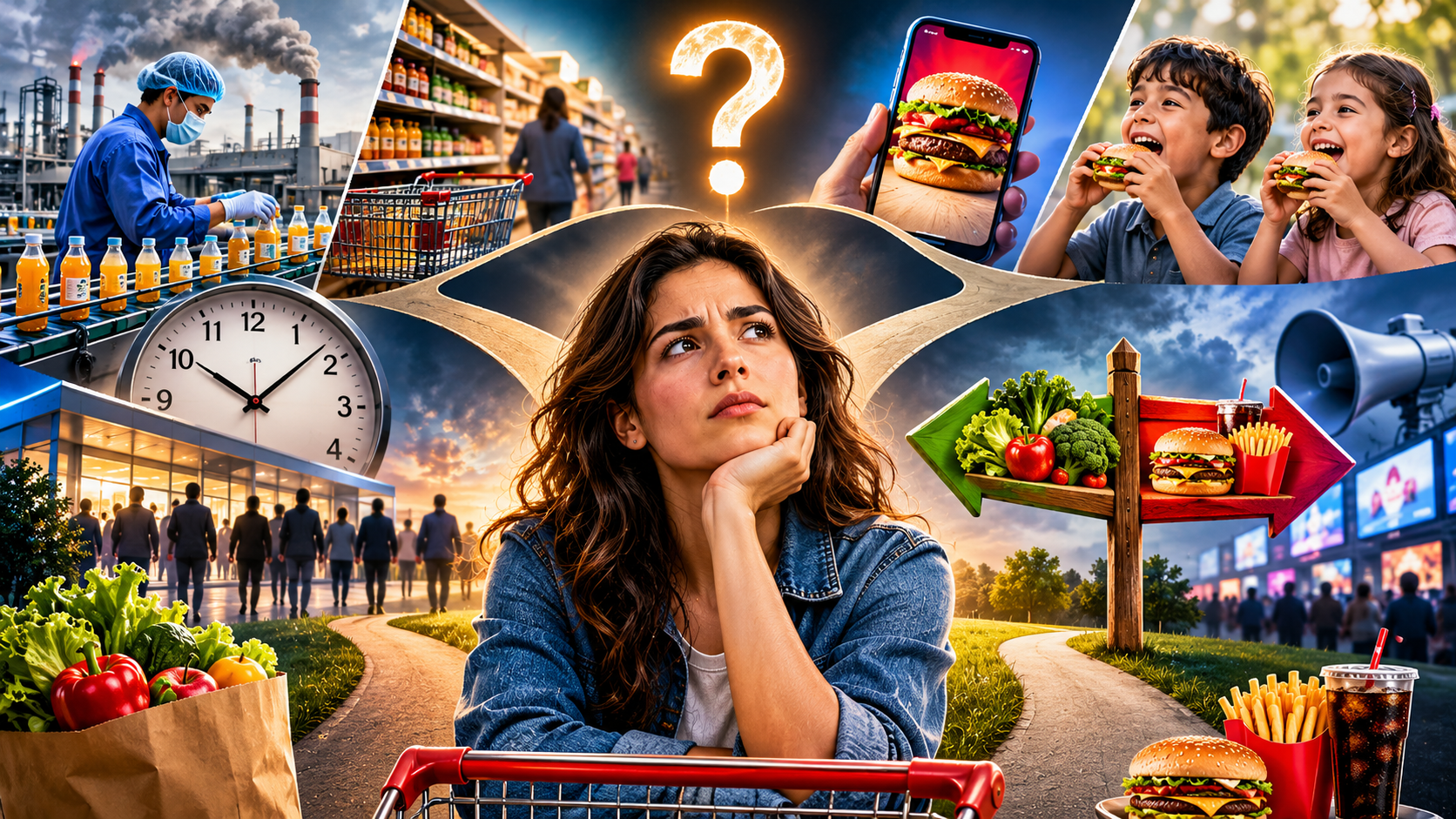

A supermarket may be one of the most carefully constructed environments we experience while still believing we are acting entirely on our own. We walk through aisles of competing colors, flavors, prices and promises, select what appeals to us and call the result personal choice. The choice is real. What is less visible is how much work occurred before we arrived to influence what would feel convenient, familiar, affordable or desirable.
This month, the World Health Organization opened a public consultation on a new food-profiling model that could help governments determine which industrially produced foods should fall within measures such as marketing restrictions, nutrition labeling or fiscal policies. In addition to established criteria for sugar, sodium and certain fats, the draft considers specified flavors, colors and sweeteners used primarily for sensory purposes. WHO stresses that their presence does not mean the ingredients themselves are unsafe. The proposal is asking something more complicated: should the way a product has been formulated to increase appeal and consumption matter when health policy evaluates it?
The debate reaches far beyond food additives. For decades, public-health advice has focused heavily on the individual: read the label, reduce sugar, control portions, make better choices. These recommendations are not wrong. What they often leave unexamined is the environment in which those choices are made.
The issue is not whether individuals possess agency. They do. People develop habits, resist impulses, change diets and make decisions that meaningfully affect their health.
Modern food does not simply wait on a shelf to be discovered. Products compete. Taste is developed, texture refined, packaging tested, prices calibrated and convenience engineered into the experience. Placement influences visibility. Advertising builds familiarity. Portion size changes expectations. None of this requires a conspiracy. It is what functioning markets do. Companies study what people want because products that attract consumers and bring them back tend to succeed.
The difficulty appears when health responsibility is discussed as though all of that influence disappears at the moment the consumer reaches for the package.
Consider an ordinary evening. A parent leaves work tired, collects the children and needs dinner quickly. One option requires ingredients, preparation and time. Another can be heated in minutes, costs less, tastes familiar and is unlikely to be rejected by a hungry child. The eventual purchase is still a choice. It is also a choice shaped by exhaustion, price, time and the way the product was created to fit precisely into that moment.
This is where the language of personal responsibility can become too simple for the reality it describes.
Two people can know exactly the same things about nutrition and still face very different choices. One has time to cook, reliable transportation, adequate storage and enough income to absorb higher food costs. Another is making decisions within a narrow budget, a long workday and whatever happens to be available nearby. Knowledge matters. It cannot create time, money or access.
Commercial design adds another layer. The healthier option may exist on the shelf while another product has been optimized across several dimensions at once: inexpensive, portable, intensely flavored, immediately available and familiar through repeated marketing. Asking the consumer to resist that combination is still reasonable. Pretending that the combination has no bearing on behavior is not.
The WHO proposal has drawn criticism from the food industry, which argues that formulation-based criteria could blur meaningful nutritional differences among products or penalize foods already reformulated to contain less sugar, salt or fat. Those objections deserve consideration because food classification is difficult. The existence of difficult boundaries, however, does not make the underlying question disappear.
If public health is willing to examine what a product contains, why should it refuse to examine how the product has been designed to compete for preference?
Food also occupies an unusual place in human life. Eating is biological, cultural, social and emotional at the same time. Food carries memory, hospitality, pleasure and identity. Convenience is not a moral failure, and processing can improve safety, shelf life and affordability. A serious argument about food should not divide every supermarket aisle into virtuous and harmful choices.
It should ask whether the burden of navigating that complexity has been placed too heavily on the person standing in front of the shelf.
Public health already recognizes that environments influence behavior. Governments restrict some forms of food marketing to children because exposure can shape preferences before children are fully equipped to evaluate persuasive messages. Schools increasingly consider not only what foods are available, but where they are placed, how they are presented and what they cost. Retailers have understood these effects for decades. Context influences choice.
The issue is not whether individuals possess agency. They do. People develop habits, resist impulses, change diets and make decisions that meaningfully affect their health.
The problem is assigning responsibility as though agency operates alone.
If millions of people repeatedly make choices associated with poorer health, the explanation cannot always be that millions of people independently failed at self-control. At some point, the environment in which those decisions are occurring deserves examination too.
The consumer chooses the product. The manufacturer determines its formulation. The retailer controls placement and promotion. Advertisers compete for attention. Governments establish labeling rules and marketing boundaries. Economic conditions influence what families can afford. Focusing almost exclusively on the final decision gives us an incomplete account of how that decision was produced.
This matters because health systems encounter the consequences much later. Diet-related disease does not appear at the checkout counter. It accumulates over years, shaped by repeated decisions that eventually become patterns. By the time diabetes, cardiovascular disease or another chronic condition becomes visible in a medical chart, the conversation often returns to what the individual should have done differently.
That may be a necessary conversation. It should not be the only one.
If millions of people repeatedly make choices associated with poorer health, the explanation cannot always be that millions of people independently failed at self-control. At some point, the environment in which those decisions are occurring deserves examination too.
The WHO consultation is important because it moves the discussion beyond the nutrient label. It asks whether governments should pay attention not only to what a product contains, but to how the product itself has been constructed to compete for human preference.
What should remain clear is that choice does not begin at the instant of purchase.
It begins with what is manufactured. With what is affordable. With what is available near home or work. With what has been made convenient. With what children recognize. With what advertising has made familiar and what daily life leaves enough time to prepare.
The final decision still belongs to the person making it. That is exactly why the conditions surrounding that decision deserve attention.
For years, we have asked people why they did not choose differently.
A more complete public-health conversation would also ask what made one choice easier, cheaper, faster and more appealing than another.
We should continue asking people to take responsibility for their health.
We should be equally willing to ask who designed the choices from which they are being asked to choose.
Julia El-Haj is a global health strategist and founder of Hermetica Health. Her writing explores the intersection of human systems, public health, conflict, and cooperation, examining how narratives, institutions, and power structures shape human wellbeing and global resilience.

