

By Ayaz Khan Lohani
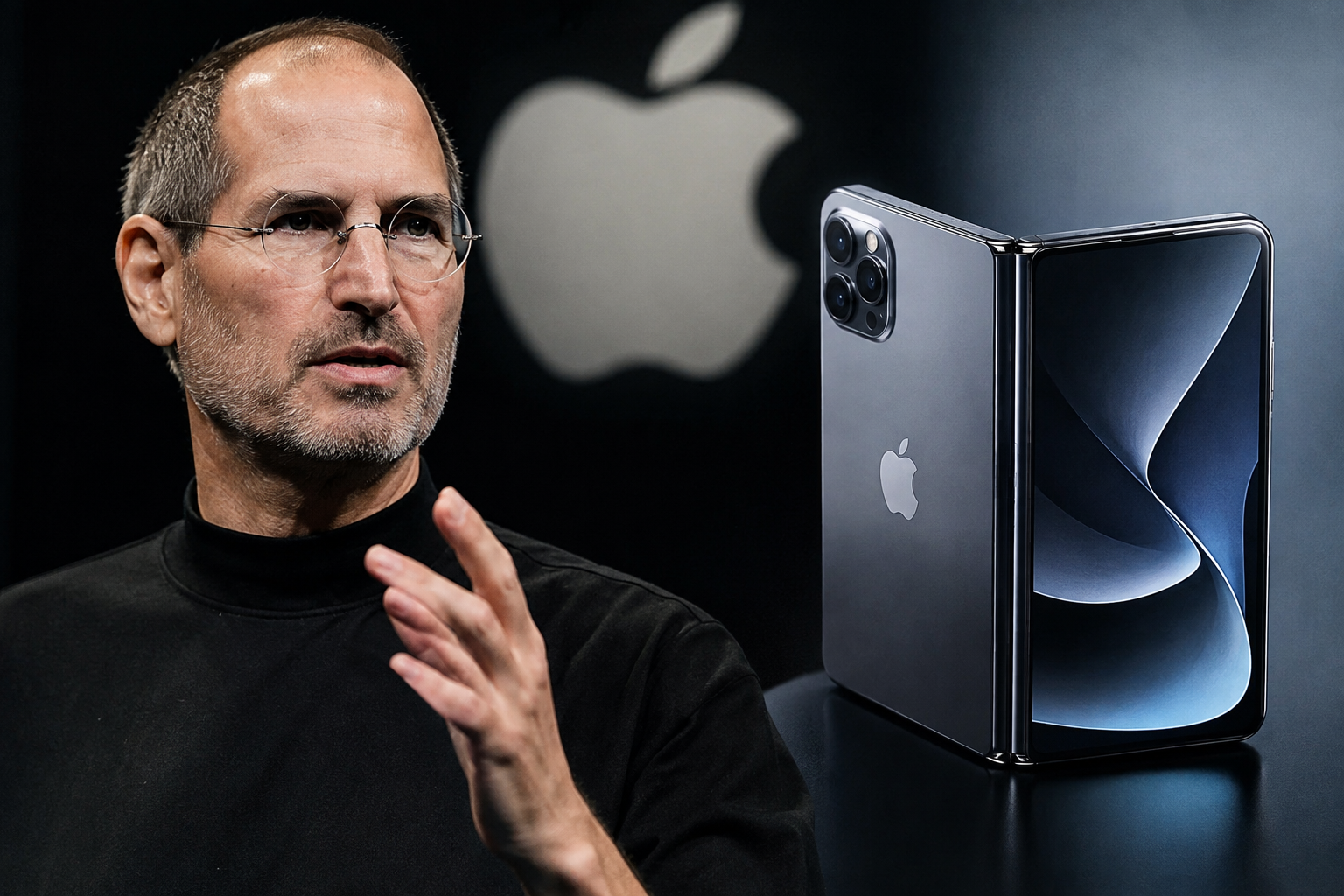
Steve Jobs argued that Apple should begin with the customer experience and work backwards to technology. But the original iPhone shows that this did not mean giving customers what they asked for. Apple created an experience that consumers had never demanded — and then changed their expectations. The new iPhone Duo presents a very different picture: a product entering a category already developed by competitors.
In 1997, shortly after returning to Apple, Steve Jobs explained his philosophy during a question-and-answer session at the Apple Worldwide Developers Conference.
Jobs said:
“One of the things I’ve always found is that you’ve got to start with the customer experience and work backwards to the technology. You can’t start with the technology and try to figure out where you’re going to try to sell it. And I’ve made this mistake probably more than anybody else in this room. And I got the scar tissue to prove it.”
The statement is often reduced to a simple formula: listen to customers and build what they want.
That was not really Jobs’ approach.
His emphasis was on understanding the experience people were having, identifying its limitations and then developing the technology required to create something better.
The original iPhone illustrates the difference.
Nobody Asked Apple for a Buttonless Phone
Before the iPhone appeared in 2007, smartphones were already well established. BlackBerry, Nokia, Motorola and Palm offered devices with physical keyboards, buttons and relatively small displays.
Consumers were familiar with that design. There was no major market demand for a smartphone with no physical keyboard.
Jobs nevertheless saw a problem with fixed controls. A telephone, music player, web browser and game require different interfaces, but a physical keyboard cannot change according to the task.
A touchscreen can.
At the iPhone launch, Jobs summarized Apple’s approach:
“Get rid of all the buttons and just make a giant screen.”
The significance was not simply the removal of buttons. Apple was changing the relationship between the user and the device. Software could determine the controls displayed on the screen, allowing the same hardware to serve different purposes.
Consumers had not specifically requested that experience.
They had to see it first.
Once they did, the definition of a desirable smartphone changed. The market moved toward large touchscreens, software-based interfaces and increasingly fewer physical controls.
This is the difference between responding to demand and creating demand.
A company can improve a product because customers complain about it. But a genuinely disruptive product can introduce a possibility that customers had never considered and then make that possibility seem obvious.
The iPhone Duo Represents a Different Model
Apple’s new iPhone Duo, its entry into the foldable-phone market, provides an interesting contrast.
Apple has focused heavily on engineering and refinement, including the foldable display, hinge, titanium construction, software and multitasking experience. The company is also addressing issues that have affected earlier foldable devices, such as the visible crease and durability.
But Apple is entering a category that already exists.
Samsung introduced foldable smartphones years before Apple, while Huawei and other manufacturers also developed competing designs.
The basic proposition is therefore no longer experimental.
Consumers already understand the idea:
A smartphone can unfold into a larger display.
Apple’s challenge is now to determine whether it can make that experience more attractive, reliable and integrated than competing products.
That is a legitimate form of innovation, but it is fundamentally different from what happened in 2007.
Apple did not invent the foldable concept.
It is refining it.
From Inventing the Category to Perfecting It
This difference becomes especially important when considering Apple’s historical identity.
The Jobs-era Apple frequently challenged assumptions about how products should work.
The iPhone questioned the need for fixed physical controls.
The iPad challenged conventional ideas about personal computing.
The company often removed elements that consumers had previously regarded as essential and replaced them with simpler alternatives.
The current Apple has greater reason to take a different approach.
As one of the world’s largest technology companies, Apple can allow competitors to experiment with emerging technologies, observe which ideas survive and then enter once the market has matured.
There is a clear strategic advantage to being second.
The pioneer pays the cost of experimentation.
The follower can learn from those experiments.
That does not mean the follower cannot produce a better product. It means the nature of the achievement is different.
The pioneer proves that a new category can exist. The later entrant tries to redefine the category through execution.
What Jobs Meant by Customer Experience
This brings us back to the 1997 quote.
Jobs was not suggesting that customers should tell Apple what to build.
A customer in 2006 could reasonably ask for a faster phone, better battery life, a better keyboard or a larger display.
But it would have been difficult for that customer to request a technology they had never experienced.
The customer could describe the frustration.
The innovator had to imagine the solution.
That is why customer experience is different from customer demand.
Customer demand tells a company what people currently want.
Customer experience can reveal what people are struggling with.
Innovation then asks a further question:
What if the entire experience were redesigned?
That is what happened with the original iPhone.
Improvement Is Not the Same as Invention
The distinction can be expressed simply.
Improvement:
Make the existing product faster, cheaper, thinner or more reliable.
Invention:
Question the assumptions behind the product and create a different experience.
The iPhone was revolutionary because Apple challenged an assumption that seemed normal at the time: that a smartphone needed a permanent physical interface.
The iPhone Duo does not challenge the existence of the smartphone or introduce the foldable concept.
Its challenge is to execute an established idea in Apple’s own way.
That may result in an excellent product.
But it is not the same type of innovation.
The Bigger Question for Apple
Apple’s evolution is partly explained by its size.
The company that Jobs returned to in 1997 needed dramatic change. Today’s Apple already has an enormous ecosystem, a massive customer base and established product lines.
The incentives are therefore different.
Apple does not have to invent every category to remain commercially successful.
But that creates a question about the company’s original philosophy.
Is Apple still trying to create products that change what consumers expect, or is it increasingly entering markets after other companies have demonstrated that the category works?
The iPhone Duo makes that question particularly visible.
Samsung and other manufacturers demonstrated that foldable phones could exist as a consumer category. Apple has now entered that market with its own interpretation.
The contrast with 2007 could hardly be clearer.
The original iPhone introduced an experience that consumers had not demanded. The iPhone Duo enters an experience consumers already know.
That does not settle whether the Duo will succeed or how consumers will judge it.
But it does reveal a significant change in Apple’s role in the technology industry.
Steve Jobs’ philosophy was not simply “give customers what they want.”
It was to understand the experience, challenge its limitations and work backwards toward a new solution.
The original iPhone demonstrated the power of that approach.
The foldable iPhone represents something else: Apple taking an existing technological direction and attempting to perfect it.
The question, ultimately, is not whether Apple can make a good foldable phone.
It is whether Apple can once again create something so different that, after experiencing it, people ask themselves:
“How did we ever live without this?”

