

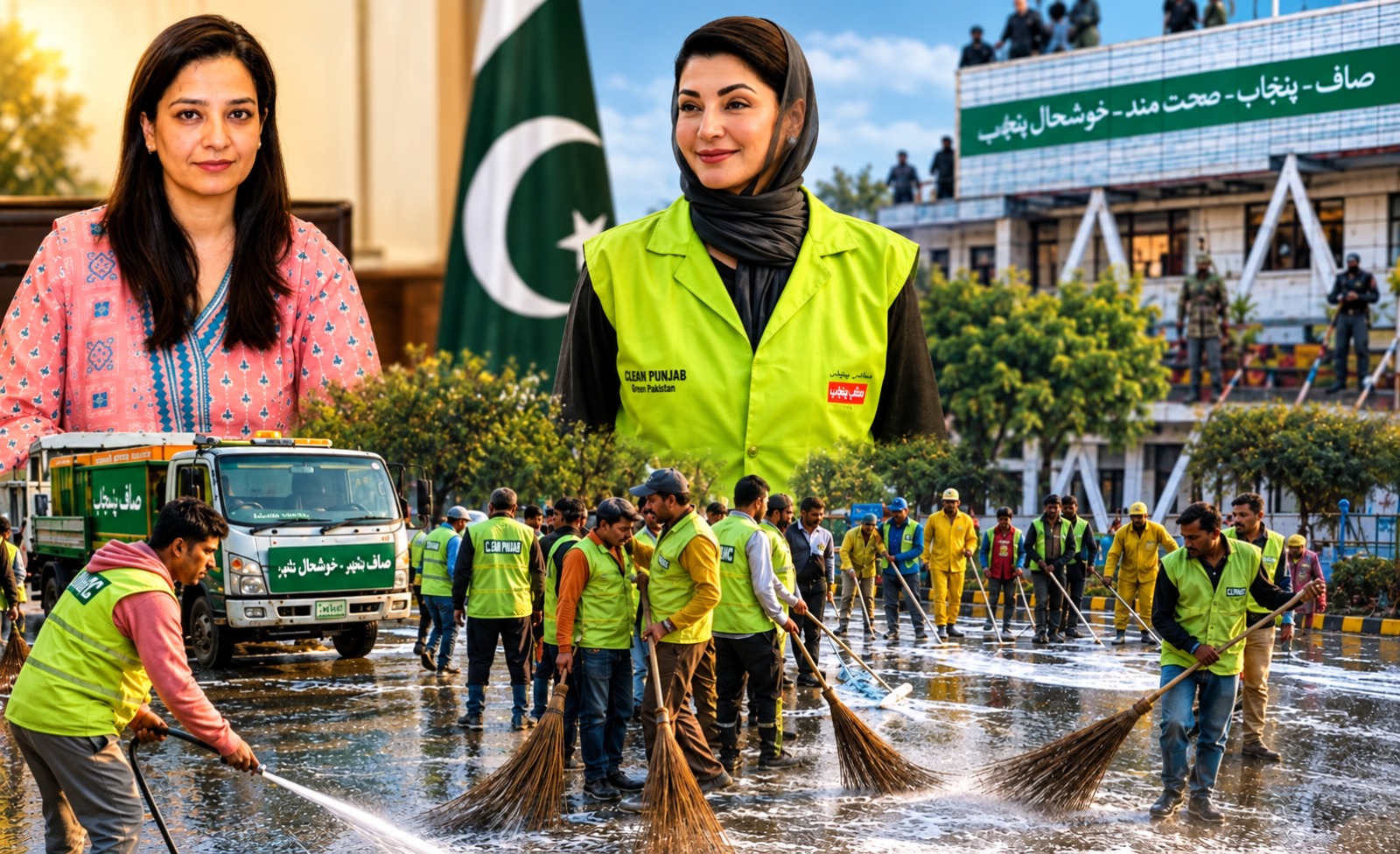
Over 280,000 tonnes of waste removed as technology-led monitoring, multi-shift operations and a new special cleaning campaign reshape sanitation across 84 union councils
Gujrat is emerging as a noteworthy example of how sustained administrative attention, modern technology and dedicated field operations can turn cleanliness from an occasional campaign into an ongoing public service. Under Maryam Nawaz’s Suthra Punjab initiative, more than 280,000 tonnes of solid waste have been collected, transported and disposed of since the programme began in late 2024, with around 680 tonnes lifted every day on average.
What makes the Gujrat experience particularly significant is not merely the scale of waste removal, but the effort to build a system in which cleaning, monitoring, revisiting and maintenance continue as a cycle. The approach has brought together thousands of sanitation workers, hundreds of vehicles and machines, extensive supporting infrastructure and a digitised performance-monitoring system.
The results have been achieved under the leadership and supervision of Deputy Commissioner Gujrat Noor ul Ain Qureshi, whose emphasis on field monitoring and administrative coordination has helped give the sanitation programme a sustained operational focus. Managing Director Suthra Punjab Agency Gujrat Mujahid Abbas is overseeing the implementation and execution of the services on the ground.
With 597 dedicated solid-waste management vehicles and machines and 2,873 sanitation personnel deployed across the tehsil, the programme represents one of the more substantial cleanliness operations in the area. Its supporting infrastructure includes 484 containers, six transfer stations, 56 waste enclosures, 704 hand carts and 1,350 waste bins.
The Gujrat model has also sought to bring greater transparency to sanitation management through a digitised, KPI-based daily monitoring and reporting mechanism for assessing contractor performance and service delivery. The technology-based system has strengthened data-driven evaluation and accountability and was subsequently showcased and acknowledged at the Global COP30 Climate Change Conference as an example of the Punjab government’s technology-led approach to public service delivery.
The latest step in this continuing effort came on Sept 1, 2026, with the launch of a Special Cleaning Activity Drive under the message “Clean Gujrat — A Collective Commitment Towards a Cleaner, Healthier & Better Gujrat.”
The campaign is designed not as a one-day exercise but as an intensive and continuing operation covering urban, rural, commercial and identified hotspot areas across 84 union councils of Tehsil Gujrat.
The coverage includes 21 urban UCs and 63 rural UCs. Of the urban councils, 12 are in Municipal Corporation Gujrat, five in Municipal Corporation Jalalpur Jattan and four in Municipal Corporation Kunjah.
The campaign includes door-to-door waste collection, manual sweeping, mechanical washing and sweeping, special cleaning of streets and public areas, bulk plot waste clearance, container clearance, commercial-area cleaning, drain desilting and union-council-wise special cleaning in rural areas.
Special attention is also being given to Gujrat Railway Station and adjoining priority areas, while dedicated cleaning activities are being undertaken in parks across the tehsil.
To maximise coverage, the operation is being conducted through morning, evening and night shifts, involving sanitary workers, supervisors, sanitary inspectors, drivers, helpers and specialised waste-management machinery.
The campaign follows a simple but important principle: Clean → Monitor → Revisit → Re-clean → Maintain. Once cleaning activities are completed in targeted urban areas, teams will return to repeat the process, while supervisors identify emerging hotspots and redirect resources where additional attention is required.
The solid waste management contractor, M/S ARAR Innovations (Pvt.) Ltd., is responsible for executing the planned activities.
The initiative also carries a message beyond the government, contractor and sanitation workforce. Residents, traders and businesses are being encouraged to regard cleanliness as a shared responsibility by avoiding open dumping, using designated waste collection arrangements, keeping streets and surroundings clean and cooperating with sanitation workers.
For a city and its surrounding rural communities, the real measure of a cleanliness drive is not how clean an area looks on the day of an inspection, but whether that cleanliness can be maintained afterwards. Gujrat’s current approach — combining manpower, machinery, technology, monitoring and repeated field intervention — offers a promising model in that direction.
The experience of Gujrat proves that cleaner communities are possible when administrative leadership is matched by operational discipline and, equally importantly, by the participation of the people who live and work there.

