

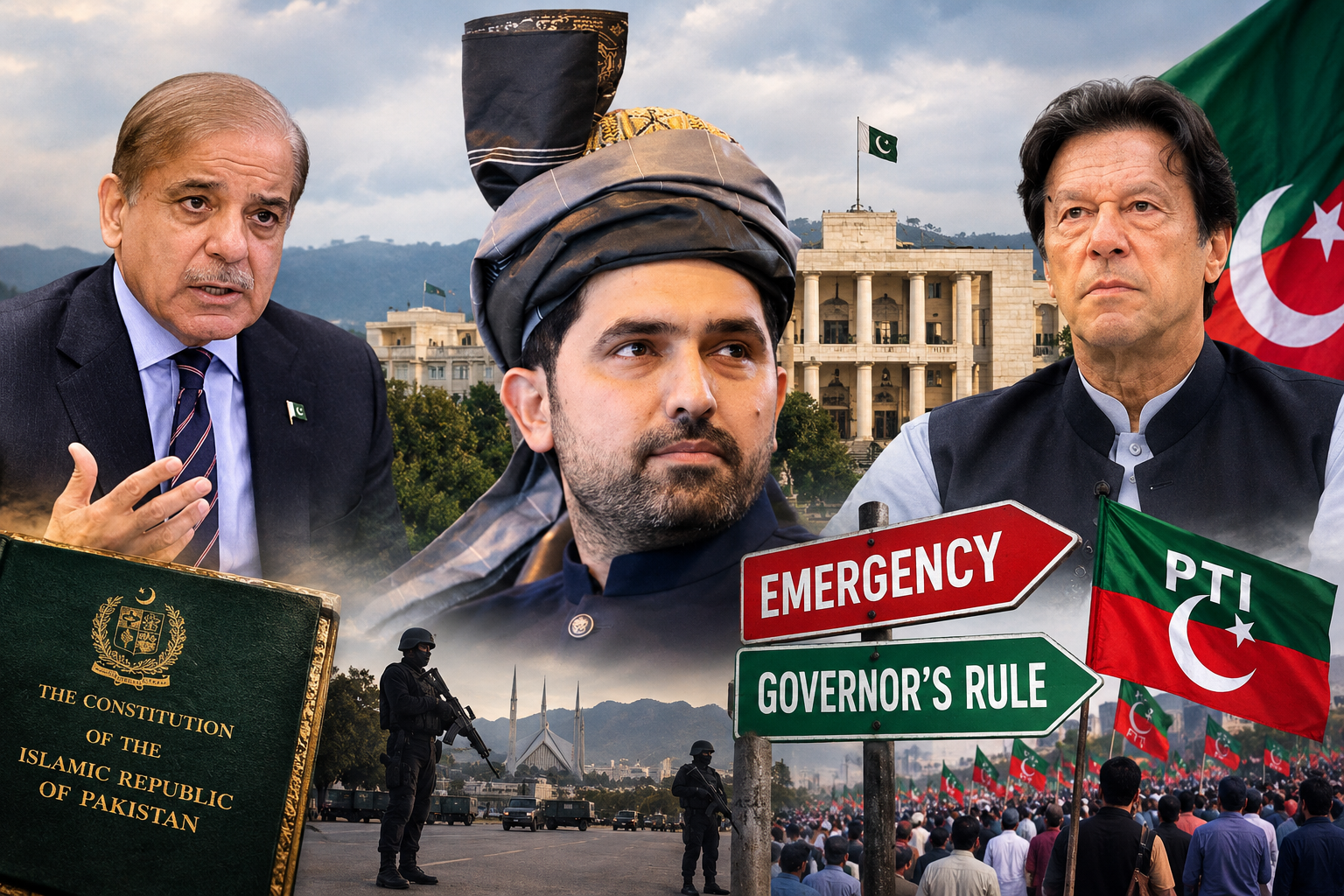
ISLAMABAD: The possibility of imposing an emergency or Governor’s Rule in Khyber Pakhtunkhwa has moved beyond political speculation, with senior federal officials now openliy discussing constitutional options as tensions rise ahead of Pakistan Tehreek-e-Insaf’s planned October 4 march on Islamabad.
Meanwhile, some ‘senior anchors,’ citing information from their sources, have also claimed that Khyber Pakhtunkhwa Chief Minister Sohail Afridi is facing a difficult political situation and could be removed from office.
The PTI had postponed its September 27 march and announced October 4 as the new date. The planned protest, which the party says is part of its campaign seeking the release of its founder Imran Khan, has become a major point of confrontation between the federal government and the PTI-led KP administration.
The federal government has increased security preparations around Islamabad, while ministers have repeatedly referred to the possibility of using constitutional provisions to deal with the situation in KP.
The discussion became more explicit on September 30 when Parliamentary Affairs Minister Tariq Fazal Chaudhry said the federal government was “seriously considering” imposing an emergency in Khyber Pakhtunkhwa.
Tariq Fazal Chaudhry linked the discussion to the security situation in the province, arguing that what he described as the provincial government’s lack of success in controlling terrorism was the reason an emergency under Article 232 was being considered.
The federal government has also previously referred to Governor’s Rule as another possible option. Federal Law Minister Azam Nazeer Tarar said Governor’s Rule or an emergency could be considered if the constitutional requirements were met. KP Governor Faisal Karim Kundi has also pointed to constitutional provisions that could be used if the situation in the province deteriorates.
However, political responses remain divided.
The Pakistan Peoples Party, a coalition partner of the federal government, has not formally endorsed Governor’s Rule. PPP Secretary General Nayyar Hussain Bukhari said that if the federal government consulted the party, it would give its position strictly according to the Constitution and law.
Bukhari described the law-and-order situation in KP as deeply concerning but also said peaceful protest was a democratic right and called for political engagement.
PTI Chairman Barrister Gohar Ali Khan, meanwhile, has opposed both emergency and Governor’s Rule, saying such measures would not resolve the dispute surrounding the march. He has maintained that the October 4 protest will be peaceful.
Anchor’s Take
Javed Chaudhry’s claim
Against this backdrop, renowned TV anchor Javed Chaudhry discussed the situation on September 26 during his programme Moaqaf on SAMAA TV.
Chaudhry claimed that the Pakistan Peoples Party wants Governor’s Rule to be imposed in Khyber Pakhtunkhwa, with Faisal Karim Kundi appointed as governor.
According to Chaudhry, the Pakistan Muslim League-Nawaz does not support the proposal because it would give the PPP governments in three provinces. The PPP already governs Sindh and Balochistan and also holds the offices of the president and chairman of the Senate.
Chaudhry said another option under consideration was the imposition of an emergency under Article 232 of the Constitution. He referred to KP’s internal and external challenges, including terrorism, as possible reasons for considering such a measure.
According to Chaudhry, once an emergency is imposed, an administrator could be appointed to run provincial affairs and oversee the cabinet.
He further claimed that, based on his information, the state was moving towards this option and that the federal government also agreed with it.
Chaudhry identified four possible categories of people who could potentially be considered for the position of administrator: a senior politician, a retired judge, a retired bureaucrat or a retired general.
He also claimed that work on the proposal was progressing rapidly and that the measure could be imposed before October 4, subject to approval from the prime minister.
The third option
Chaudhry also discussed a third possibility involving an internal revolt within the PTI.
Under this scenario, PTI members could move a vote of no confidence against the chief minister and remove him through the provincial assembly.
Chaudhry claimed that the federal government wanted to create divisions within the party so that the PTI itself could remove its chief minister.
However, he said he considered this possibility very unlikely and indicated that, based on the information available to him, the emergency option could instead be pursued.
Mansoor Ali Khan’s claims
Another renowned anchor, Mansoor Ali Khan, also discussed the issue in his YouTube vlog on September 26.
Mansoor claimed that he had spoken to two “very important” people whom he described as being at the centre of the situation — one associated with PTI and another associated with the government or establishment, “whatever you like to call it.”
According to Mansoor, he asked the person associated with the government or establishment whether Sohail Afridi was going to face serious difficulties.
Mansoor said the person told him that Afridi was in “deep trouble” and that there was no recovery in sight.
Mansoor then asked whether he should consider the information 100 percent certain. According to him, the person replied: “Consider it 90 percent.”
Mansoor said he then questioned how Afridi could be removed because he was the chief minister and had the support of a two-thirds majority in the provincial assembly.
According to Mansoor, the person responded: “You leave this matter.”
Mansoor subsequently told his audience that, according to the information he had received, there was a “game plan” under way. He said he did not know exactly how it would be implemented.
Some people, he added, were describing the plan as the imposition of an emergency, while others were referring to Governor’s Rule. He said different people were describing the situation according to their own understanding.
Mansoor nevertheless claimed that, based on his information, Sohail Afridi would be removed from office.
He stated that more than 90 percent of the decision had already been made and that Afridi would leave his position “under any circumstances.”
PTI figures also confirm difficulties, Mansoor says
Mansoor Ali Khan then presented what he described as the off-the-record version of one or two PTI figures regarding the situation.
According to Mansoor, he asked them about the information he had received concerning Sohail Afridi and told them that his information suggested the chief minister was facing very serious difficulties.
Mansoor said the PTI figures confirmed that Afridi was indeed in serious trouble and that they also believed it would be difficult for him to survive politically.
According to Mansoor, the PTI figures further suggested that an allegation involving terrorism, links with terrorists, sympathy towards militants or something similar could potentially be levelled against Afridi and used as a basis for removing him from office.
Mansoor reiterated that he did not know how the alleged “game plan” would be carried out or how Afridi could be removed from office.
However, he claimed that both the government or establishment side and the PTI side had independently confirmed to him that Afridi was facing serious difficulties and could be removed.
What does the Constitution say?
The political debate has also raised a central constitutional question: Can the federal government impose emergency or Governor’s Rule in KP because of the planned PTI march and the province’s security situation, or must specific constitutional conditions first be satisfied?
The answer lies primarily in Articles 232 and 234 of Pakistan’s Constitution.
Article 232 deals with the proclamation of emergency. Under the Constitution, the President may proclaim an emergency if satisfied that a grave situation exists in which Pakistan, or any part of it, faces a threat to its security because of war, external aggression or internal disturbance beyond the control of the provincial government.
This distinction is important.
A political protest or long march, by itself, is not the wording used by Article 232 as a ground for emergency. The constitutional threshold concerns war, external aggression or serious internal disturbance that is beyond the provincial government’s ability to control.
This is why the federal government’s reference to terrorism in KP is significant.
The government is not publicly presenting the planned march alone as the constitutional basis for emergency. Instead, its argument is that the security situation in the province, particularly militancy and the provincial government’s ability to control it, could potentially meet the constitutional threshold.
Whether that argument satisfies Article 232 would depend on the circumstances and the constitutional process that follows.
What happens if an emergency is imposed?
Once an emergency is in force, the federal government and Parliament acquire additional powers concerning the affected province.
Parliament can legislate for the province in areas that would ordinarily fall outside the federal legislative sphere, subject to the constitutional conditions governing an emergency.
The federal executive can also issue directions concerning the exercise of provincial executive authority.
The federal government may assume some or all functions of the provincial government or direct the provincial governor to exercise those functions on its behalf. However, the federal government cannot take over the powers of the provincial High Court under Article 232.
The emergency mechanism therefore does not amount to an unrestricted suspension of the provincial constitutional system.
What is Governor’s Rule?
Governor’s Rule is a separate constitutional mechanism primarily associated with Article 234, which deals with a situation in which the constitutional machinery of a province has failed.
Under this provision, the President may act after receiving a report from the provincial governor and being satisfied that the provincial government cannot function in accordance with the Constitution.
The President can then assume certain functions of the provincial government or direct the governor to exercise those functions on the President’s behalf.
The legislative powers of the provincial assembly can also be exercised by Parliament while the proclamation remains in force. However, the powers of the High Court are not transferred to the federal government or governor.
Governor’s Rule therefore represents a significant shift of executive and legislative authority, but it does not give the federal government unlimited power over the province.
Emergency and Governor’s Rule are not the same
The two terms are increasingly being used together in political debate, but constitutionally they serve different purposes.
Article 232 is an emergency mechanism connected with war, external aggression or serious internal disturbance, while Article 234 concerns the failure of constitutional machinery in a province.
Both mechanisms can result in greater federal control, but the constitutional circumstances and procedures are different.
That distinction could become particularly important if the federal government moves from political statements to formal action.
The October 4 question
The immediate political flashpoint is the PTI’s planned October 4 march.
The federal government has stepped up security preparations, while the PTI-led provincial government continues to oppose what it sees as federal pressure.
At the same time, federal ministers are publicly discussing extraordinary constitutional measures.
This creates two separate but increasingly connected questions.
First, is the security situation in KP serious enough to meet the constitutional requirements for an emergency?
Second, could the political confrontation surrounding the PTI march become part of the circumstances cited by the federal government if it seeks extraordinary measures?
For now, there remains an important distinction between discussing emergency powers and formally invoking them.
But the language from Islamabad has become more explicit. The federal government is no longer merely acknowledging that emergency or Governor’s Rule exists as a constitutional possibility. Parliamentary Affairs Minister Tariq Fazal Chaudhry has said that emergency in KP is “seriously” being considered, while the PPP says it would assess any proposal according to the Constitution and law.
The PTI, meanwhile, rejects the move and says its planned march will remain peaceful.
Any actual imposition of emergency or Governor’s Rule would therefore require more than political statements. It would have to pass through the constitutional procedures laid down in Articles 232 and 234, followed by the required parliamentary process.
For now, the question is no longer simply whether emergency or Governor’s Rule is legally possible.
The more immediate question is whether the federal government believes the conditions exist to actually invoke those constitutional powers — and whether the required constitutional and parliamentary process follows.

