

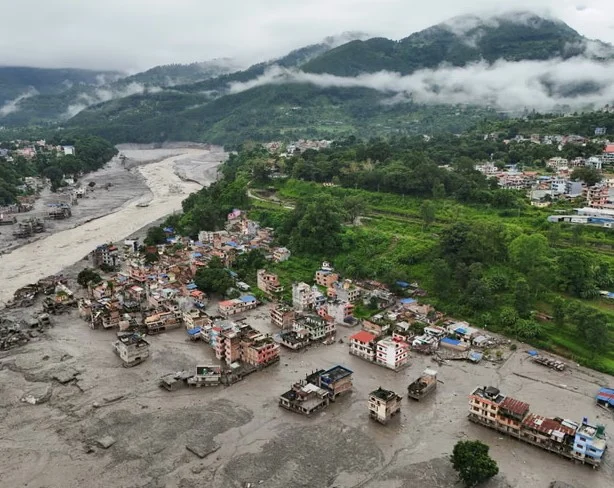
China has halted rescue operations at the epicentre of the catastrophic flooding along its border with Nepal after a debris-dammed lake began overflowing, raising fears of renewed flooding and further destruction downstream.
The decision came as the scale of devastation from the Himalayan disaster became increasingly clear. Nepal’s death toll has risen to at least 469, while more than 1,300 people remain missing, according to Nepali authorities. Hundreds of foreign tourists and pilgrims are among those unaccounted for.
The floods struck on Wednesday after a massive glacier and rock collapse triggered torrents of water, mud, ice and debris through narrow mountain valleys. Satellite imagery indicates that part of the glacier on Langtang Lirung collapsed along with the underlying bedrock, dramatically altering the Trishuli River and inundating communities downstream. Scientists say climate change may be increasing the instability of glaciers and mountain slopes, although a direct link to this particular event has not yet been established.
Roads and bridges destroyed
The disaster has severely damaged Nepal’s transport and communications infrastructure. Dozens of bridges have been destroyed, while around 40 kilometres of roads have been washed away, making it extremely difficult for rescue teams to reach isolated communities.
Entire settlements have been buried or swept away by fast-moving water and debris. The Trishuli Valley, a strategically important corridor linking Nepal with Tibet, has suffered some of the worst destruction.
The disaster has also badly damaged hydropower infrastructure, with several projects along the river affected by the sudden surge.
Race to rescue hydropower workers
One of the most dramatic rescue operations has been taking place at the Trishuli 3A hydropower project, where workers were trapped inside a flooded tunnel.
Nepali Army teams have already rescued around 350 workers and local residents, while efforts have continued to reach more than 100 others trapped inside the tunnel. Helicopters and ground teams are being used despite dangerous weather and unstable terrain.
Workers who escaped from hydropower sites along the Trishuli Valley described the flooding as extraordinarily sudden.
“There were at least 400 workers at the site,” said Dev Shrestha, who was airlifted to safety after being rescued from the project where he was working.
New threat from rising floodwater
The immediate danger has not passed. Chinese authorities have warned that an artificial lake created by enormous quantities of debris could breach its natural barrier and send another surge of water downstream.
The threat has forced Chinese rescue teams to withdraw from the disaster’s epicentre. More than 500 tourists and hundreds of local residents have already been evacuated from affected areas in Tibet, according to Chinese state media.
Nepal has also warned of renewed flooding as water levels rise in a debris-blocked lake.
Thousands affected
The International Federation of Red Cross and Red Crescent Societies estimates that around 93,000 people could have been affected by the disaster and has launched an emergency appeal for humanitarian assistance. The UN has also released emergency funding to support the relief effort.
Rescue teams from the Nepali Army, police and other agencies continue to search riverbanks, damaged settlements and isolated mountain areas. Helicopters remain crucial for evacuating survivors and delivering supplies where roads and bridges have disappeared.
With hundreds still missing and the risk of further flooding remaining, authorities face a race against time to locate survivors while preparing communities downstream for another possible surge.
The disaster has also renewed concerns over the vulnerability of Himalayan communities and infrastructure to increasingly dangerous glacial and mountain hazards.

