


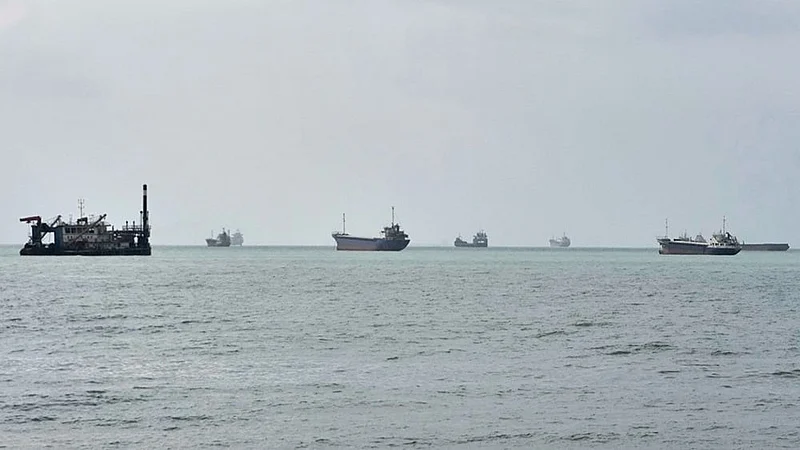


Lahore Mirror : Middle Eastern oil exports are recovering after months of disruption around the Strait of Hormuz, but shipments remain below pre-war levels and the market still faces high security, transport and supply risks.
Oil exports through and around the Strait of Hormuz increased sharply in September after Iran disrupted shipping through the waterway.
Kpler data showed an average of about 10 million barrels per day moving through Hormuz during September, while another roughly 6 million barrels per day left Persian Gulf producers through pipelines and ports that bypass the strait.
Before the conflict, around 19 million barrels per day left the region through the waterway and alternative routes.
Kpler analyst Amena Bakr also reported a recovery in Gulf exports. She said Kpler data showed major Middle Eastern producers exporting 12.8 million barrels per day in September, compared with 18.8 million barrels per day in February.
Iranian military action and threats have largely restricted normal passage through Hormuz since the United States and Israel began attacking Iran in late February.
The shuttle fleet keeps oil moving
Part of the recovery has come from a new shipping arrangement rather than a full return to normal navigation.
Vortexa analysts attributed a clear increase in energy shipments since the end of July partly to the expansion of a so-called “shuttle fleet.” Tankers protected by the US Navy travel repeatedly through the strait, carrying crude from loading terminals in the Gulf to other tankers waiting outside the waterway.
This allows oil to continue reaching international markets despite the security risks surrounding conventional commercial shipping.
The system has also been supplemented by ship-to-ship transfers and alternative export routes. Saudi Arabia’s East-West Pipeline provides another important route for moving crude toward the Red Sea without relying entirely on Hormuz.
CNN reported that last week’s oil and petroleum-product flows through the strait reached about 13.1 million barrels per day, according to Kpler, compared with an estimated 17.1 million barrels per day before the war.
Different trackers show different flows
The precise volume moving through Hormuz remains difficult to establish.
Vortexa estimated September flows at about 7.9 million barrels per day, while TankerTrackers.com put the figure at roughly 7.4 million barrels per day. Differences arise partly because some tankers switch off their tracking transponders while travelling through sensitive areas.
Kpler uses vessel movements and other data to produce its estimates, but its figures can therefore differ from other tracking services.
The International Maritime Organization has continued to warn that the waterway is not operating as a normal safe shipping route. The security risk remains an important factor for shipowners, insurers and oil buyers.
Oil prices remain high
Despite the recovery in physical shipments, oil prices remain elevated.
BigGo Finance reported that WTI crude fell 3.5% to $89.38 a barrel in New York as Gulf exports recovered. Brent remained above $100 a barrel, reflecting continued concerns about supply security and the unresolved situation around Hormuz.
BigGo Finance also reported September Middle Eastern exports at 12.8 million barrels per day, the highest level since February.
The recovery in exports has therefore helped ease some immediate supply pressure, but it has not eliminated the risk premium attached to Middle Eastern crude.
CNN reported that oil prices remained above $90 for much of the month and frequently traded above $100, while US diesel prices exceeded $6 a gallon. Refined-product flows from the Middle East were also only around 58% of their pre-war level.
Saudi Arabia adds an alternative route
Saudi Arabia has also increased its use of routes outside Hormuz.
The kingdom’s East-West Pipeline, which carries crude toward the Red Sea, returned to service after being damaged in an attack. The alternative route allows Saudi Arabia to move oil toward export terminals without sending every barrel through Hormuz.
The recovery is important because Saudi Arabia is one of the world’s largest oil producers and a major supplier to international markets.
However, alternative infrastructure cannot completely replace the capacity and efficiency of normal shipping through Hormuz.
The bigger question is sustainability
The current recovery has allowed more oil to reach international buyers, but it comes with additional costs and logistical complications.
Military protection, longer shipping routes, ship-to-ship transfers, insurance costs and congestion have all increased the complexity of moving Gulf crude.
According to CNN global oil inventories had fallen by around 2 billion barrels during the conflict, raising questions about how long the market can continue absorbing the disruption.
The situation also remains particularly difficult for Iran. The US naval blockade has prevented Iranian oil from moving normally through the strait, while attacks on tankers have increased as Tehran seeks to deter shipping and regain influence over the waterway.
For now, the oil market is receiving substantially more Middle Eastern crude than during the worst period of the disruption.
But the recovery should not be mistaken for a full return to normality.
More oil is moving. The real question is whether those flows can continue while the Strait of Hormuz remains unsafe for normal commercial navigation.

