

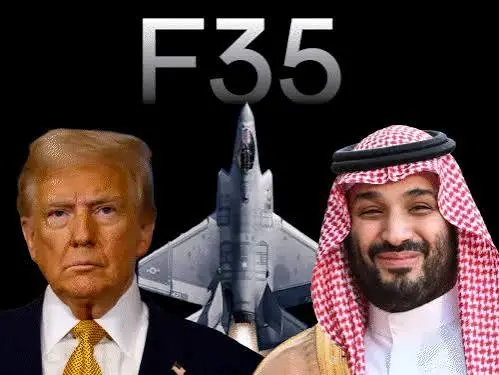
Washington clears major fighter-jet deal as Riyadh faces growing regional security threats, while US intelligence reportedly warns that China could gain access to sensitive F-35 technology
Washington: The United States has approved a proposed $24.3 billion sale of 48 F-35 stealth fighter jets to Saudi Arabia, marking a major expansion of the kingdom’s planned air capabilities amid heightened security tensions across the Middle East. The State Department announced the approval on Thursday.
Saudi Arabia has sought the advanced aircraft for years, but the proposed sale has faced concerns over Israel’s military advantage in the region and the security of highly sensitive US defense technology. Israel remains the only Middle Eastern country currently operating the F-35.
The State Department said the sale would strengthen Saudi Arabia’s ability to deter current and future threats and improve interoperability between Saudi and US forces.
Saudi Arabia Welcomes the Deal
Riyadh welcomed the proposed transaction.
The Saudi embassy in Washington described the agreement as evidence of the longstanding security relationship between the two countries, saying US-Saudi defense cooperation has contributed to regional stability and strengthened their collective defense capabilities.
The proposed F-35 sale comes as Saudi Arabia faces security challenges involving Iran and Yemen’s Houthi movement.
According to the report, Iranian forces have repeatedly targeted Saudi Arabia with missiles and drones since the US-Israeli war against Iran began earlier this year. Saudi Arabia has also faced attacks from the Iran-backed Houthis, including strikes targeting Saudi interests and ships in the Red Sea.
Congress Must Still Approve the Sale
The State Department has notified Congress of the proposed deal, meaning the transaction still requires congressional approval before it can proceed. Washington has not announced when the aircraft would be delivered if lawmakers approve the sale.
The State Department also said the sale would not alter the military balance in the region, reflecting Washington’s longstanding policy of ensuring that Israel maintains its qualitative military edge over potential regional rivals.
The United States has restricted F-35 sales to a small group of close allies, including Israel and several European NATO members. Turkey was removed from the F-35 programme in 2019 after purchasing a Russian air-defense system, amid concerns that Moscow could gain access to the aircraft’s technology.
New York Times Reports Chinese Espionage Concerns
The New York Times reported on September 16 that US intelligence officials have raised concerns that China could potentially obtain F-35 technology through espionage in Saudi Arabia or through Riyadh’s military and security cooperation with Beijing.
According to the newspaper, internal intelligence assessments, including a report from the Pentagon’s Defense Intelligence Agency, examined Chinese military access to Saudi facilities and Saudi Arabia’s use of Chinese technology in its telecommunications infrastructure. US officials have questioned whether sensitive F-35 technology could be adequately protected at Saudi sites.
The report said the concerns include the possibility that Chinese military or intelligence personnel could gain access to facilities where F-35 technology is stored or used. US intelligence officials are also examining whether Saudi Arabia would restrict Chinese involvement around those sites.
The concerns are not entirely new. Similar issues emerged when the United States considered selling F-35 aircraft to the United Arab Emirates. Intelligence agencies raised concerns over the UAE’s expanding military, intelligence and technology ties with China, and the US eventually ended that sales process.
The latest Pentagon assessment reportedly places particular emphasis on protecting the F-35’s advanced radar and surveillance systems. It also raises questions about Chinese telecommunications equipment, including technology from Huawei and ZTE, at sensitive Saudi facilities.
Israel’s May lose Military Edge?
The proposed sale also carries implications for Israel’s longstanding military advantage in the Middle East.
Israel is currently the region’s only F-35 operator and has used the aircraft in operations against Iran. US policymakers have historically maintained that Israel should preserve its “qualitative military edge” over other regional states.
The United States has nevertheless continued to deepen defense cooperation with Saudi Arabia. The F-35 proposal follows several other major weapons agreements approved this year, including a $5 billion sale of more than 10,000 bombs, a $750 million deal for tank engines and related equipment, and a $1.96 billion agreement for rocket guidance systems.
The F-35 deal would therefore represent a significant step in US-Saudi defense cooperation, but its path to completion remains subject to congressional approval and concerns over the protection of advanced American military technology.

