

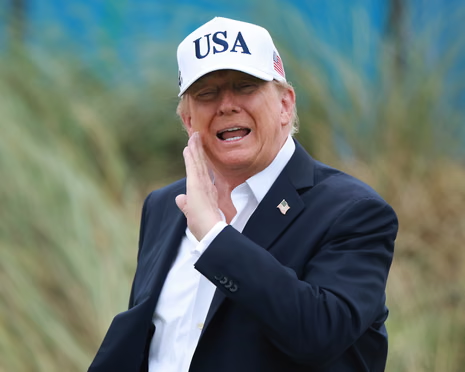
Doonbeg, Ireland: US President Donald Trump has said the United States could potentially remain in Iran and retain control of the country’s oil, comparing the possibility to Washington’s oil arrangement with Venezuela earlier this year.
Speaking on Sunday while attending the Irish Open golf championship in Doonbeg, Trump said the United States would eventually leave the war unless Washington decided to remain and “keep the oil like Venezuela.”
Trump also claimed that revenue generated through the Venezuela arrangement had already paid for the war “many times.”
Under the agreement reached in August, Venezuela ceded majority US control of more than 65 billion barrels of oil reserves in return for $209 billion for the Venezuelan state treasury. US Secretary of State Marco Rubio said the arrangement was also expected to attract nearly $100 billion in private investment to help revive Venezuela’s economy.
Trump said he expected the seven-month conflict with Iran to end before the close of the year, possibly after the November US midterm elections. He also predicted that gasoline prices would fall sharply once the war ends.
The US president said Washington would accept only what he described as the “right deal” with Tehran. He further claimed that Iran had been repeatedly calling for peace talks, although Iran has previously rejected that characterization.
Trump’s comments came as diplomatic efforts over the Strait of Hormuz suffered another setback.
A planned meeting in Oman between Iran and Gulf countries to discuss possible arrangements concerning the strategic waterway was postponed, according to Omani Foreign Minister Badr Albusaidi. He cited the need to reach greater consensus before the talks could proceed.
Iranian and Gulf officials had been expected to meet on Monday to discuss an agreement establishing an Iran-Oman shipping route through the Strait of Hormuz. No direct negotiations between the United States and Iran were taking place at the time.
The Strait of Hormuz has become a central flashpoint in the conflict because it is a vital route for global oil and gas shipments. The waterway has faced an Iranian and subsequently US naval blockade since the war began in February, keeping pressure on international energy markets.
A June agreement between Washington and Tehran also broke down over disagreements concerning the Strait. Meanwhile, intensified attacks by Yemen’s Houthi forces have increased risks around the Bab el-Mandeb, another major maritime route linking energy producers with global markets.
The growing tensions have pushed oil prices higher. Crude prices again moved above $100 a barrel, while concerns over supply increased after Saudi Arabia shut a key East-West oil pipeline following damage caused by Iraqi drone strikes.
US West Texas Intermediate crude futures rose 2.3% to $102.39 a barrel, while Brent crude, the international benchmark, gained 2.4% to $107.11 a barrel.
The latest developments have raised fresh concerns about the potential economic impact of a prolonged conflict. Continued disruption around the Strait of Hormuz could put further pressure on global energy supplies, shipping routes and fuel prices.
With negotiations stalled and military tensions continuing across several key waterways, the future of the conflict remains closely tied to the security of the region’s energy infrastructure and the flow of oil through some of the world’s most important maritime routes.

