

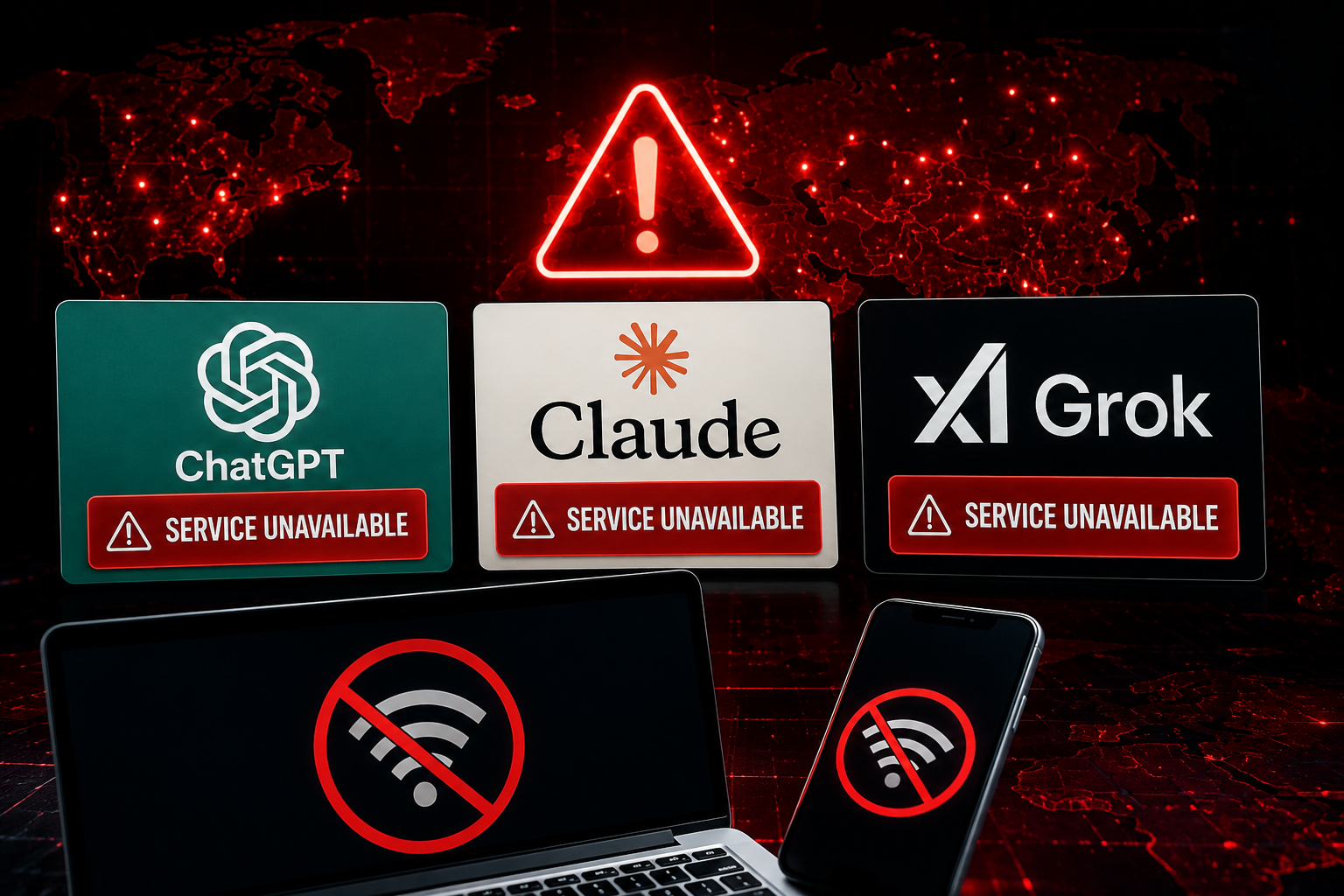
WASHINGTON: Users of three of the world’s biggest artificial intelligence platforms were hit by an unusual disruption on Thursday after ChatGPT, Claude and Grok became unavailable at roughly the same time.
The outages affected OpenAI’s ChatGPT, Anthropic’s Claude and Elon Musk’s Grok, temporarily cutting millions of users off from tools that have become part of everyday work, research and communication. Some users also reported difficulties with Google’s Gemini, although Google did not confirm a major service disruption.
The simultaneous nature of the incidents quickly attracted attention because outages involving individual AI platforms are relatively common, while several major competitors experiencing problems during the same period is far less usual.
OpenAI said ChatGPT and its Codex coding service were experiencing higher-than-normal error rates. The company subsequently traced the ChatGPT problem to a routing issue, deployed a fix and monitored the system as access gradually returned.
Anthropic also reported an infrastructure problem affecting Claude and some related services. Although the platform was restored, certain models continued to experience elevated error rates before returning to normal.
Grok users faced a similar interruption. xAI later attributed its outage to a problem involving its Memphis computing facility, with services subsequently recovering.
The cluster of failures prompted questions over whether the platforms could have been affected by common infrastructure or third-party systems. Reports of problems involving Microsoft Azure around the same period added to speculation about a possible connection.
However, there was no confirmed evidence showing that the three AI companies suffered from one common failure. The outages appeared to involve different technical issues, highlighting how complicated the infrastructure supporting modern AI services has become.
Behind the familiar chatbot interfaces are enormous computing facilities, networking systems, software layers and routing mechanisms. A failure in any of these areas can prevent users from accessing services even when the underlying AI models themselves remain operational.
The disruption also highlighted how heavily businesses and individuals now depend on AI. Developers use these systems for coding, companies rely on them for research and customer support, while students, writers and professionals increasingly incorporate AI into routine tasks.
For users without alternative platforms, even a short outage can interrupt work and delay projects. The incident therefore renewed concerns about the industry’s resilience as dependence on AI continues to grow.
By after dark on Thursday, ChatGPT, Claude and Grok had largely returned to service, bringing the immediate disruption to an end. But the unusual overlap of the outages left the technology industry with a broader question: as AI becomes increasingly central to daily life, how prepared are users and companies when several major platforms become unavailable at once?
The episode ultimately demonstrated that even the most advanced AI products remain dependent on complex infrastructure. A problem buried deep within that infrastructure can quickly turn a familiar digital assistant into an unavailable service

