

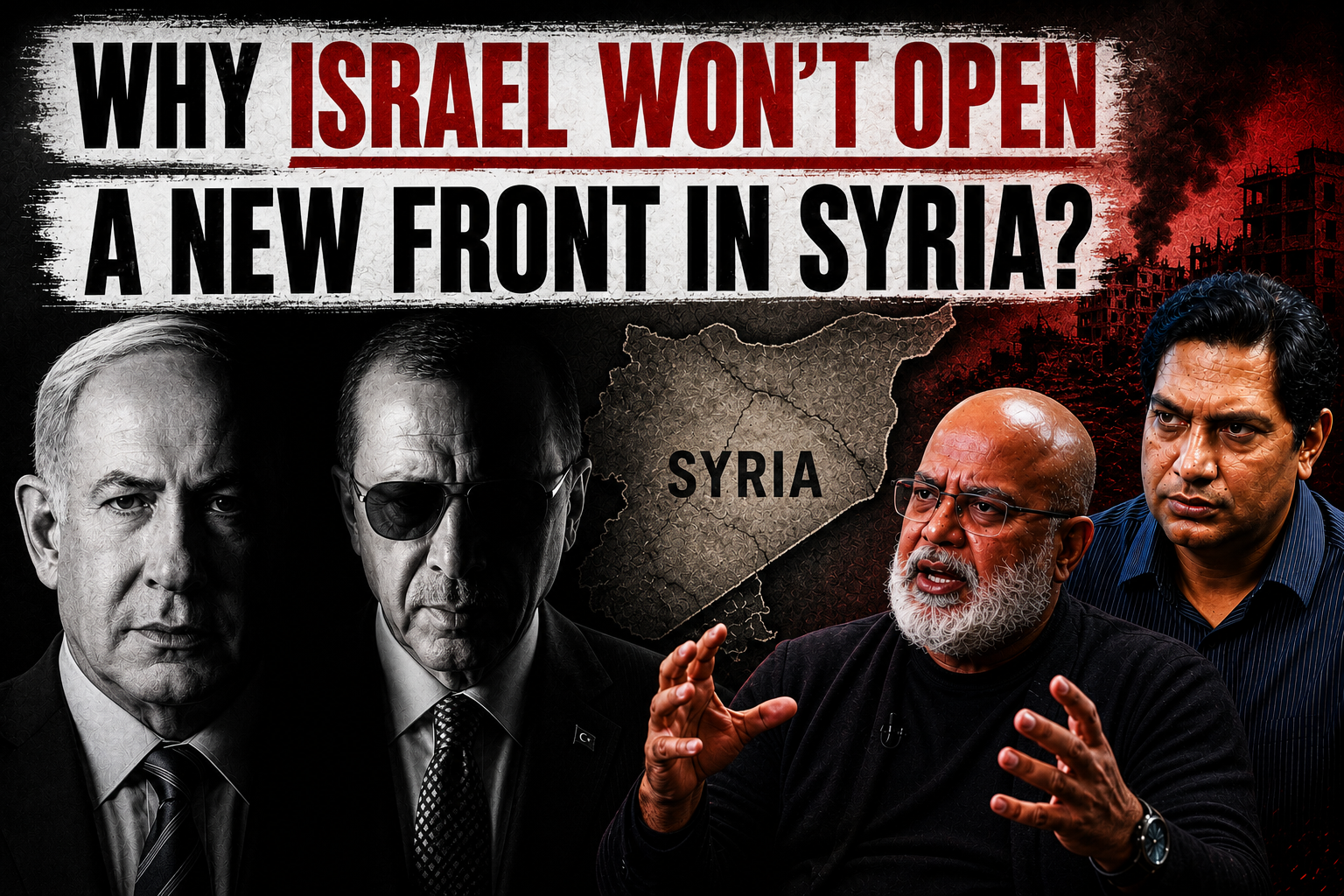
Growing tensions between Israel and Turkey over their competing interests in Syria have raised concerns about the possibility of a new regional confrontation, but a geopolitical analyst says a direct war between the two countries remains unlikely.
In an exclusive discussion with JP Global Affairs anchor Ayaz Khan Lohani , senior journalist and analyst Rifa Alam said the situation in Syria is still fluid, with regional alignments continuing to change following the fall of Bashar al-Assad’s government and the emergence of Ahmed al-Sharaa as Syria’s new leader.
The discussion comes after an Israeli strike on a Syrian airbase triggered a strong reaction from Turkey. The incident also prompted debate in Israeli media over whether tensions with Ankara could develop into a new military front inside Syria.
Asked whether Israel and Turkey could eventually go to war in Syria, Rifat rejected the possibility of an imminent direct conflict.
According to the analyst, Syria itself is seeking to move away from years of war and instability and is unlikely to support the opening of another military front on its territory.
“Syria wants peace,” Rifat Alam said, arguing that Damascus would likely try to discourage Turkey from taking steps that could lead to another confrontation.
Israel’s strategy in Syria
The analyst also discussed Israel’s growing security concerns over developments in Syria.
Rifat Alam argued that Israel appears focused on creating what it considers a security buffer around its territory. He said Israel’s settlement expansion and support for new settlements indicate expansionist objectives, although he suggested those ambitions remain within what Israel considers a defined strategic perimeter.
The situation is complicated further by Turkey’s expanding security and military interests in Syria.
Alam described Turkish President Recep Tayyip Erdogan as a leader whose intentions can be difficult to predict because he generally keeps his emotions, fears and plans private.
Can Syria contain Hezbollah?
The conversation also examined reports that US President Donald Trump has considered using Syria as part of a broader strategy to contain Hezbollah in Lebanon.
Dalamsar questioned whether such a plan would succeed, arguing that Syria’s current leadership may have little interest in becoming part of another regional conflict.
He suggested that some of the plans being discussed in Washington may not necessarily reflect the priorities of Syria or other regional actors.
Trump and the changing regional balance
A major part of the discussion focused on the role of the United States in the rapidly changing Middle East.
Dalamsar described the current international environment as highly fluid, comparing it to jelly that has not yet fully set.
He argued that uncertainty surrounding US policy has made it difficult for regional powers to predict Washington’s next move.
According to the analyst, countries across Europe, Asia and the Arab world are increasingly reconsidering their dependence on the United States as a source of regional stability.
He said the changing alignments could become clearer following the US midterm elections and any subsequent changes in Washington’s political leadership.

