

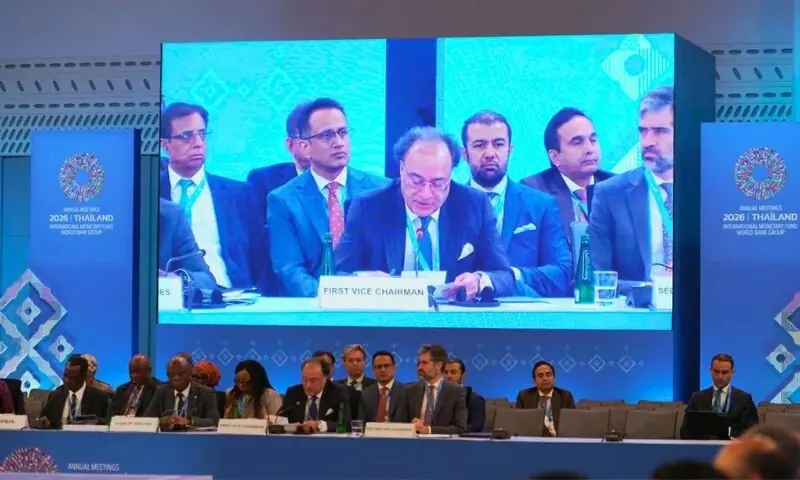
Bangkok: Pakistan has been unanimously elected chair of the Governing Council of the Borrowers’ Platform, a group of more than 30 developing countries seeking stronger cooperation on debt management and development financing.
Federal Minister for Finance and Revenue Senator Muhammad Aurangzeb accepted the position on Pakistan’s behalf during the platform’s first Governing Council meeting in Bangkok, held on the sidelines of the annual meetings of the World Bank Group and the International Monetary Fund (IMF).
Aurangzeb acknowledged Egypt’s leadership in establishing the platform and thanked member countries and its Secretariat for making the initiative operational. He said the platform should focus on mutual learning and technical cooperation rather than collective bargaining or crisis management.
Outlining Pakistan’s priorities for the 2026-27 work plan, the finance minister highlighted better debt-management practices, the exchange of economic reform experiences and innovative instruments for development financing.
“Debt should remain an instrument for development rather than a constraint on it,” he stressed.
UN Warns of Growing Debt Burden
United Nations Secretary-General António Guterres warned that poor and developing countries were facing a major economic storm as rising debt-servicing costs continued to squeeze public finances.
According to the latest United Nations Development Programme (UNDP) report cited in the discussions, developing countries spend an average of around 9.5% of their total revenue on interest payments, the highest proportion since 2001.
The growing debt burden has intensified calls for international cooperation to help developing economies maintain financial stability while investing in infrastructure, public services and climate resilience.
Pakistan Discusses Economic Reforms With IMF
On the sidelines of the Bangkok meetings, Aurangzeb met IMF First Deputy Managing Director Dan Katz to discuss Pakistan’s economic stabilisation, progress under the IMF-supported programme and structural reforms.
According to the Finance Ministry’s statement, both sides welcomed the staff-level agreement and noted improvements in fiscal performance, foreign exchange reserves, inflation and external sector stability.
Aurangzeb also highlighted improved investor confidence, sovereign credit rating upgrades and Pakistan’s renewed access to international capital markets.
The discussions also covered the impact of the conflict in the Middle East on global energy prices and inflation, which could create additional challenges for economies dependent on imported fuel.
Climate Finance and Disaster Preparedness
Aurangzeb also participated in the 17th V20 Ministerial Dialogue, where he appreciated the group’s support for developing Pakistan’s Climate Prosperity Plan.
He referred to Pakistan’s inaugural green Panda bond as part of efforts to explore innovative financing for climate-related priorities. The minister cautioned that international climate initiatives must translate into practical results, pointing to the need for effective implementation of mechanisms such as the Loss and Damage Fund.
In a separate meeting, he held discussions with United Nations Under-Secretary-General and UN Economic and Social Commission for Asia and the Pacific (ESCAP) Executive Secretary Armida Salsiah Alisjahbana.
Aurangzeb identified climate change and population growth as major challenges for Pakistan and sought technical assistance to strengthen disaster preparedness and develop bankable climate projects.
Pakistan’s election to lead the Borrowers’ Platform comes as developing economies face mounting pressure to service debt while financing economic growth, climate adaptation and essential public services. The platform’s 2026-27 agenda is expected to focus on sharing practical policy experiences and strengthening countries’ capacity to manage debt sustainably.

