

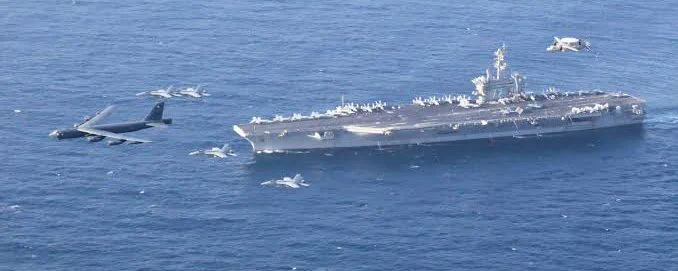
Washington: The Pentagon is preparing to deploy a third US aircraft-carrier strike group and an additional Marine expeditionary unit to the Middle East, bringing an estimated 9,000 to 10,000 additional troops to the region as President Donald Trump considers resuming military strikes against Iran after the November midterm elections.
According to The Wall Street Journal, the USS Theodore Roosevelt and its carrier strike group departed San Diego on Sunday and are expected to reach the Middle East in November. The USS Makin Island Amphibious Ready Group, carrying Marines from the 13th Marine Expeditionary Unit, also departed on Monday.
The Journal reported that the deployment includes ships, fighter aircraft, Marines and sailors and could add up to 10,000 personnel to the US military presence in the region.
It remains unclear whether the Roosevelt deployment will replace another carrier already operating in the Middle East or add to the existing US force posture.
The incoming forces could operate alongside the USS George H.W. Bush and USS George Washington carrier strike groups. If all three remain in the region, it would mark the first time since April that three US carrier strike groups have operated simultaneously in the Middle East. However, officials said the USS George Washington could eventually return to its home port in Japan.
The Journal also reported that Trump has told aides he expects the United States to resume bombing Iran in November, after the midterm elections.
The buildup comes as more than 50,000 US troops are already stationed across the Middle East.
Trump leaves door open to renewed Iran war
Trump’s comments in a TIME interview published Thursday have added to concerns about a possible new phase of US military action against Iran.
Asked why the war had continued beyond the four-to-six-week timeline he had initially discussed, Trump rejected the suggestion that the conflict had simply exceeded his expectations.
“I could have stopped then, but I wanted to go further,” Trump told TIME.
Trump also said the media had emphasized his original prediction about the duration of the conflict, while he had intended to continue military operations.
He further reiterated his threat to “annihilate” Iran, a warning he had previously made before the United Nations General Assembly.
When asked how that threat could be reconciled with his description of himself as a president of peace, Trump responded that “by annihilating Iran, we’ve created peace in the world.”
Trump also told TIME that it was “possible” he could increase bombing of Iran after the midterm elections. He disputed reports that the Pentagon was facing a shortage of munitions and said the United States had been replenishing its weapons supplies.
Ceasefire efforts remain unresolved
The military preparations come after Trump rejected Iran’s latest seven-day ceasefire proposal.
Tehran had proposed reopening the Strait of Hormuz and resuming nuclear negotiations in exchange for Washington lifting its blockade of Iranian ports.
Trump’s rejection of the proposal, combined with his comments to TIME and the reported deployment of additional US forces, has left open the possibility of renewed military action after the elections.
Hormuz remains a key flashpoint
The US Navy is maintaining roughly 20 vessels in the region, including forces involved in enforcing the port blockade and escorting commercial vessels through the Strait of Hormuz.
The waterway is a critical route for global energy shipments, making any renewed military confrontation around it a potential threat to commercial shipping and energy markets.
The arrival of another carrier strike group and thousands of additional troops would give Washington additional military capacity in the region, although the exact role of the new deployment remains unclear.
For now, the Pentagon is preparing for a larger regional presence while the Trump administration continues to weigh its next steps toward Iran. The coming weeks will determine whether the buildup supports a rotation of existing forces or becomes part of preparations for renewed US military strikes after the November midterm elections.

