

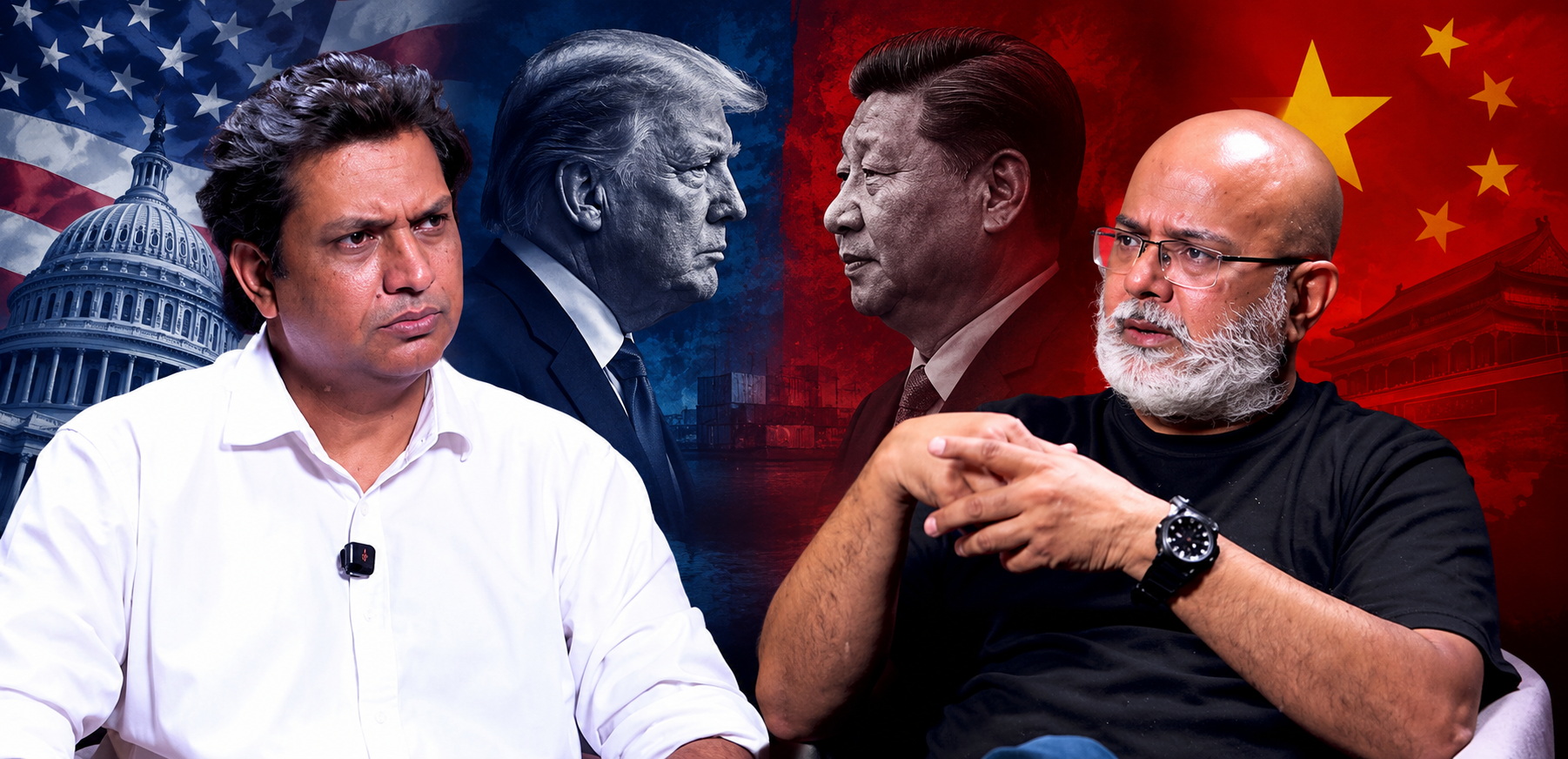
WASHINGTON: The meeting between US President Donald Trump and Chinese President Xi Jinping is drawing global attention as Washington and Beijing seek to manage one of the world’s most consequential geopolitical and economic rivalries.
The meeting was discussed in depth on JP Global, where host Ayaz Khan Lohani was joined by veteran journalist and analyst Rifat Alam, former CEO of Din News Network, former editor of Daily Times and former deputy editor of Geo Television Network, with more than four decades of media experience.
The discussion focused on how dramatically the balance between the United States and China has changed over the past decade and what the Trump-Xi meeting could realistically deliver.
According to Alam, expectations of a major breakthrough should be tempered. He argued that the most realistic immediate outcome would be stabilization of the US-China relationship rather than a comprehensive settlement of their disputes.
“China is not a country that you can just walk over,” Alam said during the JP Global discussion, emphasizing that Beijing now possesses considerably greater economic and strategic leverage than it did a decade ago.
The relationship has changed significantly since the period when Washington imposed tariffs on Chinese goods and took increasingly aggressive action against Chinese technology companies, including Huawei. In the latest phase of the rivalry, China has demonstrated its ability to respond through its control over critical supply chains, particularly rare-earth minerals that are essential to advanced manufacturing and technology.
Alam identified semiconductors and artificial intelligence as two of the most important issues likely to dominate the discussions. The technology competition has expanded beyond tariffs into advanced chips, AI capabilities, export controls and strategic supply chains.
He also suggested that neither side is likely to make major concessions on core strategic questions. Beijing, he argued, is unlikely to fundamentally alter its position on Taiwan, while Washington is unlikely to abandon its broader approach to the Taiwan issue.
Iran could provide another major point of disagreement. The discussion noted that China maintains economic and diplomatic relations with Iran, making any US demand for Beijing to reduce cooperation with Tehran particularly difficult.
The two sides could also discuss the detention of individuals and broader human-rights concerns, although Alam suggested that limited concessions in such areas would have greater symbolic than strategic significance.
Taiwan, Iran and Ukraine
The discussion also examined whether the Ukraine war could feature in the Trump-Xi talks.
Alam said China could raise the issue in the context of international stability and efforts to end ongoing conflicts. Beijing’s position on Ukraine could therefore become relevant to broader US attempts to reshape global diplomacy.
He linked the significance of the Trump-Xi meeting to wider international diplomacy, including the UN General Assembly, arguing that major decisions on conflicts and global security would be difficult to assess without understanding the direction of US-China relations.
For China, he identified Taiwan, artificial intelligence and semiconductors, and the US-Iran confrontation as among the most significant issues.
The discussion ultimately highlighted a fundamental shift in the US-China relationship: Washington is no longer dealing with the same China it confronted a decade ago.
Rather than producing an immediate grand bargain, the meeting could instead determine whether the two powers can establish mechanisms to manage their rivalry and prevent further escalation.
As the global economy remains deeply dependent on both countries, the outcome of the Trump-Xi engagement could have implications far beyond Washington and Beijing, affecting technology, trade, energy, supply chains and conflicts across the wider international system.

