

Ayaz Khan Lohani
Lahore Mirror: In the early 1990s, Pakistan was moving through a profound cultural and political transition. Against this backdrop, the musical revolution that had begun in the late 1980s was reaching a defining moment.
At the forefront was Vital Signs, a group of young musicians who had evolved from a college-band project into national icons. Following the extraordinary success of their self-titled debut in 1989 and the darker, more experimental Vital Signs 2 in 1991, the band stood at an important creative crossroads.
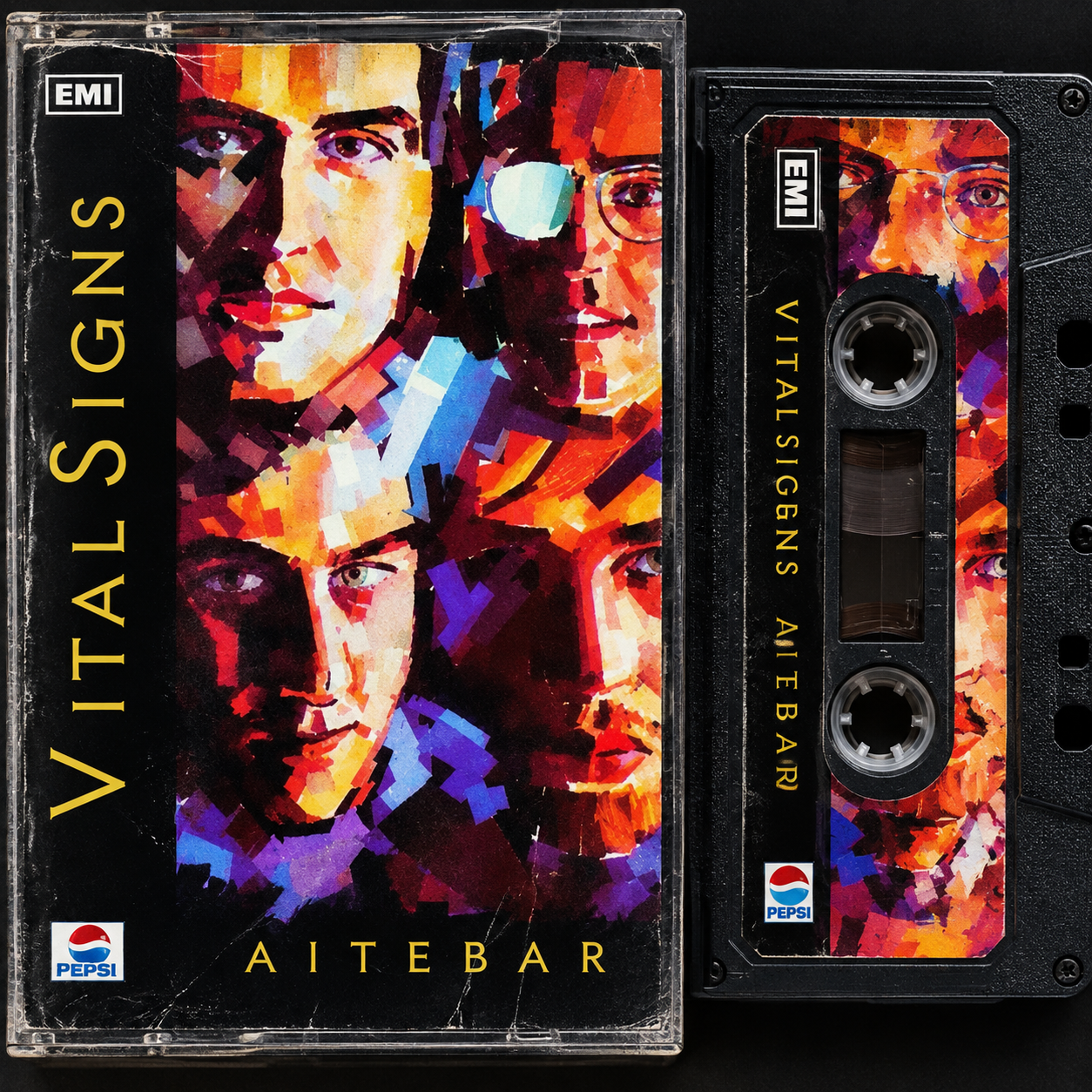
The response came with Aitebar, released in the early 1990s.
More than simply another pop album, Aitebar represented a significant moment in the development of Pakistani popular music. It brought together the creative strengths of the band’s celebrated vocalist Junaid Jamshed, lyricist and director Shoaib Mansoor, and producer and keyboardist Rohail Hyatt.
The result was an album that managed something remarkably difficult: it was commercially accessible without becoming musically shallow, emotionally powerful without becoming overly sentimental, and distinctly Pakistani while still sounding modern.
That balance helped make Aitebar one of the defining records of Pakistan’s golden era of pop.
The Backdrop: From Darkness to Hope
To appreciate the significance of Aitebar, it is important to understand the atmosphere surrounding Vital Signs at the time.
Vital Signs 2 had moved away from the straightforward optimism of the band’s debut. Its sound was darker and more introspective, reflecting themes of loneliness, uncertainty and urban alienation. The period was also marked by changes within the band, including the departure of guitarist Salman Ahmad, who would go on to form Junoon.
The change in direction demonstrated that Vital Signs were not interested in simply repeating the formula that had made Dil Dil Pakistan a national anthem.
But there was a challenge. A large part of the band’s audience still wanted melody, warmth and emotional reassurance.
Aitebar provided that reassurance without taking the band backward.
With Rizwan-ul-Haq contributing guitar and Shahzad Hasan (Shahi) continuing on bass, Vital Signs had a lineup capable of combining polished musicianship with accessible songwriting. Rohail Hyatt’s production gave the songs an expansive but intimate quality, allowing keyboards, guitars, bass and vocals to work together without overwhelming one another.
The album sounded contemporary, but it also felt unmistakably Pakistani.
The Shoaib Mansoor–Junaid Jamshed Connection
At the heart of Vital Signs’ appeal was the creative relationship between Shoaib Mansoor and Junaid Jamshed.
Mansoor brought the words, ideas and visual imagination. Junaid brought the voice that could turn those words into something deeply personal.
Junaid’s greatest strength was not vocal showmanship in the conventional sense. His voice had a remarkable sincerity. He could sound vulnerable without sounding weak and hopeful without sounding artificial.
That quality became particularly important on the album’s title track, Aitebar.
Interestingly, the song’s final message of hope was not necessarily where the creative process began.
When Shoaib Mansoor initially brought the lyrics to the studio, they carried a much heavier emotional weight. The original version was rooted in betrayal, disappointment and missed connections:
“Aitebar bhi aa hi jata, tum mile hi nahi
Raasta koi mil hi jata, tum chale hi nahi.”
The sentiment was essentially one of regret: trust might have developed, and a path might have been found, but the other person never arrived and never took the journey.
As Junaid Jamshed and Rohail Hyatt heard the draft and worked on the music, however, they felt something was missing. The melody Rohail was developing seemed to demand a message that went beyond defeat. They saw the possibility of a song that could heal, comfort and encourage rather than simply mourn what had been lost.
Their musical intuition challenged the emotional direction of the original lyrics.
Mansoor returned to the drawing board and transformed the song’s emotional architecture. Instead of describing what had failed to happen, he turned the lyrics toward possibility and action:
“Aitebar bhi aa hi jaega, milo to sahi
Raasta koi mil hi jaega, chalo to sahi.”
The shift was deceptively simple but artistically profound.
The original version essentially said: It could have happened, but you never came.
The final version said: It can still happen. Come. Walk.
That single transformation changed Aitebar from a conventional romantic lament into something much larger—a philosophy of patience, resilience, faith and hope.
The song’s central idea became beautifully simple: sometimes the answer is not to give up, but to take the first step.
Trust will come—just meet.
A road will appear—just walk.
That is where Junaid’s restrained delivery became so important. He did not oversing the words. His gentle, reassuring voice allowed the melody and lyrics to breathe, giving the song an almost conversational intimacy.
Rohail Hyatt’s arrangement reinforced that feeling. Rather than turning the song into a grand, overproduced anthem, the production allowed its emotional core to remain exposed.
The result was something rare: a pop song that sounded deeply personal while simultaneously speaking to an entire generation.
A Sonic Tapestry
One of Aitebar‘s greatest strengths is its variety.
The album demonstrated that Pakistani pop could draw from different musical traditions without losing its identity. Its songs moved between upbeat pop, romantic balladry, folk influences and patriotic sentiment while retaining a coherent sound.
“Woh Kaun Thee” brought energy and immediacy, capturing the youthful romanticism that had always been central to Vital Signs’ appeal.
“Dil Dhoondta Hai” revealed a more reflective side of the band. Its melodic character and Junaid’s increasingly mature vocal performance showed how comfortably Vital Signs could move into more emotionally demanding territory.
“Challa” and “Yarian” demonstrated the band’s ability to absorb elements of Punjabi musical culture into contemporary pop. Rather than treating folk influences as something separate from modern music, Vital Signs incorporated them naturally into their sound.
Then there was “Yehi Zameen.”
Vital Signs had already given Pakistan one of its most enduring patriotic songs with Dil Dil Pakistan. But “Yehi Zameen” approached patriotism differently.
It was quieter and more reflective—a musical expression of attachment to place, memory and homeland.
That difference mattered.
It showed that patriotism in Pakistani pop did not always have to arrive with a soaring chorus and dramatic instrumentation. Sometimes it could be expressed through affection, nostalgia and a simple recognition of the land itself.
When Music Became Cinema: Geetar ’93
The story of Aitebar cannot be separated from the visual culture surrounding it.
Shoaib Mansoor understood earlier than many others that Pakistan’s emerging music-video culture could transform the way audiences experienced popular music.
His Geetar ’93 project, associated with the launch and presentation of Vital Signs’ music, went beyond the conventional studio performance format. The band was presented against Pakistan’s landscapes, giving the music a cinematic visual dimension.
The approach was significant.
Instead of presenting Vital Signs simply as musicians performing in front of a camera, Mansoor placed them within the physical landscape of Pakistan.
Mountains, roads, cities and open spaces became part of the visual language.
The effect was to connect modern Pakistani pop with the country itself.
This was particularly powerful at a time when music television and professionally produced music videos were rapidly changing popular culture. The combination of music, television, advertising and cinematic storytelling helped turn an album release into a broader cultural event.
Geetar ’93 also demonstrated something that would become increasingly important in Pakistani popular culture: the idea that music could be used to tell a story about Pakistan beyond politics and headlines.
Why Aitebar Still Matters
The real test of an album is not its sales at the time of release. It is whether people continue to return to it years later.
Aitebar has passed that test.
Its importance lies not simply in nostalgia for the 1990s. The album represents a moment when Pakistani pop music discovered that commercial success and artistic ambition did not have to be opposing forces.
Vital Signs could write melodies that millions could remember while still leaving room for subtlety.
Shoaib Mansoor could write lyrics that sounded simple while carrying deeper emotional meanings.
Rohail Hyatt could produce music that sounded polished without stripping it of warmth.
And Junaid Jamshed could deliver those songs with a sincerity that made them feel personal to millions of listeners.
That combination was rare.
Perhaps that is why the title track has endured so strongly.
Aitebar does not promise that life will be easy. It does not pretend that every broken relationship can be repaired or every difficult road will suddenly become clear.
Its message is more modest—and perhaps more powerful.
Trust may come. A road may appear. But first, you have to take the step.
That is why Aitebar remains more than an album from Pakistan’s golden era of pop.
It is a document of a particular cultural moment, a showcase of an extraordinary creative partnership, and a reminder of what Pakistani popular music could achieve when melody, poetry, musicianship and visual storytelling came together.
Decades later, the reassurance in its title track still feels remarkably fresh.
Sometimes the most enduring songs are not the ones that tell us everything will be fine.
They are the ones that simply tell us:
Come. Walk. The road will appear.

