

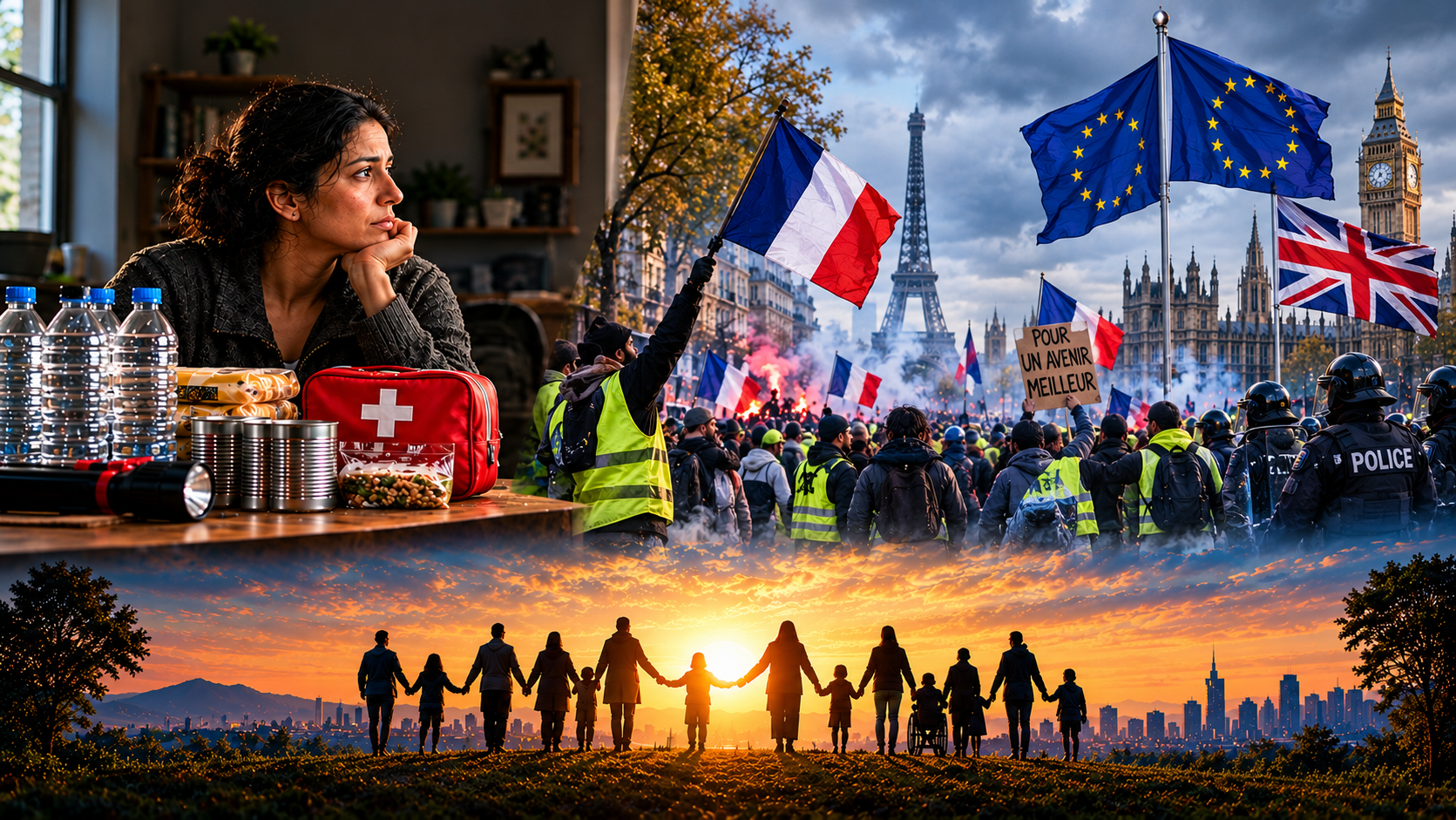
Three days may be enough to prepare for an interruption.
What happens after that tells us whether the system around us works.
Across Europe, governments are asking citizens to think more seriously about temporary disruptions to the systems that make daily life possible. Britain is the latest to do so through its “Be Ready” campaign, which advises households to keep several days of water, food, medication, cash, batteries and other basic supplies on hand. Similar guidance already exists elsewhere in Europe.
The advice is sensible. A household that can manage for a short period without immediate assistance gives emergency services time to focus on people in greater danger.
The more consequential question begins when those supplies run out.
Call it the fourth day.
Not literally the fourth morning. One household may be able to manage for a week. Another may exhaust its reserves within hours. The fourth day is the point at which private preparation reaches its limit and the strength of the society surrounding the individual becomes visible.
An emergency kit is not a miniature infrastructure system. It buys time.
Once stored water runs low, food spoils or medication needs replenishing, the problem changes. It becomes less about what someone remembered to buy and more about whether water can be distributed, pharmacies remain supplied, hospitals stay accessible, electricity can be restored and reliable information reaches the people who need it.
Preparedness allows a household to absorb disruption for a while. Resilience determines what happens when that temporary buffer disappears.
That distinction matters because modern health depends on far more than healthcare itself.
Safe water is health. Electricity becomes health when medication requires refrigeration or medical equipment requires power. Transportation becomes health when someone needs dialysis, emergency care or a prescription. Communication becomes health when people need accurate information about contamination, evacuation, extreme heat or disease.
A prolonged failure rarely remains inside the system where it began. A power outage can become a food problem when refrigeration fails and a medical problem when powered equipment stops working. Flooded roads can make a functioning hospital effectively unreachable. A communications outage can isolate people from services that remain technically available.
Modern life works because these systems are connected.
Disruption travels through those same connections.
That is why several days of household preparation can be extremely useful without telling us very much about how resilient a society actually is.
It also reveals how uneven preparedness can be.
Preparation requires margin.
Extra food costs money before it is needed. Water requires space. Spare medication depends on access. Backup electricity costs considerably more. Cash held for an emergency cannot simultaneously pay this week’s rent or grocery bill.
One household may have a full pantry, savings, a generator and two vehicles. Another may have enough food to reach payday.
The same outage arrives at both homes. It does not create the same emergency.
This is where resilience begins to look less like a personal virtue and more like a question of capacity.
People should know what to do when essential services fail. Households able to maintain basic emergency supplies should do so. Neighbors knowing one another can make a meaningful difference. None of these things can substitute for functioning institutions.
Bottled water cannot repair a damaged water network. A charged power bank cannot replace an electrical grid. Several days of medication cannot restore a disrupted pharmaceutical supply chain.
Household preparation should create breathing room while larger systems respond. It should not become a quiet transfer of responsibility from institutions to individuals.
Real resilience is layered.
Households manage what they reasonably can. Neighbors notice who needs help. Community organizations connect people with resources. Utilities restore essential services. Healthcare systems maintain continuity. Governments move resources at a scale no household can reproduce.
The strength lies in the connection between those layers.
That matters more as emergencies become increasingly difficult to isolate. Severe weather can disable electricity. Electricity failure can interrupt communications. Communications failure can separate people from emergency services. Cyber disruption can interrupt daily life without damaging a single physical building.
The event may begin in one place and become dangerous somewhere entirely different.
A serious preparedness conversation therefore must extend beyond what belongs in the cupboard.
Can safe water still reach people if electricity is interrupted? Can essential medication move when transportation fails? Who remains invisible when the phones stop working?
These are questions about continuity.
The most difficult part of a crisis often begins after the dramatic moment has passed. A storm makes landfall. A river rises. A network goes dark. Then comes the longer test: can ordinary life continue while essential systems are being restored?
That is also where trust enters.
People are more likely to prepare when they believe they are participating in a shared system rather than receiving an early warning that they will eventually be left on their own.
The message matters.
Here is what you can do while the larger response mobilizes around you is very different from prepare because no one may come.
One creates partnership.
The other creates retreat.
Too little household capacity can place unnecessary pressure on emergency services. Too much reliance on households can leave vulnerable people carrying risks they have neither the money nor the ability to manage.
A mature system understands both limits.
Europe’s growing emphasis on household preparedness reflects a wider recognition that citizens, communities and institutions all have a role in continuity planning. There is value in that shift. Societies should be able to discuss vulnerability without panic, and people should know what they can reasonably do for themselves and those around them.
The real test begins when private reserves end.
That is where inequality becomes impossible to ignore.
A family with savings, secure housing, backup power and social support can absorb disruption longer than one without any of those things. What looks like readiness from a distance is often accumulated advantage up close.
That does not make preparation meaningless. It makes the surrounding system more important.
The goal cannot be universal self-sufficiency. Modern civilization exists precisely because individuals do not have to generate their own electricity, purify their own water, manufacture their own medicine or survive disaster alone.
The goal is shared capacity.
Households able to manage temporary disruption. Communities able to recognize who needs help. Institutions strong enough to maintain essential services and protect people whose personal reserves have run out first.
A resilient society is not one in which every citizen can survive alone for seventy-two hours.
It is one in which people do not have to survive alone when those seventy-two hours are over.
Three days tell us what a household can hold in reserve.
The fourth day tells us what we have built together.
Julia El-Haj is a global health strategist and founder of Hermetica Health. Her writing explores the intersection of human systems, public health, conflict, and cooperation, examining how narratives, institutions, and power structures shape human wellbeing and global resilience.

