

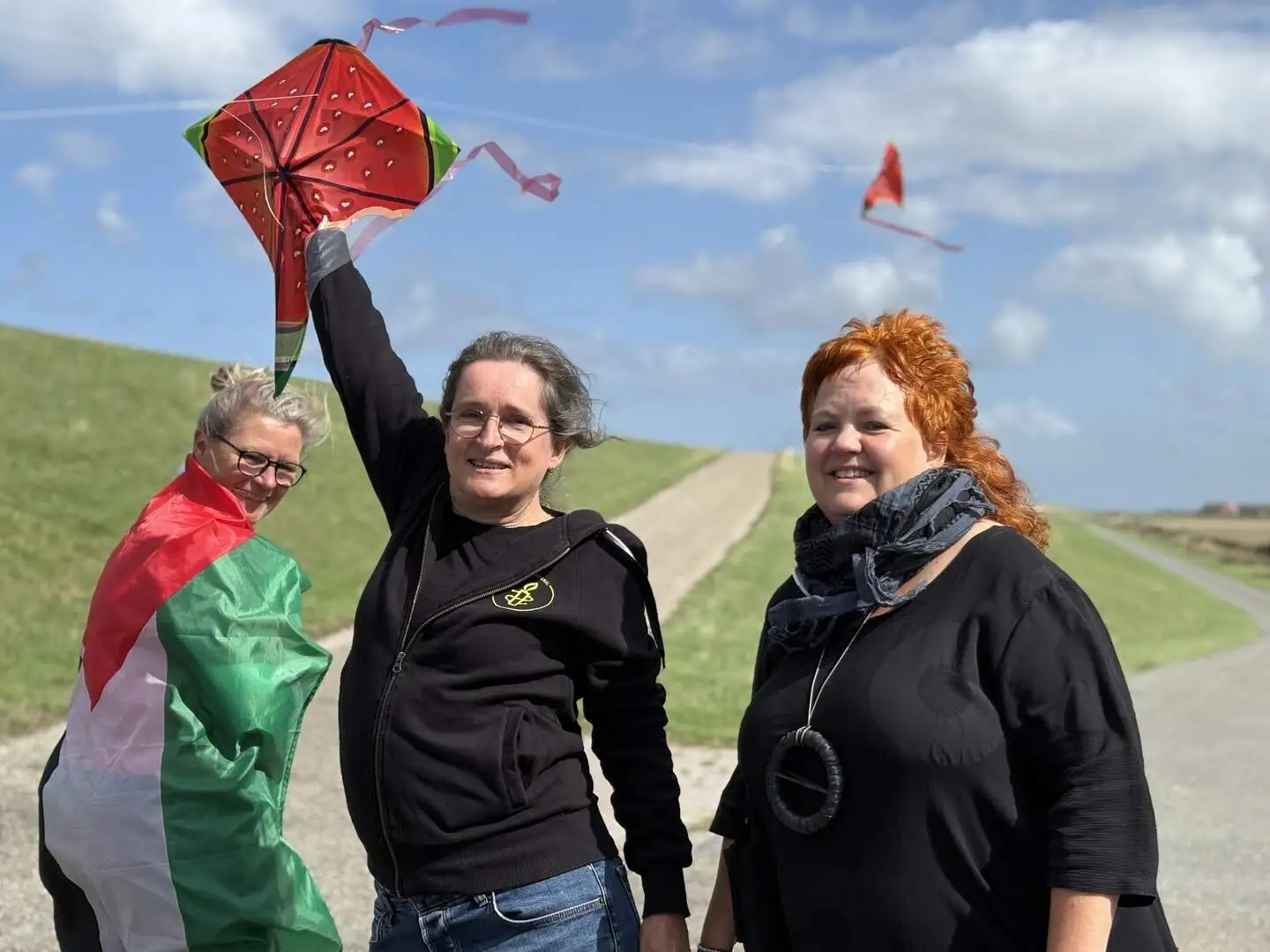
A child’s kite is a symbol of innocence. But across the Netherlands, it has become a symbol of protest, solidarity and a reminder of the human cost of the war in Gaza.
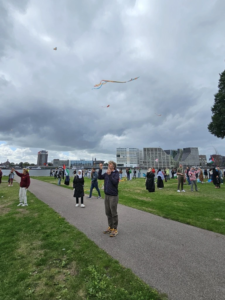
On Saturday, kites rose over at least 13 locations across the Netherlands as people gathered to express solidarity with Palestinian children. In other communities, residents hung kites from their homes, turning streets and rooftops into quiet displays of support for Gaza.
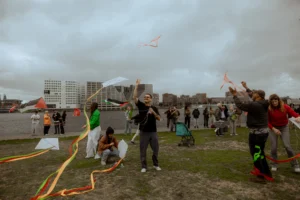
What began as a simple gesture involving one of childhood’s most familiar toys evolved into a nationwide message: children should be allowed to play without fear, and childhood should not become another casualty of war.
The demonstrations were sparked in part by recent Israeli warnings concerning kites flown from the Gaza Strip. Israeli authorities have reportedly raised security concerns over kites launched from Gaza and indicated that they could be treated as potential threats.
For those taking part in the Dutch campaign, however, the meaning of the kite could not be more different.
It represents childhood.
It represents freedom.
And above all, it represents children who should be thinking about games, school and the future — rather than war.
Ellen de Bruin: Giving a Child’s Kite a Global Voice
Among the voices behind the campaign is Ellen de Bruin, a social worker and lecturer associated with Dolle Mina’s Friesland. Through her activism, De Bruin has helped draw public attention to the plight of children in Gaza and the symbolism surrounding their kites.
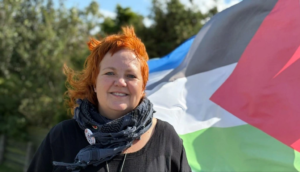
Her message is striking because it transforms something ordinary into a powerful humanitarian statement.
De Bruin has pointed to reports that the Israeli army determined that recently discovered kites contained no explosives or flammable substances and had been flown by children.
For her, the issue is therefore not simply about kites. It is about what happens to childhood when even an ordinary children’s pastime becomes entangled in a conflict.
“Children made kites themselves, but they are no longer allowed to fly,” De Bruin said. “Perhaps that is why it resonates so deeply with people, because you see directly what kind of effect this has on children.”
Her work demonstrates how humanitarian activism does not always require large demonstrations, political power or institutional influence.
Sometimes, it requires simply giving people a symbol they can understand.
A kite can do that.
From the Frisian Coast to Rotterdam
In Friesland, a group of residents gathered along the sea dike near Zwarte Haan to fly kites in solidarity with Palestinian children.
The gathering formed part of a wider nationwide campaign, with demonstrations reported in numerous Dutch cities.
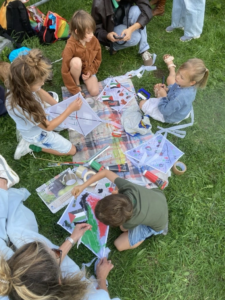
In Rotterdam, participants gathered at Noordereiland Square with kites decorated in Palestinian colours and flags. Children and adults attached messages including “Free Palestine” and “Save Gaza” to the kites, while others flew designs inspired by the Palestinian flag.
The images created a striking contrast: colourful kites drifting across the Dutch sky while carrying messages about children living through one of the world’s most devastating conflicts.
The Plant an Olive Tree Foundation organized events in several cities, seeking to raise awareness about the situation in Gaza and express solidarity with Palestinian children.
Leaflets were also distributed to inform members of the public about the humanitarian situation and the impact of the conflict on civilians.
When a Small Gesture Becomes a Powerful Statement
The strength of the campaign lies in its simplicity.
There were no weapons. No military formations. No complicated political speeches.
There were kites.
Yet that simplicity is precisely what makes the message difficult to ignore.
A kite is one of the most recognizable symbols of childhood. It requires little more than paper, sticks, string and imagination. For a child, it is a game. For a community living through conflict, it can become a symbol of freedom.
The Dutch campaign shows how a small act of solidarity can travel far beyond the people who organize it.
A photograph of dozens of kites filling the sky can make a distant conflict suddenly feel personal. It can transform statistics into something people can see and understand.
And that is where the work of activists such as Ellen de Bruin becomes significant.
By helping place Gaza’s children at the centre of the conversation, De Bruin is drawing attention away from the language of military operations and political calculations and toward the lives of children caught in the middle.
A Sky Full of Questions
The kites flying over the Netherlands cannot change the course of a war by themselves.
But they can make people ask questions.
What does childhood look like in Gaza today?
What happens when children cannot play freely?
And what does it say about a world in which a child’s kite can become a matter of security?
Those questions may be more powerful than they first appear.
Because the purpose of a solidarity campaign is not necessarily to solve a conflict in a single day. Sometimes its purpose is simply to ensure that suffering is not forgotten.
On Saturday, the Dutch sky became a canvas.
Hundreds of kites carried a message from people who wanted the world to look beyond headlines, borders and political arguments and remember the children at the heart of the crisis.
A kite may be small. The hand that launches it may belong to a child. But when thousands of eyes look toward the same sky, even a small gesture can become impossible to ignore.

