

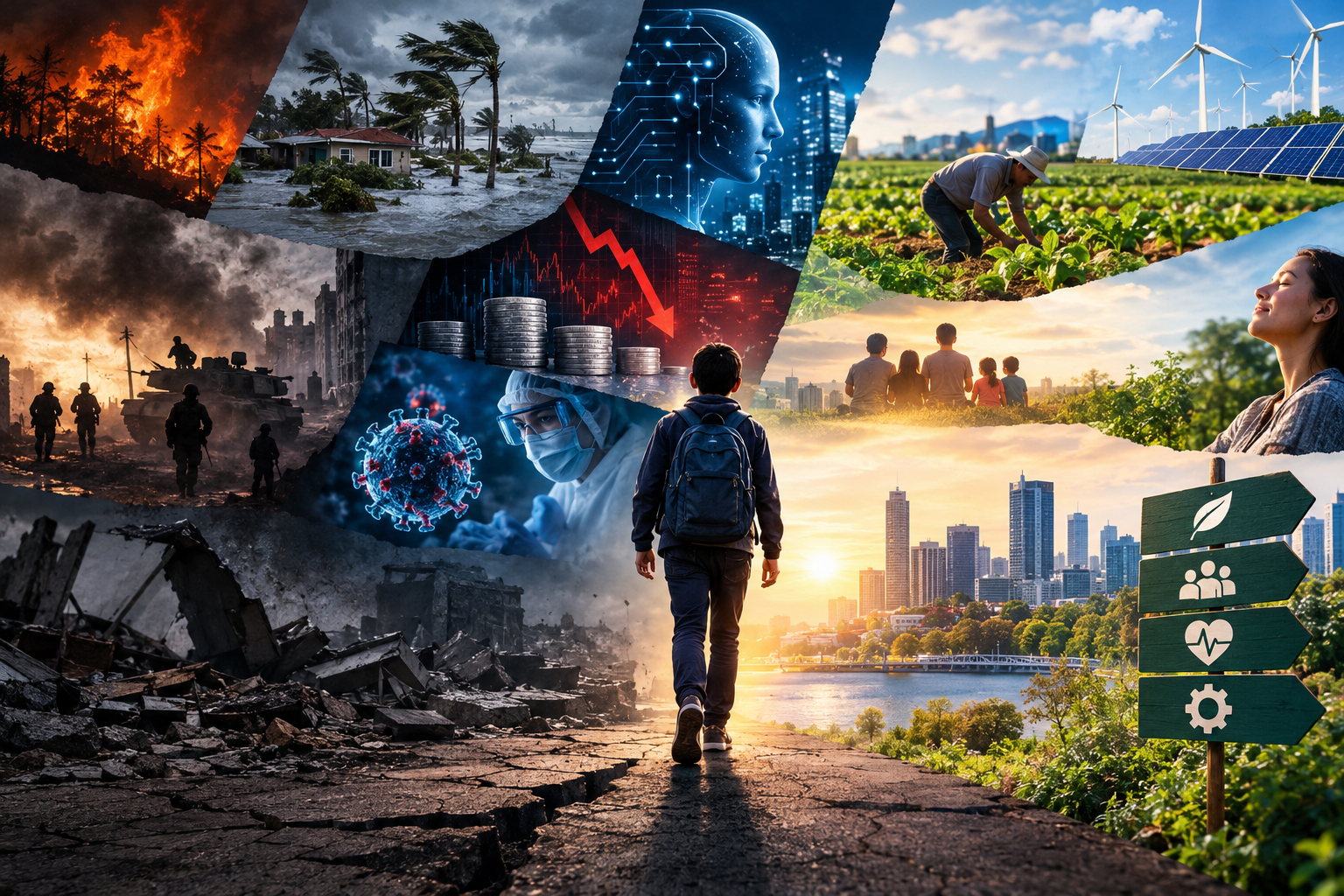
A crisis is survivable. A crisis that never quite gets to end is something else.
Human beings are remarkably capable of responding to acute stress. Attention narrows, energy shifts and the body prepares to endure. When danger passes, another process is supposed to begin: recovery.
Recovery is not an optional pause after the real work is finished. It is part of the response itself.
Our societies may be forgetting that.
Over the past several years, one disruption has repeatedly arrived before the previous one has fully settled. A pandemic moved into inflation and housing pressure. Wars disrupted energy, food and trade. Extreme weather struck communities rebuilding from earlier events. Technology accelerated. Artificial intelligence began reshaping work almost overnight. The information environment made distant crises part of daily life everywhere.
None of these pressures is entirely new. Their accumulation is.
We have become accustomed to measuring whether societies can withstand disruption. We pay far less attention to whether they have enough time to recover from it.
People are functioning. Offices are open. Airports are crowded. Children are in school. Markets operate. Restaurants fill. From the outside, the machinery of ordinary life appears to have resumed.
Functioning and recovering are not the same thing.
A system can remain operational while quietly consuming the reserves that make it resilient.
There is a useful way to understand this: recovery debt.
Financial debt allows us to use tomorrow’s resources today. Recovery debt works similarly. We push through exhaustion, postpone maintenance, spend savings, ask more of workers, delay repairs or tolerate levels of stress that are manageable in the short term. Each decision may make sense under pressure. Trouble begins when temporary adaptation becomes the permanent baseline.
A hospital can manage one surge by stretching staff. The next emergency becomes harder when staffing, morale and capacity have not recovered. A household can absorb one sharp increase in living costs by drawing down savings. Another shock lands differently when that cushion is gone. A city can rebuild after one flood. Repeated damage eventually consumes money intended for schools, infrastructure and future development.
The next crisis rarely begins from zero. It begins on top of whatever the last one left unfinished.
That changes the meaning of resilience.
We often describe resilience as toughness: enduring pressure, continuing to function, bouncing back. Endurance is only half of the equation. A resilient system must restore enough capacity after disruption so that each new demand does not begin from a progressively weaker position.
Recovery is difficult to measure because many of the things that matter most are not captured by conventional indicators.
We know when schools will reopen. We know when employment returns. We know when roads are repaired and businesses resume trading. Those measures tell us that activity has started again.
They do not tell us whether teachers are exhausted, families have rebuilt savings, children have regained routine, healthcare workers have recovered, communities have restored trust or local governments have enough capacity left for the next emergency.
We measure what is visible.
Human reserves are harder to see.
This matters enormously in global health. Health is not produced only inside hospitals and clinics. Housing, food security, sleep, employment, education, social connection, environmental stability and a sense of control over one’s life all shape wellbeing.
A population can therefore appear recovered economically while carrying substantial health and social strain underneath.
Chronic stress rarely announces itself as a national emergency. It emerges gradually through poorer sleep, burnout, weakened concentration, strained relationships, chronic illness and diminishing participation in community life. These outcomes often appear as separate problems because they fall under different institutions and different budgets.
Sometimes they are also signs of the same underlying condition: people being asked to absorb more disruption than they have had time to recover from.
Climate disruption makes the importance of recovery time especially visible.
The severity of floods, droughts, wildfires or a heat wave matters. So does the interval before the next one arrives. A farmer may survive one failed season. Repeated losses can make planting economically impossible. A family may rebuild once. Rebuilding again before debt is repaid changes the calculation. Infrastructure repaired after one disaster may remain vulnerable when another arrives too quickly.
Nature itself depends on recovery intervals. Forests regenerate. Soils restore. Ecosystems adjust. When disturbance arrives faster than regeneration, stress becomes deterioration.
Human systems do not escape this principle simply because we can force them to continue operating.
Technology adds another layer. For most of human history, crisis had some degree of geographical distance. Today, a person can encounter war, wildfire, political upheaval, economic uncertainty and technological disruption before getting out of bed.
That access to information has immense value. We can understand events beyond our borders, mobilize assistance and witness suffering that previous generations might never have known about.
Permanent awareness also changes the experience of stress.
There is a difference between being informed and being continuously activated.
When every alert competes for urgency and every crisis appears immediately on the same screen, the mind receives fewer cues that danger has passed. The result is not always panic. More often, it is a low-level state of attention, the sense that something else is always approaching.
Modern systems can operate remarkably well under those conditions. Work continues. Messages are answered. Productivity remains visible.
The cost surfaces elsewhere.
This is why recovery should never be confused with inactivity. Recovery is when reserves are replenished, experience is processed, lessons are incorporated, relationships are repaired and systems regain flexibility.
We understand this instinctively in the human body. Athletes do not become stronger through exertion alone. Adaptation happens through exertion and recovery. Sleep is not wasted time between productive days. It is one of the biological processes that makes productive days possible.
Our institutions often behave as though the same principle does not apply to them.
An empty hospital bed can look inefficient until a surge arrives. Financial reserves can look excessive until revenues collapse. Spare capacity can appear wasteful until ordinary demand becomes extraordinary.
For decades, efficiency has often meant removing slack.
A more volatile world is revealing the value of having some.
If recovery capacity matters, our definition of successful recovery needs to change. Returning to previous levels of activity as quickly as possible cannot be the only objective. We also need to ask whether the reserves that make the next disruption survivable have been restored.
That means looking beyond visible reconstruction. Has a health workforce regained capacity? Have households rebuilt financial buffers? Have children regained stability after prolonged interruption? Has infrastructure been repaired for future conditions rather than simply restored to its previous state? Has a community recovered enough social trust and cohesion to respond again?
These are harder things to measure than output.
They may matter more than we think.
There is also a cultural challenge. We tend to treat continued functioning as evidence that a system is healthy.
Human beings are extraordinarily adaptive. We normalize difficult conditions because adaptation helps us survive them. That strength can conceal deterioration.
The person still showing up may be exhausted. The institution still functioning may be understaffed. The community that rebuilt may have depleted its savings. The society that appears resilient may simply be very good at borrowing against its future capacity.
Recovery debt does not disappear because we stop measuring it.
Eventually, it is collected somewhere.
The years ahead are unlikely to become simpler. Climate pressures will continue. New technologies will alter economies and work. Conflicts and financial shocks will occur. New health threats will emerge. No serious system can promise a future without disruption.
The more useful ambition is to build societies capable not only of surviving shocks, but of genuinely recovering between them.
We speak constantly about sustainability in relation to energy, agriculture and the environment. There is also such a thing as a sustainable pace of human life.
Society should not have to exhaust its people in order to prove that it is resilient.
After the next crisis, the most important measure may not be how quickly everything looks normal again.
It may be whether enough capacity has actually returned before normal is asked to carry another emergency.
Survival gets us through the crisis.
Recovery determines what remains available for everything that comes next.
Julia El-Haj is a global health strategist and founder of Hermetica Health. Her writing explores the intersection of human systems, public health, conflict, and cooperation, examining how narratives, institutions, and power structures shape human wellbeing and global resilience.

