

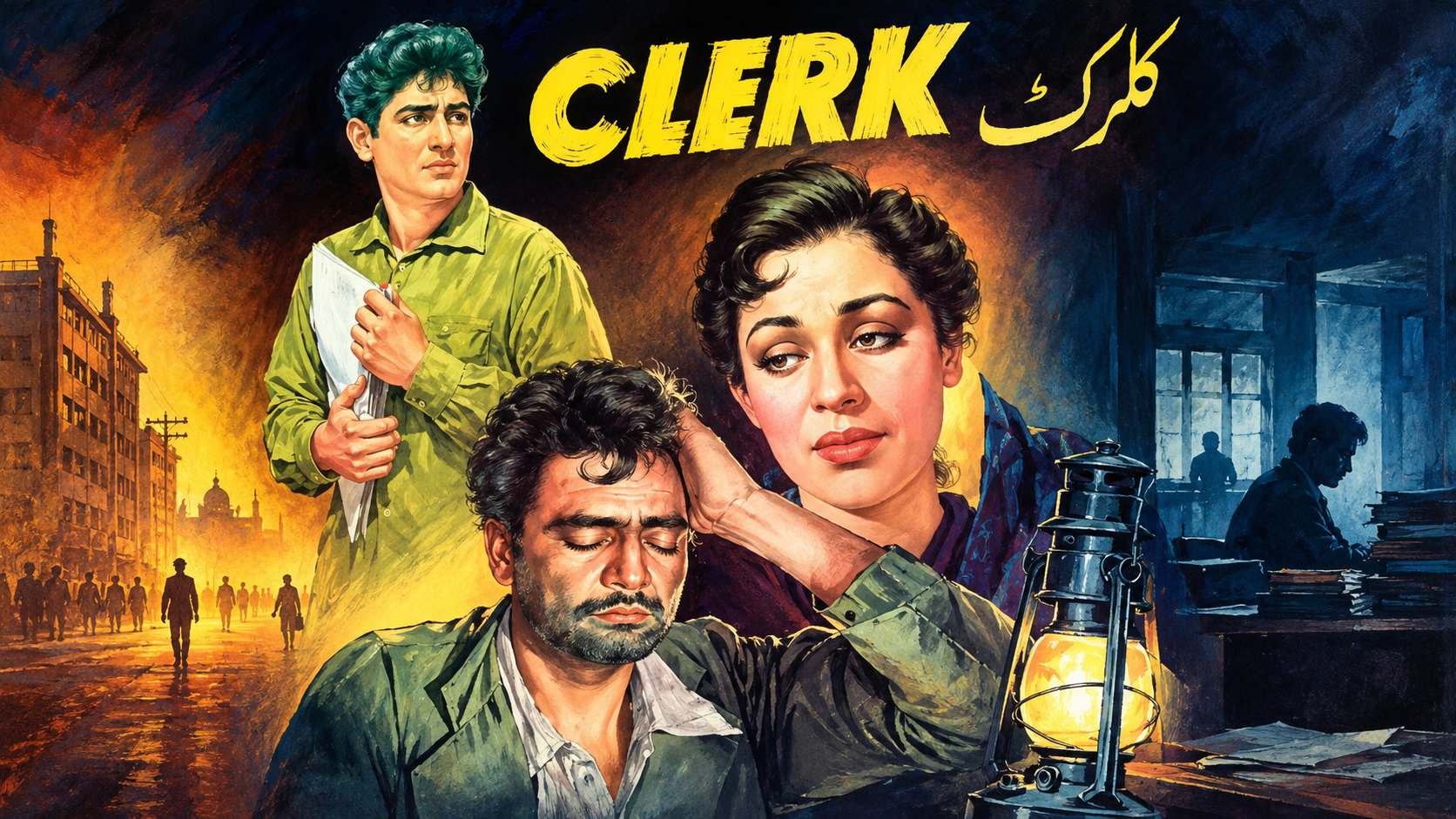
The history of Pakistani cinema is often remembered through its romantic musicals, family dramas and commercially successful stars. But beneath that popular tradition existed another, more socially conscious strand of filmmaking—one that sought to portray poverty, class inequality and the frustrations of ordinary people.
At the center of this emerging tradition was filmmaker Khalil Qaiser, whose 1960 film Clerk offered a striking departure from the escapist cinema of its time. More than six decades later, the film remains significant not only for its subject but also for what it represented: an attempt to bring the struggles of the working class to the centre of Pakistani cinema.
Qaiser’s story, however, became inseparable from tragedy. His violent death in Lahore in September 1966, at the age of just 36, abruptly ended a promising career and deprived Pakistani cinema of a filmmaker whose work was moving increasingly towards political and social themes.
A Different Kind of Pakistani Film
Released on January 22, 1960, Clerk appeared at a time when Pakistan’s young film industry was still heavily influenced by the conventions of pre-Partition Indian cinema and Hollywood. Wealthy heroes, romantic plots, elaborate sets and melodramatic conflicts dominated the screen.
Qaiser chose a different path.
Working under his independent banner, Films Hayat, he focused on the life of an ordinary office clerk, Anwar, a man struggling to survive within an unforgiving economic system. Rather than presenting poverty as a temporary obstacle that could be overcome through individual courage or good fortune, Clerk portrayed it as a condition shaped by the wider social and economic structure.
The film brought everyday anxieties to the screen: unpaid bills, household expenses, children’s education and the humiliation of living on an inadequate salary.
Its world was deliberately constricted. Offices filled with paperwork and modest homes reflected the psychological pressure experienced by its characters. The physical environment became part of the story, reinforcing the sense that the characters were trapped in circumstances beyond their control.
A Partnership with Riaz Shahid
One of the most important aspects of Clerk was the collaboration between Qaiser and writer Riaz Shahid, who contributed the screenplay and dialogues.
Shahid’s writing avoided the exaggerated speeches common in commercial cinema. Instead, the dialogue carried a quieter irony, allowing the characters’ exhaustion and frustration to emerge through ordinary conversations.
The film also benefited from the performance of Musarrat Nazir, who portrayed a working-class woman with dignity rather than reducing her character to a conventional figure of helplessness.
Although Clerk did not achieve the commercial success that its creators had hoped for, its importance lay elsewhere. It demonstrated that Pakistani cinema could address class, poverty and social inequality without abandoning dramatic storytelling.
From Social Realism to Political Cinema
For Qaiser, Clerk was only the beginning.
He subsequently worked closely with Riaz Shahid and composer Rasheed Attre, forming one of the most significant creative partnerships in Pakistani cinema of the period.
Their films increasingly dealt with questions of colonialism, imperialism, political power and social injustice.
In Shaheed (1962), Qaiser explored themes linked to imperial politics and the Middle East. Farangi (1964), meanwhile, turned towards the history of resistance against British colonial rule.
These films demonstrated Qaiser’s growing interest in using historical stories to comment on contemporary political realities. Beneath the surface of period dramas were questions about power, exploitation and resistance—subjects that carried particular significance during the authoritarian political climate of the 1960s.
Qaiser was therefore becoming more than a commercial filmmaker. He was developing a distinct political and social voice.
A Career Cut Short
That trajectory came to an abrupt end on September 21, 1966, when Khalil Qaiser was murdered outside his residence in Lahore. He was only 36.
The circumstances surrounding his death have remained a subject of discussion and speculation. While the incident was treated at the time as a criminal matter, the sudden loss of a filmmaker increasingly associated with politically charged cinema inevitably generated questions about whether his killing had a deeper motive.
What is beyond dispute is the scale of the artistic loss.
Qaiser was working on Sadaaye Kashmir when he was killed. The project dealt with the Kashmir question and was reportedly intended to address a politically sensitive subject. After his death, the unfinished project was eventually altered and completed by others, emerging years later under the title Do Baghi (1970).
Whatever its subsequent fate, the film could no longer represent Qaiser’s original vision.
The Cinema That Might Have Been
Qaiser’s death came at a crucial point in the development of Pakistani cinema. His work suggested that popular films could simultaneously entertain audiences and confront difficult questions about class, colonialism and political power.
His absence became particularly significant as Pakistani cinema moved into later decades and commercial formulas increasingly dominated mainstream production.
His close collaborator Riaz Shahid continued to pursue politically conscious filmmaking, most notably with Zerqa (1969). But Shahid himself died in 1972, leaving the progressive tradition of Pakistani cinema without two of its most influential figures.
It is impossible to know what Qaiser might have achieved had he survived. He may have continued making historical epics, turned increasingly towards contemporary political subjects, or helped establish a stronger tradition of socially conscious filmmaking in Pakistan.
But Clerk provides an important indication of the direction he was taking.
The film looked beyond glamorous heroes and romantic fantasies to the lives of people whose struggles rarely occupied the center of the screen. Its clerk was not a larger-than-life hero. He was an ordinary man confronting extraordinary economic pressure.
That remains the enduring significance of Clerk.
Khalil Qaiser understood cinema not merely as entertainment, but as a way of examining society. His films asked uncomfortable questions about who held power, who paid the price and whose suffering remained invisible.
His career lasted only a few years. His influence, however, belongs to a much longer history—the history of Pakistani cinema’s unrealized possibilities and of filmmakers who believed that the screen could become a mirror of society’s conscience.

