

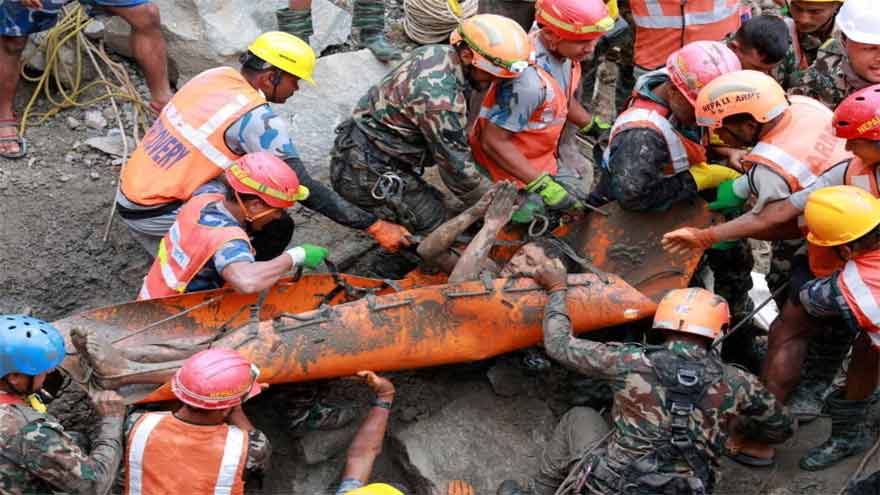
KATHMANDU: Two hydropower workers have been rescued alive after spending nine days trapped inside a tunnel beneath the devastation caused by Nepal’s worst flooding in decades, in a survival story that has raised hopes for others still missing.
Kabir Maharjan and mechanical foreman Sanjay Sah were pulled from a tunnel linked to the Upper Trishuli 3A hydropower project on September 4, nine days after a glacier collapse triggered a massive landslide and wall of water in the Trishuli valley.
Maharjan was found in a confused and weakened state after surviving in an air-filled chamber. After being taken to hospital, he initially failed to recognise his wife and asked why she had not arranged a bed for him earlier, according to his family.
The two men survived in an air pocket inside the tunnel, according to lawmaker and veteran tunnel engineer Shri Ram Neupane, who was involved in the rescue operation.
The disaster struck on August 26 after a glacier collapsed near Langtang Lirung mountain, around 25 miles upstream from the hydropower projects. The resulting landslide sent huge volumes of mud and water downstream, devastating villages and submerging a network of hydropower facilities.
Around 900 workers were believed to have been inside 12 hydropower projects when the disaster struck.
At the Upper Trishuli 3A project, Maharjan had called his wife, Hira Shova Maharjan, at around 7:30am before entering the tunnel for his shift.
“I have to go inside the tunnel,” he told her, according to his wife.
About an hour later, officials monitoring power stations in Kathmandu began watching one facility after another disappear from their control screens as the flood swept through the valley.
Officials eventually ordered the evacuation of workers at 3A. Sah, who was working in the powerhouse control room, moved through the facility warning colleagues to leave.
Many workers outside the tunnels attempted to escape the advancing floodwaters but were overwhelmed. Officials said footage showed around 30 workers being swept away.
Rescuers later identified an escape ladder that could potentially have allowed many more workers to survive, but those inside were unaware of where it led.
The project had four access routes. Engineering drawings reviewed by Reuters showed that one route extended more than 180 metres towards the underground powerhouse, but rescuers initially believed it had been completely flooded.
Neupane instead focused on a shorter cable-duct tunnel that rose gradually and was less exposed to the floodwaters. Maharjan and Sah had taken refuge there, around 160 metres from the exit.
For the next nine days, the air pocket that protected them from the flood became their only refuge.
Sah later told rescuers that he recited Hindu prayers to maintain his courage. Maharjan survived by drinking the same muddy water surrounding him, his wife said.
For Hira Shova, hope was quickly fading. Repeated attempts to contact her husband went unanswered, while photographs showing the destruction around the project entrance appeared to leave little chance of survival.
“I told myself he couldn’t possibly be alive,” she recalled.
But the rescue of the two workers has renewed hopes that others trapped in tunnels across the devastated valley may still be alive.
According to information available to rescuers, around 121 workers were still believed to be trapped in tunnels as of Monday.
The account of the two men’s survival and their rescue was reconstructed by Reuters through interviews with relatives, engineers, government officials and rescuers involved in the operation, as well as a review of site documents, maps and internal communications.
Source: Reuters

