

Getiye Yalew
“One enemy, one ally.”
This appears to be the guiding principle behind the formation of a new coalition of seven Ethiopian armed groups. Despite their significant strategic differences and, in some cases, their history as former enemies the groups have established a common front against the regime of Prime Minister Abiy Ahmed.
The coalition brings together groups representing different ethnic and political interests. Their long-term strategic objectives may conflict with one another, yet they have found common ground in their opposition to the Abiy Ahmed crisis maker regime. Their immediate objective appears to be to remove what they describe as a Genocider regime.
The alliance is highly controversial. A significant portion of Ethiopia’s political elite supports the removal of the current regime , while members of the coalition themselves face criticism from segments of their respective constituencies.
The members of the newly formed coalition are:
-Amhara Fano National Movement (AFNM)
-Oromo Liberation Army (OLA)
-Tigray People’s Liberation Front (TPLF)
-Ogaden National Liberation Front (ONLF)
-Afar Revolutionary United Front (ARUF)
-Benishangul Peoples’ Liberation Movement (BPLM)
-Gumuz Peoples’ Democratic Movement (GPDM)
From an Ethiopian alliance to a regional power struggle
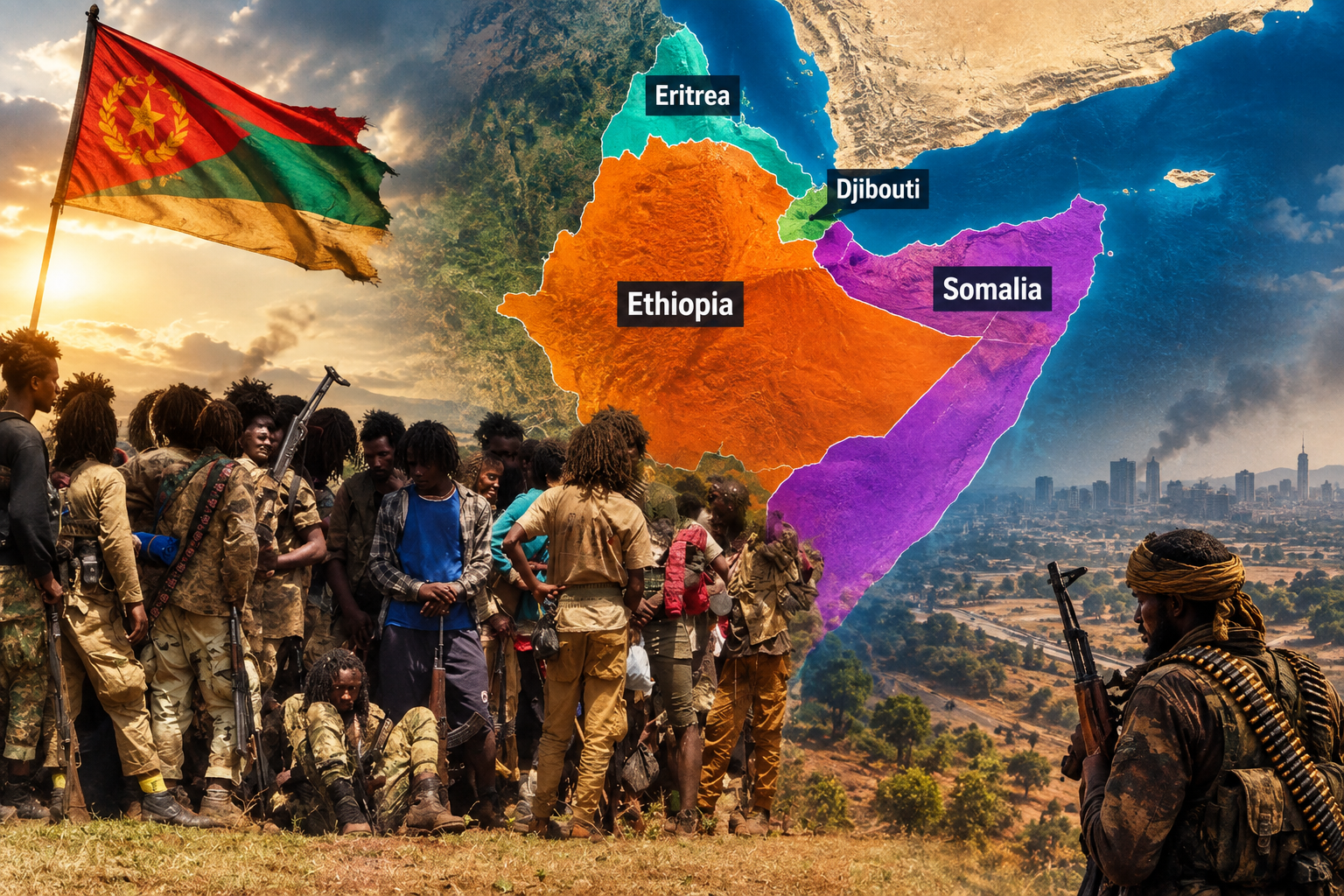
The coalition’s implications may extend beyond Ethiopia’s domestic political crisis. The group’s emergence could also affect the broader strategic competition in the Horn of Africa because of the involvement and interests of neighboring countries, particularly Eritrea and Sudan.
The Nile (known in Ethiopia as the Abay) has long been at the center of regional strategic competition. Around the Nile dispute, Ethiopia, Egypt, and Sudan have developed competing interests, although the relationships among these countries have also shifted over time.
From this perspective, it is possible to argue that the Ethiopian armed coalition could become part of a broader regional balancing strategy. Some observers may interpret Eritrean and Sudanese involvement as indirectly serving Egyptian interests. However, this requires careful examination because the interests of Eritrea, Sudan, and Egypt do not always fully converge.
Beyond the Abay, the Red Sea is another major arena of competition
Middle powers; particularly the United Arab Emirates (UAE) and Saudi Arabia are seeking to expand their influence across the Horn of Africa and the Red Sea. Both countries have increasingly engaged with non-state and sub-state actors as instruments of regional influence, although their approaches differ.
The Iranian model is relevant to this discussion. Tehran has developed relationships with non-state armed organizations such as the Houthis, Hezbollah, and Hamas. Some regional powers have sought their own networks of local partners, although the structure and objectives of these relationships differ significantly from Iran’s model.
Sudan provides one important example. The UAE has been accused of supporting the Rapid Support Forces (RSF), while Saudi Arabia has maintained closer relations with the Sudanese Armed Forces (SAF) and has participated in diplomatic efforts surrounding the Sudanese conflict. These competing relationships have contributed to a broader Saudi-UAE rivalry over influence in the region.
What does the coalition want?
The coalition itself has appealed to neighboring countries and the international community to support its political objectives.
In its statement, the coalition says:
“We call upon the neighboring countries and international community to recognize that the genocidal regime currently in power is isolated from the people, lacks both the capacity and the willingness to establish peace and stability in Ethiopia and the Horn of Africa, and is a declining regime approaching removal from power through the struggle of the people.”
The coalition therefore calls on external actors to support what it describes as the struggle for “justice and democracy.”
The coalition consists of groups with different political programs, territorial interests, ethnic constituencies, and historical grievances. Their common opposition to the Abiy regime may therefore be stronger than their agreement over what should come afterward.
That creates a central strategic uncertainty: What happens to the coalition if its common enemy disappears?
Why has the UAE condemned the coalition?
Several international and regional actors have expressed concern about the escalation of armed conflict in Ethiopia. Their interests are not identical, but regional stability is particularly important for actors concerned with Red Sea security, maritime commerce, counterterrorism, and regional trade.
The UAE has taken a particularly clear position against attempts to alter Ethiopia’s constitutional order through armed force.
UAE Minister of State Shakhboot bin Nahyan Al Nahyan said that the UAE expressed its “full solidarity” with the government and people of Ethiopia and rejected “any attempts to alter the constitutional order in Ethiopia through force or armed action,” while reaffirming support for Ethiopia’s sovereignty, unity, territorial integrity, security, and stability.
This raises an important question:
What does “full solidarity” actually mean?
Does it mean diplomatic support? Political support? Economic assistance? Intelligence cooperation? Military cooperation? Or some combination of these?
The language itself does not necessarily establish that the UAE would provide all of these forms of support. Nevertheless, the strength of the statement reflects the importance Abu Dhabi attaches to the stability and continuity of its relationship with Addis Ababa.
The UAE and Ethiopia have developed close political, economic, security, and military relationships in recent years. Consequently, instability in Ethiopia could directly affect UAE strategic interests in the Horn of Africa and the Red Sea.
Ethiopia as a strategic arena in the Sudanese war
The relationship between Ethiopia, Sudan, and the UAE becomes even more complicated when viewed through the Sudanese civil war.
The UAE has faced allegations including from Sudanese authorities and other international actors of supporting the RSF. Abu Dhabi has repeatedly denied allegations of providing military support to the RSF.
At the same time, Ethiopia has become increasingly important to the wider Sudanese conflict because of its geographical position along the Sudanese border and its proximity to the areas affected by the war.
RSF has built huge military camps, training facilities in Ethiopia close to Asosa town with the logistics support of UAE. Currently offensives to Blu Nile region of Sudan against SAF is commanded from this base.
The strategic importance of the border region is nevertheless clear. The area connecting Ethiopia, Sudan, and South Sudan sits at the intersection of several conflicts and political networks.
The Abay basin adds another layer of strategic significance.
The Sudan People’s Liberation Movement-North (SPLM-N) has also been involved in Sudan’s war, while armed actors from South Sudan remain part of the broader security environment.
The Ethiopian conflict has further complicated these dynamics. Tigrayan armed actors have historically maintained relationships and networks extending across the Ethiopia-Sudan border, while the Sudanese war has created new opportunities and risks for cross-border military activity.
If Ethiopian armed groups increasingly move between Ethiopia, Eritrea, and Sudan, the borderlands could become another arena in which local conflicts overlap with regional rivalries.
Could Saudi Arabia engage with the Ethiopian coalition?
This brings us to another important question.
Given the growing Saudi-UAE competition in the Horn of Africa and the Red Sea, could Riyadh eventually seek relationships with Ethiopian armed or political actors capable of balancing UAE influence?
This remains a hypothesis rather than an established policy. Saudi Arabia has traditionally emphasized state-to-state relationships and has generally sought to preserve the territorial integrity and stability of states in the Red Sea region. However, the increasing fragmentation of regional politics could force Riyadh to consider a broader range of political actors.
The Ethiopian coalition could theoretically become relevant to this calculation because of its geographical reach, armed capacity, and connections across several Ethiopian regions.
There is also another possibility: the coalition could develop relationships with actors involved in the Red Sea and Yemen conflict.
One TPLF-linked figure has reportedly discussed the possibility of cooperation with the Houthis. If such relationships were to develop beyond political statements, they could introduce an entirely new dimension into the Horn of Africa’s security environment. However, such a scenario should be treated as a possibility rather than an established alliance.
Riyadh and Abu Dhabi: Different strategies in the Horn
The Saudi-UAE competition becomes clearer when their regional relationships are examined comparatively.
Somalia
The UAE has developed close relationships with Somaliland and Puntland, including commercial, port, and security arrangements. Saudi Arabia, by contrast, has generally maintained closer relations with Somalia’s federal government.
Sudan
Saudi Arabia has maintained closer relations with the Sudanese Armed Forces, while the UAE has faced extensive allegations of support for the RSF, which Abu Dhabi denies.
Yemen
Saudi Arabia has supported the internationally recognized Yemeni government and the Presidential Leadership Council, while the UAE has maintained strong ties with the Southern Transitional Council and other southern Yemeni actors.
Ethiopia
The UAE has developed a close strategic partnership with the Ethiopian regime, particularly in economic, diplomatic, military and security spheres.
Saudi Arabia, meanwhile, has maintained strong relationships with Egypt and other Red Sea states and has emphasized regional stability and the protection of maritime routes.
Djibouti and the Red Sea
Djibouti occupies an especially important position because of its location near the Bab el-Mandeb Strait. The country hosts foreign military facilities and controls critical infrastructure connecting the Red Sea to the Gulf of Aden.
The UAE’s regional strategy has placed considerable emphasis on commercial ports, logistics networks, and relationships with local political and security actors.
Saudi Arabia, by contrast, has a particularly strong interest in maintaining Red Sea stability because of its economic transformation agenda.
These differences suggest two partially different regional approaches.
Abu Dhabi has frequently relied on networks involving ports, commercial infrastructure, and local or sub-state actors. Riyadh has generally placed greater emphasis on relationships with recognized governments and state institutions.
The question is whether this distinction will remain sustainable as political fragmentation increases across the Horn of Africa.
What could the coalition mean for the Horn of Africa?
If the Ethiopian armed coalition survives and develops meaningful military and political capabilities, its consequences could extend beyond Ethiopia.
There are at least five possible regional implications.
1-Ethiopia could experience a new phase of internal fragmentation.
The coalition’s members have different territorial, ethnic, and political objectives. Their cooperation against a common enemy does not necessarily mean that they share a common vision for Ethiopia’s future.
2- Neighboring states could become more deeply involved.
Eritrea, Sudan, Egypt, South Sudan, and other regional actors have direct security interests in Ethiopia. A prolonged Ethiopian conflict could therefore become increasingly internationalized.
3 -The Red Sea security environment could become more complicated.
Ethiopia’s strategic location and its interest in securing access to the Red Sea mean that internal Ethiopian conflict could affect relations among Red Sea states.
4- External powers could seek relationships with individual members of the coalition.
If the coalition becomes militarily significant, regional powers could view some of its members as potential partners, proxies, or balancing instruments.
5-The humanitarian consequences could be severe.
The most important issue, however, should remain the protection of civilians.
The civilian cost of a hybrid regional conflict
The Horn of Africa is increasingly becoming an arena of overlapping conflicts, alliances, proxy relationships, and strategic competition.
For ordinary people, however, these geopolitical calculations have a much simpler meaning: displacement, insecurity, hunger, loss of livelihoods, and death.
Northern Ethiopia has experienced years of armed conflict and political instability. Sudan has been devastated by its civil war, producing one of the world’s largest displacement crises, with millions of Sudanese forced from their homes and many fleeing to neighboring countries, including Chad and South Sudan.
Some civilians who fled conflicts in Sudan and Yemen have sought refuge in Ethiopia, only to encounter another unstable security environment. This creates a tragic cycle:
People flee one conflict, cross a border, and discover that the next conflict is waiting for them.
The Horn of Africa cannot become a permanent battlefield for the strategic interests of external powers and regional competitors. Whether the Ethiopian coalition succeeds or fails politically, its emergence demonstrates a deeper reality: the boundaries between Ethiopia’s internal conflicts and the wider geopolitical competition in the Horn of Africa are becoming increasingly difficult to separate.
The international community therefore needs to look beyond military alliances and geopolitical competition and pay greater attention to the civilians who bear the consequences.
For Ethiopia, Sudan, Yemen, and the wider Horn of Africa, lasting security will ultimately require more than military victory. It will require political settlements, accountable institutions, inclusive governance, and regional agreements capable of addressing the underlying security dilemmas that continue to drive conflict.
Getiye Yalew
getiye.yalew12@protonmail.com

