

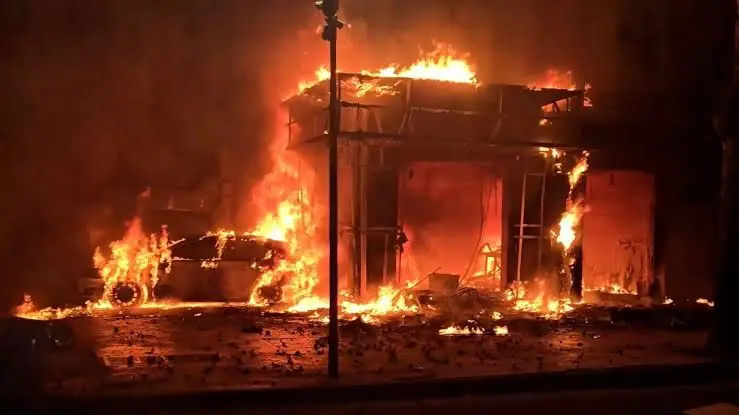
Lahore Mirror (TIRANA, Albania) — In a major escalation of political instability, violent antigovernment demonstrators set fire to offices inside the Supreme Court of Albania in Tirana. The arson attack marked the fifth consecutive day of swelling protests across the capital, as citizen anger over economic hardship and governance boiled over into widespread civil unrest.
The security crisis deepened when a large faction of demonstrators broke away from the main march. They bypassed security perimeters to target key state institutions. Demonstrators smashed ground-floor windows of the Supreme Court, hurling petrol bombs and incendiary devices inside. Plumes of thick, black smoke were seen billowing from the judicial complex.
The Supreme Court burns to the ground in Albania, Parliament and the Department of Education has been stormed, the Prime Minister is in hiding and the country is effectively in the hands of the rebels.
Albania rejects blatant corruption and their country being sold. https://t.co/EH22FBySId
— BladeoftheSun (@BladeoftheS) October 18, 2026
Firefighters faced significant delays reaching the blaze due to blocked roads and flying projectiles, but they ultimately contained the fire before it destroyed the building’s historical archives.
The Supreme Court was not the only target in the coordinated wave of unrest. Rioting crowds attacked the entrance of the Bank of Albania, targeted the Ministry of Education, and vandalized the central headquarters of the ruling Socialist Party.
The protests, which began as small, student-led rallies, have rapidly expanded into a broader citizen movement. Demonstrators are expressing deep frustration over entrenched government corruption, soaring costs of living, high youth unemployment, and systemic underfunding of the country’s educational infrastructure.
Riot police deployed in full force, utilizing tear gas, water cannons, and rubber bullets to disperse the crowds. The ensuing street battles left dozens of officers and protesters injured. Emergency medical services treated many for smoke inhalation and lacerations, while police confirmed scores of arrests across the capital.
Responding to the crisis, Prime Minister Edi Rama condemned the violence and the targeting of judicial institutions. In a public address, Rama called for immediate calm and blamed external disinformation campaigns and foreign influences for manipulating public grievances to destabilize the nation. Meanwhile, opposition leaders rejected the government’s characterization, arguing that the unrest is a direct and inevitable consequence of state neglect and economic failure.
As tension grips the capital, international observers are calling for a peaceful resolution. The European Commission issued a statement urging all sides to exercise maximum restraint, stressing that while the right to peaceful protest is a core democratic value, violence against public infrastructure remains entirely unacceptable. With additional rallies planned, security forces maintain a heavily armed presence around Tirana’s government district.

