

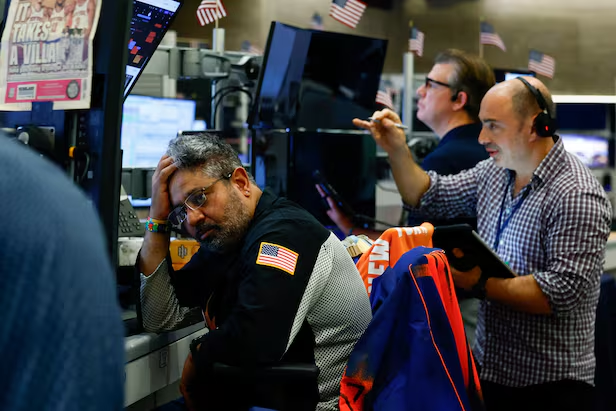
LAHORE MIROR- Global technology stocks suffered a massive sell-off on Thursday, wiping out trillions of dollars in market value as investors reacted to the Democrats’ sweeping victories in the US midterm elections and growing concerns about the future of artificial intelligence (AI).
The technology-heavy Nasdaq Composite fell more than 5.5%, while the Nasdaq 100 dropped 6.3%, erasing approximately $2.3 trillion from its market value. The S&P 500 declined 4.4%, losing another $2.8 trillion, while the Dow Jones Industrial Average plunged 1,833 points, or 3.4%.
The losses marked the worst single-day performance for major US stock indexes since April 2025, when President Donald Trump’s global tariffs triggered a major market sell-off.
Investors are increasingly concerned that Democratic victories could lead to tighter regulations on artificial intelligence and restrictions on the construction of massive data centers required to operate the technology.
Democrats have campaigned against the rapid expansion of data centers, raising concerns about their electricity consumption, environmental impact and effects on local communities. Several newly elected officials have promised to restrict or even halt new projects.
The victory of Texas Democratic governor-elect Gina Hinojosa has particularly worried investors. Texas is the largest data center market in the United States, and Hinojosa campaigned on a pledge to impose a moratorium on new data center construction.
Democrats have also secured control of both chambers of Congress, giving them greater influence over technology policy and regulatory oversight during the remainder of Trump’s presidency.
Chipmakers Lead Global Market Sell-Off
Technology and semiconductor companies suffered some of the heaviest losses.
Nvidia shares dropped more than 9%, while AMD, Micron and Western Digital each fell approximately 17%. SanDisk plunged 22%, and Seagate lost around 16%.
The Philadelphia Semiconductor Index declined 12.3%, marking its worst trading session since March 2020.
Arm Holdings shares fell 13%, while Qualcomm dropped 9.5% following earnings reports that disappointed investors.
The so-called Magnificent Seven technology companies, including Apple, Nvidia, Tesla and other major technology giants, also suffered significant losses.
Elon Musk’s companies were particularly affected. Tesla shares fell nearly 11%, while SpaceX lost around 8% in the reported sell-off. Together, the two companies shed more than $400 billion in market value following the election results.
Musk had spent hundreds of millions of dollars supporting Republican candidates during the midterm campaigns. The Democratic victories have now raised concerns about increased regulatory pressure on businesses associated with him.
Sell-Off Spreads Across Europe and Asia
The market turmoil quickly spread beyond the United States.
European technology stocks declined sharply, with German semiconductor manufacturer Infineon falling more than 8.5% and Dutch chip equipment maker ASML losing approximately 6.5%.
Asian markets faced even heavier pressure on Friday. Japan’s Nikkei 225 dropped as much as 6%, while South Korea’s Kospi fell more than 8% at one point, triggering a temporary marketwide trading halt.
Shares of South Korean chipmakers SK Hynix and Samsung Electronics also suffered significant losses.
Taiwan’s benchmark TAIEX index plunged approximately 9%, reflecting concerns about the outlook for the global semiconductor industry.
AI Investment Bubble Under Pressure
Beyond the political implications of the election, investors are increasingly questioning whether the enormous sums being invested in artificial intelligence will generate sufficient returns.
Technology companies have committed hundreds of billions of dollars to AI infrastructure, including advanced semiconductors, data centers and cloud computing facilities. However, concerns are growing that the expansion may be running ahead of actual demand and commercial profitability.
Market analyst Ed Yardeni described the situation as an AI investment bubble rapidly losing momentum rather than necessarily approaching an outright collapse.
Industry executives have also acknowledged the growing resistance to data center construction.
OpenAI president and co-founder Greg Brockman said technology companies had underestimated the strength of opposition from local communities. He argued that businesses must engage directly with residents rather than simply assume that communities will welcome new infrastructure.
Meta president Dina Powell McCormick also acknowledged that technology companies need to do more to explain the benefits of artificial intelligence.
Trump Blames Democrats for Market Collapse
President Donald Trump blamed the stock market losses on the Democrats’ election victories.
In a post on Truth Social, he described the market’s performance as one of the worst days in history and accused Democrats of being responsible for the decline.
Trump also warned that investors’ retirement savings had suffered as stock prices fell, while insisting that markets would eventually become stronger.
However, analysts say the sell-off reflects a combination of political uncertainty, concerns about AI regulation, disappointing corporate earnings and growing doubts about the profitability of massive investments in artificial intelligence.
With Democrats preparing to exercise greater control over Congress, technology companies and investors now face increased uncertainty over the future of America’s AI industry.

