

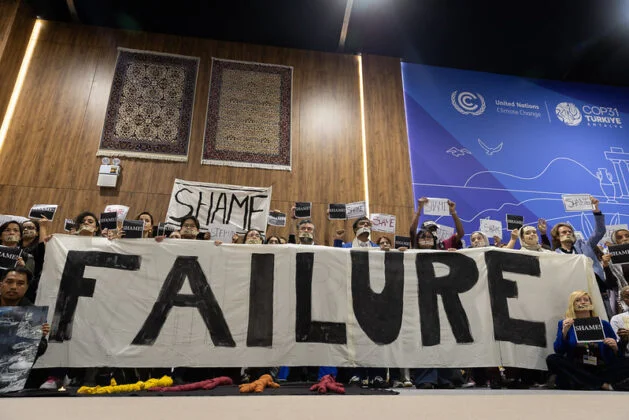

LAHORE MIRROR (Reuters) – The collapse of COP31 talks in Turkey on Sunday without a political agreement left exhausted negotiators questioning the future of a process that for three decades has led the global fight against climate change.
For the small, vulnerable countries most exposed to rising sea levels and the increasingly extreme weather scientists link to rising carbon emissions, annual UN conferences are their chance to draw the world’s attention to their plight and seek financial help.
But the failure of the Turkish talks, which follows on from weak outcomes at other COPs in recent years, lays bare the need for change.
Andres Martin Garrido Sanchez, director of environment in Peru’s Ministry of Foreign Affairs, said “the credibility of the process” was at stake.
“This system needs in-depth reforms,” he said.
Simon Stiell, the UN climate chief representing the UN convention that underpins international climate talks, said the consensus-based system can still function, but work was needed.
“I have taken steps in engaging external knowledge leaders in advising on areas of potential reform. That is something I will be championing with considerable effort as we leave here,” he said as the talks ended on Sunday.
THREE DECADES OF SEEKING A GLOBAL SOLUTION
Two stand-out victories for UN climate diplomacy were the 1997 Kyoto Protocol, when the world for the first time agreed on legally binding targets to curb climate emissions and the 2015 Paris agreement, which established an aspiration to limit global warming to no more than 1.5 degrees Celsius (2.7 degrees Fahrenheit).
A major difference in Paris compared with Antalya was that the US was still engaged in the climate process in 2015.
The Antalya talks, the first since a UN report saying the world was set to breach the 1.5 C threshold that can prevent the worst consequences of warming, marked the second climate conference since US President Donald Trump withdrew from the UN climate process.
China, the world’s biggest carbon emitter, but also a major part of the solution as a provider of low-carbon technology, has attended the talks but sought to be low profile.
James Fletcher, who led the CARICOM group of Caribbean nations in Antalya, cited the lack of a major power backing a positive outcome as a big issue.
“There isn’t that one party that has sufficient gravitas that can get parties that may be far apart to come together,” he said.
Delegates said, however, the need for a multilateral deal to direct the shift towards renewable energy has become less necessary as renewable energy becomes economically compelling.
China’s clean energy exports last year alone, for example, will help the Global South avoid 257 million metric tons of carbon dioxide emissions per year once deployed — an amount equal to the emissions of France, according to analysis by Lauri Myllyvirta, co-founder of the Helsinki-based Centre for Research on Energy and Clean Air.
The business world as a result is less dependent on COPs to guide investment decisions.
“It used to be that you’d worry about how these (COP) decisions might affect the investment signal,” said Chris Dodwell, co-head of the sustainability centre at Impax Asset Management.
“I don’t think they really have that impact anymore …. the economics have taken over and are driving the transition.”
And bad as the absence of a deal was, some saw a hint of the positive in the wider refusal to accept a weak deal.
The determination of big oil producers, led by Saudi Arabia, to block language on fossil fuel, arguably reflected the scale of progress that has been achieved.
“The fact that they are blocking so much is also an expression of the fact that we are accelerating the transition,” Mattias Frumerie, Sweden’s chief negotiator, said.
“They’re seeing the direction of travel and this is the forum where they can express their frustration.”
SMALLER GROUPS FIND COMMON CAUSE
Like-minded governments, meanwhile, have focused on smaller groups to get things done. They have formed alliances to push together for faster emissions cuts and to rally finance, forestry initiatives, and efficiency programmes.
Such forums include the Conference on Transitioning Away from Fossil Fuels, or TAFF, the Green Grids Initiative, the Global Methane Pledge and the Beyond Oil and Gas Alliance.
“There is growing interest in how can we work together to move, not through consensus, but through a coalition of people that are willing to work together,” said Maina Talia, climate minister of Tuvalu, which will next year host TAFF. As one of the low-lying Pacific island nations, Tuvalu is particularly keen for rapid action to address climate change.
He said he expected roughly 90 countries to send representatives including Britain, Mexico and Nigeria.
Fiji, another Pacific island, voiced its exasperation with COP.
“It is exhausting and frustrating and disappointing when you come year in, year out and there is no movement,” Lynda Tabuya, Fiji’s climate minister, said.
The country’s chief negotiator, Sivendra Michael, however, said the consensus-driven process of COPs remained vital to ensuring the progress achieved by previous conferences was maintained.
“I do not know how else we are going to bring together all the parties that have committed legally to a legally binding agreement, hold up to their commitments, and discuss how they implement these commitments,” he said.

