

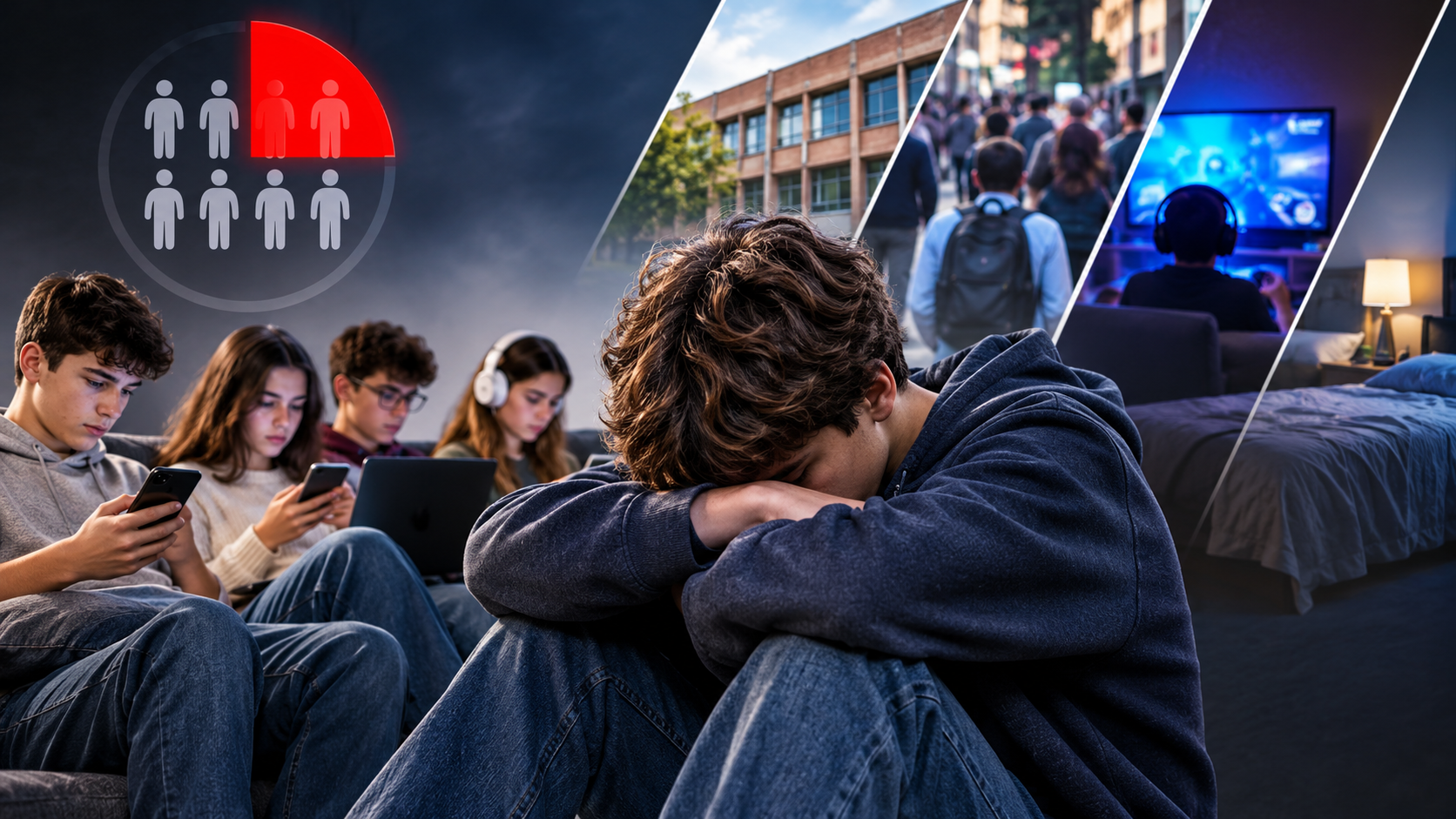

Children have not suddenly forgotten how to move. What has changed is the world around them.
New global estimates released by the World Health Organization on November 4 found that one in four adolescents ages 11 to 17 reported not getting even 60 minutes of moderate-to-vigorous physical activity on a single day during the previous week. That represents roughly 240 million young people. Adolescents averaged only 2.7 active days a week, and only 14 percent reported being active every day. After fifteen years of global concern about childhood inactivity, the numbers have barely improved.
The easiest response is to blame children. They spend too much time on phones. They play too many video games. They need more discipline, more sports, more exercise. Those explanations contain pieces of truth. They also place almost the entire burden on young people while overlooking a larger transformation: movement has gradually been removed from the ordinary architecture of childhood.
For much of human history, physical activity did not have to be isolated as a health behavior because it was embedded in daily life. Children walked places. They climbed, carried, chased, wandered, played games that existed only as long as bodies kept moving. Transportation, recreation and social life demanded more physical effort. No one needed to count every minute because movement was mixed into the day.
There is no reason to romanticize that past. Many children lived in unsafe neighborhoods, lacked recreational opportunities or faced restrictions on where they could go. Modern life has brought enormous gains in safety, education, transportation and technology. The important change is not that everything was once better. It is that movement increasingly has to be deliberately added back into childhood because fewer parts of ordinary life require it.
That difference has consequences.
When walking becomes driving, free play becomes scheduled activity and neighborhood games become organized sports, movement changes form. It begins to require a destination, a timetable and often an adult. A child may need a parent available to drive, money for registration, equipment, a safe facility and enough free time between school, homework and family obligations. Physical activity moves from being something that happens along the way to something that must be arranged.
That transition is easy to miss because organized sports are so visible. A soccer field full of children looks like evidence of an active generation. It does not show the children who cannot get there.
Once movement becomes organized, access becomes more dependent on resources. Families with money can purchase club sports, lessons, gym memberships, equipment and transportation. Families without those resources may have fewer alternatives, particularly if neighborhoods lack safe sidewalks, parks or public recreation. Physical activity can begin to resemble another opportunity distributed unevenly according to income, geography and family time.
The global environment reinforces that concern. WHO, UNICEF and UN-Habitat reported earlier this year that only 44 percent of urban residents worldwide live near an open public space. In low- and middle-income countries, the figure is only 30 percent. As cities expand, traffic, urban sprawl, privatization and the loss of child-friendly spaces increasingly shape whether children can simply step outside and play.
A child cannot play in a park that does not exist. A teenager cannot safely cycle to school on a road designed almost entirely around cars. Parents cannot be expected to encourage independence when the physical environment makes that independence feel dangerous. In those circumstances, telling young people to move more begins to confuse an outcome with its cause.
WHO’s latest findings make that distinction unusually clear. The organization explicitly argues that the answer is not simply asking adolescents to try harder. Transportation, safe public spaces, walking and cycling opportunities, school environments, affordability, social expectations and increasingly screen-based lifestyles all influence whether movement is easy enough to become part of daily life.
The gender gap makes the point even more difficult to dismiss. Twenty-eight percent of girls reported no active days during the previous week, compared with 22 percent of boys, and girls were less active in almost every country and WHO region studied. That difference cannot plausibly be explained by millions of girls independently deciding they care less about their health. Freedom of movement, safety, access to sport, cultural expectations and available opportunities differ considerably across communities. Behavior always takes place inside a set of conditions.
Screens are part of those conditions, although they have become such a convenient explanation that they can obscure what came before them. Phones and digital entertainment clearly compete for attention and encourage long periods of sitting. At the same time, screens entered childhood as daily life was already becoming more motorized, more supervised and more structured. The phone is easy to see because it is sitting in the child’s hand. The missing sidewalk, disappearing playground, shortened recess period or unsafe road is far less visible.
The distinction matters because physical inactivity carries consequences far beyond fitness. Regular movement supports bone and muscle development, cardiovascular health, cognitive development and mental well-being. WHO estimates that 86 percent of adolescents globally do not meet recommended physical-activity levels and projects that physical inactivity could cost public healthcare systems nearly $300 billion between 2020 and 2030.
Those numbers expose a familiar contradiction in modern health systems. We are prepared to spend enormous resources treating chronic disease later in life while allowing many of the conditions that shape risk to develop much earlier. The child who moves very little at 13 does not suddenly become a public-health problem at 45. Health develops across time, long before diagnosis gives it a name.
This does not remove personal responsibility. Children benefit from learning that movement matters. Parents influence routines. Schools make choices about physical education and recess. Technology habits deserve attention. Organized sports can provide extraordinary benefits, from physical skill to confidence, friendship and belonging.
The problem begins when those individual choices are treated as though they occur independently of the world around them.
A family can encourage outdoor play, but it cannot build a safe street. A teacher can value physical activity, but cannot create school space that does not exist. A teenager can want to exercise, but desire does not pay registration fees or provide transportation. The more movement depends on deliberate intervention, the more important the surrounding conditions become.
There is also something culturally revealing about the fact that childhood movement increasingly requires instruction. We tell young people to exercise for sixty minutes a day in much the same way adults are told to reach a certain number of steps. The recommendation is medically useful. Its necessity should still make us curious. Human beings evolved to move. Why has ordinary life become so sedentary that movement itself must now be prescribed?
The answer is not a single technology or cultural failure. It is the accumulation of thousands of design decisions about streets, schools, transportation, work, housing, safety and recreation. Few were made with the intention of making children inactive. Together, they can produce exactly that result.
This is why physical activity should not be understood primarily as sport. Walking to school counts. Riding a bicycle counts. Dancing counts. Playing in a courtyard counts. So does the unstructured movement that happens when children have somewhere safe to go and enough freedom to use it. Health does not care whether movement comes with a coach, a uniform or a scoreboard.
The distinction becomes particularly important in places where organized sport is inaccessible. If physical activity depends too heavily on formal programs, societies risk turning a basic element of healthy development into a service some families can buy more easily than others. The better question is whether children can move without needing an appointment.
That is what makes the lack of global progress over the past fifteen years so telling. We have issued recommendations, measured inactivity and warned about long-term disease. Information has not been enough.
The world does not need another generation of children who know exercise is good for them. Most already understand that movement matters. They need lives in which movement remains ordinary enough that choosing it does not always require planning, money, transportation or permission.
When one quarter of adolescents report no active day in an entire week, it is difficult to explain the problem as millions of individual failures occurring simultaneously. At some point, we have to examine the environments that produced the behavior we are trying to change.
Children did not simply stop moving.
We made movement easier to remove from childhood.

