

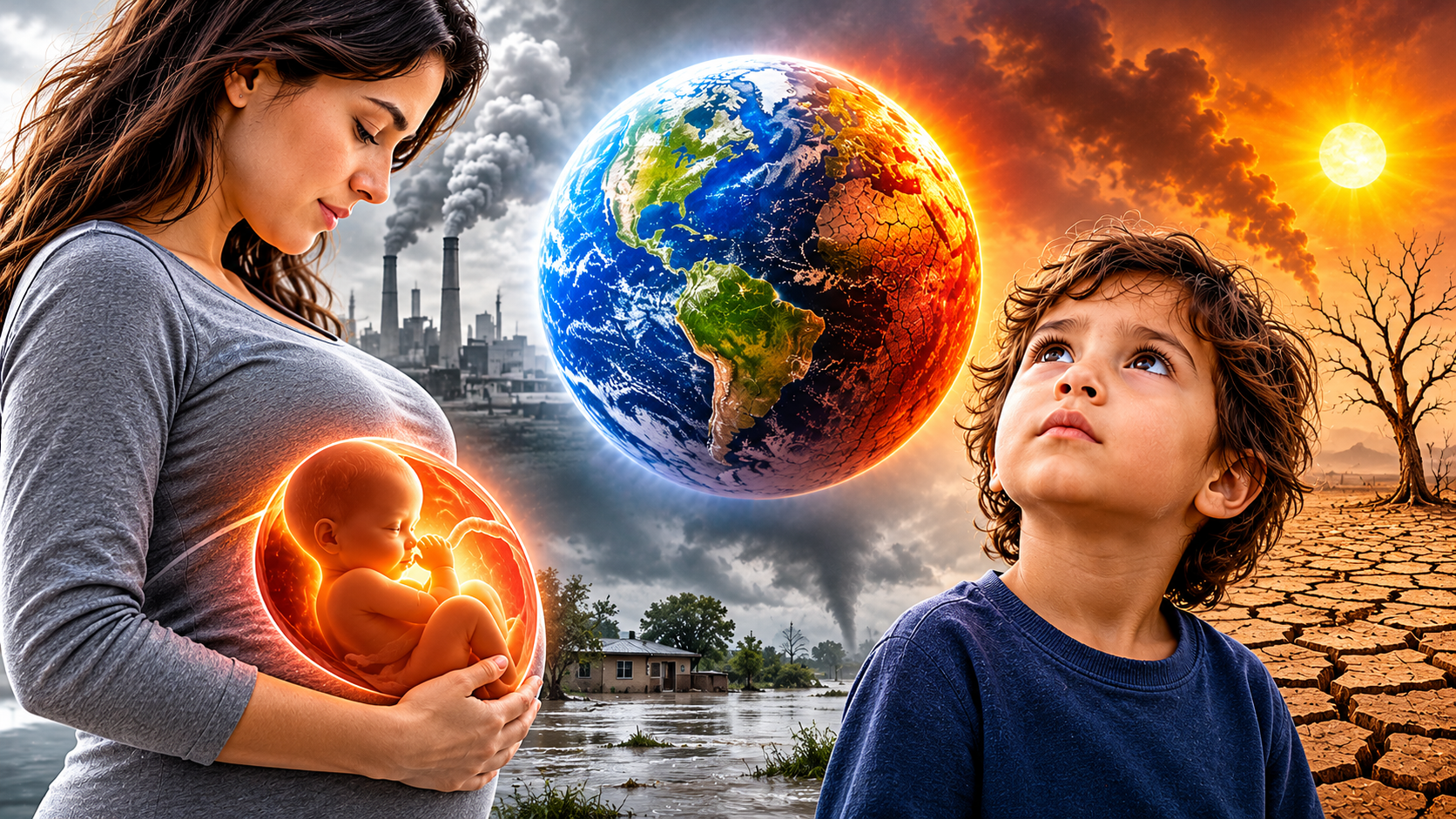
We often speak about climate change as something children will inherit. The language places its consequences somewhere ahead of them, as though childhood comes first and the inheritance arrives later. Increasingly, that sequence is becoming inaccurate. Some of the conditions associated with a warming world are entering human development before a child is born.
This month, the World Health Organization, UNICEF, the World Meteorological Organization and the United Nations Population Fund introduced the first global set of priority indicators designed to help countries track the effects of extreme heat on pregnant women, newborns and children. The framework recommends examining outcomes including premature birth, low birthweight, stillbirth, pregnancy hypertension and childhood illness alongside heat exposure. The change may sound technical. It represents something more consequential: the environment is beginning to be measured not simply as the setting in which health occurs, but as one of the conditions capable of shaping health from its earliest stages.
For decades, climate change has largely been described as an external threat. Temperatures rise, droughts deepen, fires spread, crops fail and storms intensify. Human health usually enters the story afterward, as one consequence among many. Pregnancy complicates that sequence because there is no clean boundary between the environment surrounding a pregnant woman and the biological environment in which a fetus develops.
Extreme heat places additional demands on hydration, circulation and temperature regulation during a period when the body is already undergoing substantial physiological adaptation. Research reviewed by WHO continues to associate heat exposure with adverse maternal and newborn outcomes, including increased odds of preterm birth. Babies under one year of age are also experiencing far more heatwave days than previous generations did.
None of this means temperature alone determines pregnancy outcomes. Human development is shaped by genetics, nutrition, infection, maternal health, stress, medical care and countless interacting factors. The more important realization is that environmental exposure belongs among them.
That sounds almost obvious once stated. Our systems have not always been organized as though it were.
A medical record can tell us that a baby arrived early, how much the baby weighed, whether blood pressure rose during pregnancy and what treatment followed. It may tell us far less about the conditions through which that pregnancy unfolded: repeated nights of extreme heat, unreliable electricity, outdoor work, a home that trapped heat or difficulty reaching prenatal care. Medicine has become extraordinarily sophisticated at describing what happens inside the body. It has been less consistent at recording what was happening around it.
This is why measurement matters. When preterm birth, low birthweight or pregnancy complications are recorded without information about surrounding exposures, each event can appear largely individual. Once environmental data are examined alongside health outcomes, patterns that were previously difficult to see can become visible. WHO’s new framework is explicitly designed to make those connections easier to identify.
The implication reaches beyond data collection. It changes where prevention begins.
Pregnancy and early childhood are periods in which development is unusually sensitive to surrounding conditions. Nutrition matters. Infection matters. Maternal health matters. Housing, income and access to care matter. UNICEF now includes climate-driven hazards such as extreme heat and flooding among environmental exposures that can influence neonatal health, including exposures occurring before conception and during pregnancy.
Temperature belongs within that larger landscape because exposure is never determined by weather alone. Two women can live through the same heat wave and experience very different levels of risk. Air conditioning, housing quality, electricity, occupation, transportation, shade and access to medical care all change what the temperature outside means inside a human life.
One woman may spend the hottest part of the day indoors with reliable cooling and the ability to change her schedule. Another may work outside, return to a home that remains hot through the night and have little control over either environment. The thermometer can record the same number for both. Their exposure is not the same.
This is where climate reveals something that global health has understood for a long time: risk is rarely distributed only by biology. It is shaped by the resources people can access, the environments they inhabit and the choices actually available to them.
That distinction matters when health advice becomes the primary response. Encouraging hydration, rest and reduced heat exposure can be useful. Those recommendations also presume that water is available, work can be interrupted, a cooler place exists and medical care can be reached if symptoms worsen. Information can help people navigate risk. It cannot create options that their circumstances withhold.
If environmental conditions can influence pregnancy and early development, maternal and child health cannot be understood entirely inside a clinic. A prenatal appointment may identify vulnerability, though many of the forces producing that vulnerability began before the appointment and exist far beyond the examination room. Housing, electricity, working conditions, transportation and the physical design of communities begin to look less like separate policy subjects when the body experiences their combined effects.
We divide these problems because institutions need categories. Climate belongs to one agency, housing to another, energy somewhere else and pregnancy to medicine. Human beings do not experience those divisions. A pregnant woman living through repeated heat waves encounters one physical reality, regardless of how many departments are responsible for different parts of it.
This is one reason the changing climate challenges more than infrastructure. It challenges where we draw the boundary around health itself.
Global health has spent decades widening that boundary. Food security, clean water, sanitation, education, housing and economic stability are now understood as deeply connected to health outcomes. Climate adds another dimension because it alters the physical conditions within which all of those systems operate.
Extreme heat makes the connection unusually visible, although it is not unique. Flooding can interrupt prenatal care or contaminate drinking water. Wildfire smoke can travel far beyond the fire itself. Drought can alter nutrition through food availability and price. The common lesson is not that every environmental event produces a predictable medical outcome. It is that the environment does not need to cause disease directly in order to influence who becomes vulnerable to it.
That brings prevention into a different frame.
By the time a premature infant enters neonatal intensive care, medicine can perform extraordinary interventions. The more difficult question reaches further back: what conditions surrounded the pregnancy before medical rescue became necessary? Which exposures were avoidable, which were not, and which vulnerabilities were visible long before they appeared on a hospital chart?
Those questions should not become another burden placed on mothers. Pregnancy already attracts an enormous amount of instruction about what women should eat, avoid, monitor and control. New knowledge about climate risk could easily produce one more list of responsibilities for individuals who may have little power over the environments in which they live and work.
That would misunderstand the significance of the evidence.
If heat exposure matters, responsibility cannot end with telling a pregnant woman to stay cool. If housing traps heat, electricity is unreliable or work conditions make avoidance impossible, the problem has already exceeded individual behavior. Better knowledge should widen responsibility rather than narrow it.
The larger shift, then, is not simply what health systems will begin to count. It is what they will begin to recognize as part of health in the first place.
That recognition changes the language of inheritance.
We often say that today’s children will inherit a warmer planet, unstable weather and damaged ecosystems. The phrase carries an important moral truth: one generation makes choices whose consequences another must live with. It also places those consequences in the future, as though children arrive first and environmental inheritance follows.
For many children, there may be no such separation.
Their first environment is the maternal body, and that body exists within a home, a workplace, a neighborhood, an economy and a climate. Those conditions can shape temperature, sleep, stress, nutrition, exposure and access to care during some of the most consequential stages of development. Environmental inheritance, in that sense, can begin before memory and before language.
It can begin before birth.
That should not make pregnancy another source of fear. It should make our understanding of prevention more complete. The purpose of recognizing environmental risk is not to suggest that every outcome can be controlled. It is to see more clearly where health begins, and therefore where responsibility must begin as well.
We have spent years asking what kind of planet today’s children will inherit.
The question is no longer entirely about the future.
It is also about the environment in which they are already becoming human.
Julia El-Haj is a global health strategist and founder of Hermetica Health. Her writing explores the intersection of human systems, public health, conflict, and cooperation, examining how narratives, institutions, and power structures shape human wellbeing and global resilience.

