

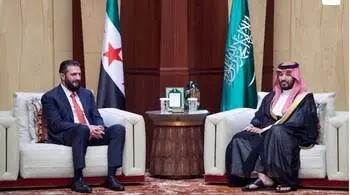
Damascus: Syria is considering providing military assistance to Saudi Arabia as Riyadh and Yemeni government forces intensify their campaign against the Iran-backed Houthi movement in Yemen.
The discussions include the possibility of deploying Syrian forces to Yemen, although no final decision has been made. Damascus has publicly rejected suggestions that it has already agreed to send troops.
The issue was reportedly discussed during Syrian President Ahmed al-Sharaa’s meeting with Saudi Crown Prince Mohammed bin Salman in Riyadh on October 6. Saudi Arabia is seeking additional support as its-backed Yemeni forces attempt to reverse Houthi territorial gains.
Several forms of assistance are being considered, including defensive support to protect Saudi Arabia from Houthi missile and drone attacks, military expertise and potentially the deployment of Syrian forces alongside Saudi-backed Yemeni troops.
One proposal under discussion could involve 10,000 to 20,000 Syrian troops, although the figure remains a possibility rather than an approved deployment.
Damascus has not committed to sending troops
Syrian presidential media adviser Ahmad Zaidan rejected claims that Damascus had agreed to deploy forces to Yemen.
A Syrian diplomat said Damascus stood firmly with Saudi Arabia in the face of Houthi attacks but emphasized that Syria’s primary focus remained rebuilding the country after years of civil war.
Any military cooperation or exchange of expertise with Saudi Arabia, the diplomat said, would take place through official channels and within existing bilateral agreements.
The distinction is important: Syria is considering military assistance, but a Syrian ground deployment has not been confirmed.
Why Saudi Arabia wants Syrian support
Saudi Arabia and Yemeni government forces launched a major counteroffensive earlier this week after weeks of Houthi missile and drone attacks against the kingdom.
The campaign aims to retake territory controlled by the Houthis, including areas around Sanaa and the strategic Bab al-Mandeb Strait. Saudi forces are providing air support while Yemeni government-aligned forces lead the ground campaign.
The Houthis have responded with further missile and drone attacks against Saudi targets, including airports, while fighting has intensified across Yemen.
For Riyadh, the Bab al-Mandeb is particularly important. The strategic waterway connects the Red Sea with the Gulf of Aden and is a major corridor for global trade and energy shipments. Saudi Arabia wants to prevent the Houthis from using their position around the waterway as military and economic leverage.
Washington has been consulted
The Trump administration has reportedly been consulted about the Saudi-Syrian discussions and does not oppose Syrian involvement in principle.
U.S. Central Command has also been consulted about possible deployment arrangements.
For Washington, greater regional participation could strengthen the Saudi-backed campaign without requiring the United States to commit large numbers of ground forces.
A Syrian contribution could also strengthen relations between Saudi Arabia and Syria, two countries that Washington considers important regional partners.
Risks for Damascus
For Syria, however, entering the Yemen war would carry substantial political and military risks.
The country’s new military is still being assembled from armed groups that fought against former President Bashar al-Assad. Some include hardline Sunni Islamist fighters and foreign combatants who participated in the Syrian civil war.
A Syrian force fighting the Houthis could therefore acquire a sectarian dimension. The Houthis follow Zaydi Shiite Islam, while many elements of Syria’s new military structure emerged from predominantly Sunni Islamist opposition groups.
Intervention could also provoke Iran and its regional allies, including Hezbollah and Iran-aligned militias in Iraq. Damascus is attempting to stabilize Syria after a 14-year conflict and may be reluctant to open another front involving powerful regional actors.
Saudi-Syrian ties
Despite those risks, al-Sharaa has strong incentives to demonstrate support for Riyadh.
Saudi Arabia has helped Syria’s new leadership gain international legitimacy and has provided financial assistance as Damascus attempts to rebuild. Relations with Crown Prince Mohammed bin Salman have consequently become an important part of Syria’s emerging regional diplomacy.
For Riyadh, even limited Syrian military assistance could strengthen its campaign against the Houthis. For Damascus, however, sending thousands of troops abroad could divert resources from Syria’s own reconstruction and security challenges.
A limited deployment of defensive personnel or technical specialists could offer al-Sharaa a way to support Saudi Arabia without committing Syria to a major ground war.
A large-scale intervention would be a much greater gamble.
For now, Syrian involvement remains under discussion, not a confirmed deployment. The critical question is whether Damascus ultimately limits its support to defensive and technical assistance or sends Syrian troops directly into Yemen.
Syria-Yemen war, Saudi Arabia Houthis, Ahmed al-Sharaa, Saudi-Syria relations, Yemen conflict, Bab al-Mandeb

