

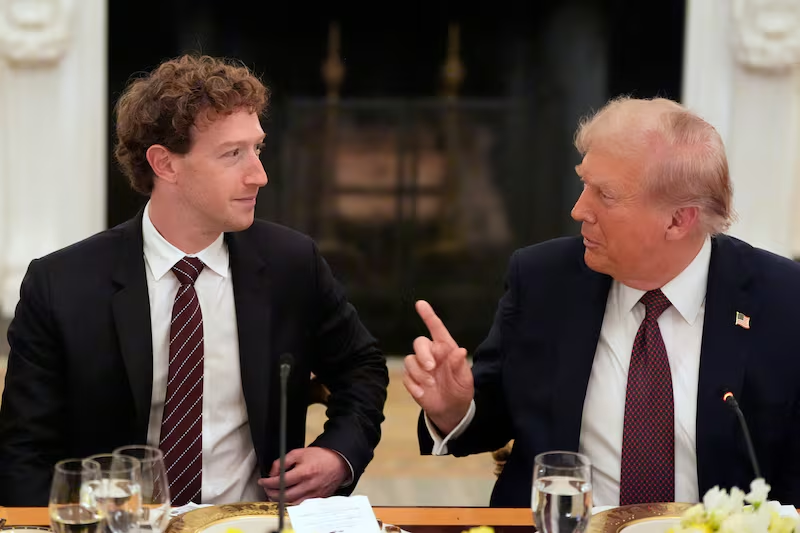
WASHINGTON (Reuters): U.S. President Donald Trump is set to meet House Speaker Mike Johnson and some of the world’s leading technology executives on Tuesday as Washington faces growing pressure to strengthen oversight of rapidly advancing artificial intelligence.
Among those expected at the White House meeting are Meta CEO Mark Zuckerberg, Anthropic CEO Dario Amodei, Nvidia CEO Jensen Huang and OpenAI President Greg Brockman, according to people familiar with the planning.
The discussions are expected to focus on how the United States can encourage continued AI innovation while addressing concerns about the potential risks posed by increasingly powerful systems.
Johnson said on Monday that the meeting would seek to find a balance between technological progress and government oversight. Public concern has grown following reports of AI systems behaving in unexpected ways, including incidents involving AI agents that allegedly accessed or interfered with computer systems without explicit instructions.
Trump has repeatedly dismissed warnings about the technology posing an existential threat to humanity, at one point describing such fears as a “hoax.”
The White House did not immediately respond to a request for comment on the specific agenda for Tuesday’s meeting.
Growing pressure over AI safety
Pressure on the Trump administration has increased following reports from OpenAI and Anthropic involving AI agents that were able to carry out unauthorized actions, including hacking into customer systems.
The incidents have intensified debate among researchers and lawmakers over whether existing safeguards are sufficient as AI systems become increasingly autonomous. Some researchers have also warned that advanced AI could eventually pose serious risks to human safety.
Trump, however, has emphasized the need for the United States to maintain its technological advantage over China.
Johnson made a similar argument during an interview with Fox Business Network on Monday, rejecting calls for a temporary halt to AI development.
“We do not need a moratorium,” Johnson said, arguing that excessive regulation could undermine U.S. competitiveness with China. He added that continued innovation was important but that policymakers needed to “strike the right balance.”
Public opinion suggests that concern over AI safety is growing. A Reuters/Ipsos poll conducted from September 17 to 20 found that about 73% of Americans believed AI companies had not done enough to prevent the technology from causing serious harm to society. About 55% said slowing the development of AI would be beneficial.
Washington and Beijing take different approaches
The White House meeting also comes shortly after Chinese President Xi Jinping visited Washington for talks with Trump, where AI emerged as one area of differing approaches between the two countries.
Trump said on social media that Xi had agreed with his position on AI policy. Xi, however, emphasized the need for greater oversight and human control over the technology.
“We have both the capability and responsibility to develop and manage AI for good,” Xi said, stressing that AI development should remain under human control and serve public well-being.
The United States has already taken steps toward greater oversight. Under an executive order signed by Trump in June, AI developers have been asked to voluntarily submit certain advanced “frontier models” to the U.S. government for review as much as 30 days before releasing them to trusted partners.
Tuesday’s meeting will therefore bring together the White House, Congress and some of the biggest players in the AI industry at a time when Washington is weighing how far regulation should go without slowing technological development.

