

Ayaz Khan Lohani
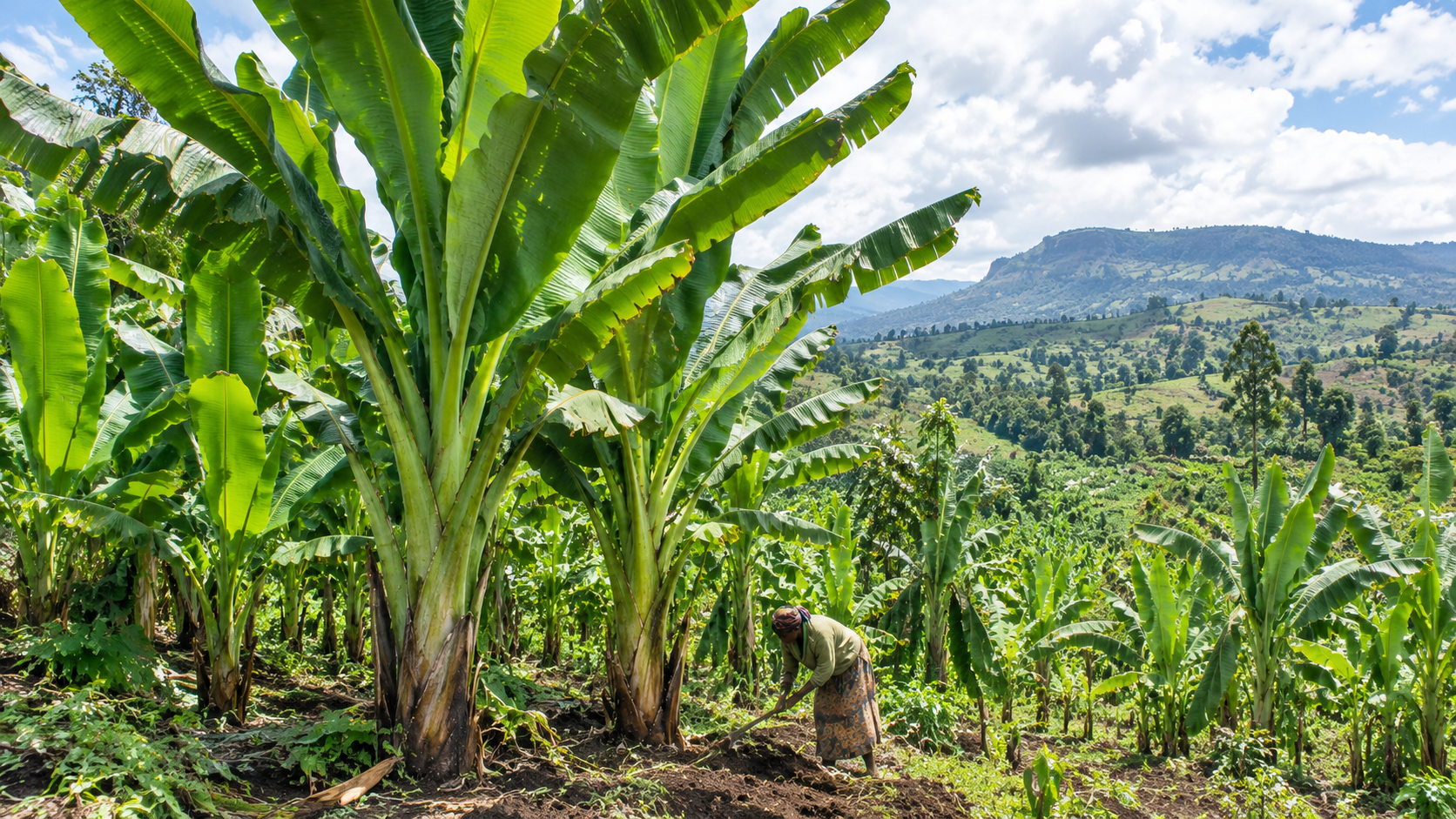
For thousands of years, farmers in Ethiopia have cultivated a remarkable plant that looks like a banana but behaves very differently. Known as enset, or Ethiopian false banana, the crop has survived droughts, food shortages and climatic uncertainty—and scientists now believe its unusual qualities could make it an important tool in the global fight against hunger.
Often described as “the tree against hunger,” enset has been cultivated in Ethiopia for more than 7,000 years. Today, between 18 and 25 million people depend on it to some degree, particularly in southern and southwestern Ethiopia.
But the growing scientific interest in enset is not simply about introducing another staple food. Its greatest potential may lie in something more important: helping vulnerable communities survive the periods when other crops fail.
A crop unlike almost any other
Enset is a close relative of the banana. Yet, unlike bananas, its fruit is not the part people eat. The orange fruit contains numerous hard, bullet-like seeds and is considered inedible.
Instead, farmers harvest the plant’s starchy trunk and enormous underground corm—a bulb-like structure that can weigh as much as 100 kilograms. These parts are processed into different foods, including a traditional fermented flatbread known as kocho.
The plant can also produce bulla, a powdery by-product of processing kocho that can be prepared as porridge.
In some communities, pieces of the corm are placed in deep earthen pits and allowed to ferment. When properly stored, the food can remain usable for years.
That ability to remain in the ground and be harvested when needed is one of the characteristics that makes enset particularly interesting to scientists.
A “green asset” against hunger
Unlike annual crops such as wheat, maize and rice, enset is a perennial plant. It continues growing year after year rather than being harvested and destroyed after a single growing season.
But perhaps its most important feature is its flexibility.
Enset does not have one narrow harvest window. Farmers can allow plants to grow for several years and harvest them when food is needed.
On many farms, plants of different ages are grown together. A farmer may have three-, four-, five-, six- or even seven-year-old plants at the same time.
In a good year, fewer plants may be harvested, allowing the household’s stock to grow. During a drought, crop failure or other emergency, farmers can harvest plants that might otherwise have been left to mature.
This effectively turns the crop into a living food reserve.
Researchers describe it as a kind of “green asset”—something farmers can draw upon when circumstances suddenly become difficult.
That could be particularly valuable in regions where climate change is making agricultural seasons increasingly unpredictable.
As one researcher put it, a community might have sufficient food for 50 weeks of the year but face severe shortages for just two weeks. Those two weeks can still create a major humanitarian crisis.
A crop that can remain standing in the field and be harvested precisely during those difficult weeks could therefore provide an important buffer.
More than 100 million people could potentially benefit
The possibilities extend far beyond Ethiopia.
A 2021 range-modelling study involving researchers studying enset found that the crop could potentially be cultivated across substantial parts of southern and eastern Africa.
The research suggested that existing cultivation areas could theoretically be expanded by around 12 times, potentially making enset available to as many as 111.5 million additional people across sub-Saharan Africa.
That does not mean 111 million people could immediately switch to enset. Nor are scientists suggesting that it should replace established crops.
The argument is more nuanced.
Enset could be grown alongside other crops, providing farmers with another layer of protection when drought, extreme weather, pests or economic shocks damage conventional harvests.
Its role could therefore be less about becoming everyone’s main food and more about becoming a strategic insurance crop.
Ethiopia’s ancient food system
For Ethiopian farmers, however, enset is anything but a new discovery.
The plant has been cultivated for thousands of years and remains an important staple in parts of the country. Estimates suggest that roughly 18 to 20 million people, or around one-fifth of Ethiopia’s population, depend on it as a staple food.
Enset is frequently grown alongside coffee. Its enormous leaves provide shade, creating a useful agricultural relationship between the two crops.
Almost every usable part of the plant has a purpose.
The corm can be boiled and eaten, while the processed trunk and stalk can be fermented and turned into kocho. Bulla can be prepared as porridge, while the plant’s strong fibres can be used to make products such as sacks.
This versatility has led some researchers to describe enset as something resembling the Swiss Army knife of crops.
Could it work outside Ethiopia?
That is now one of the biggest questions surrounding the plant.
Researchers believe enset’s tolerance of different climatic conditions means it could potentially grow across a much wider geographical area.
Its reputation for drought tolerance is particularly significant as climate change increases pressure on food systems.
Experiments outside Africa are already providing clues.
In April 2023, enset flowered for the first time inside London’s Kew Gardens Temperate House, after arriving at the gardens as a plant only about 30 centimetres tall four years earlier.
For scientists, such examples demonstrate the plant’s ability to adapt to environments beyond its traditional home.
There is, however, a major difference between proving that a plant can grow somewhere and establishing it as a successful food crop. Farmers would need suitable varieties, knowledge, processing facilities, markets and cultural acceptance.
So the future of enset will depend not simply on its biology but also on economics, agricultural research and local farming traditions.
The forgotten diversity of the world’s food supply
Perhaps the most important lesson from enset is not that humanity has discovered a miracle crop.
It is that humanity has forgotten—or ignored—many of the crops that already exist.
There are thousands of plants that humans have historically eaten, yet modern agriculture depends heavily on a remarkably small number of species.
More than half of humanity’s calories come from just three grasses: wheat, rice and maize.
That concentration creates vulnerability.
If millions of farmers across the world depend on similar crops, similar growing seasons and similar agricultural systems, a major climatic shock can affect huge populations simultaneously.
Crop diversity offers another form of insurance.
Different plants respond differently to drought, heat, floods, disease and changing growing seasons. Maintaining a wider agricultural portfolio can therefore make food systems more resilient.
Enset may be one of the most promising examples, but it is certainly not the only one.
Not a miracle cure—but a potential lifeline
There is a temptation whenever a remarkable crop is discovered to call it the solution to world hunger.
Enset does not deserve that description.
It cannot replace wheat, rice or maize overnight. It requires knowledge, processing and cultural adaptation. Expanding its cultivation would also require careful research to ensure that new growing areas are environmentally and economically suitable.
But its unique combination of characteristics makes it unusually interesting.
It is perennial. It can remain in the ground for years. It can be harvested when needed. It can withstand periods of climatic stress. It provides food at different stages of processing. And it can be integrated with other crops.
Most importantly, it can give farmers something that conventional annual crops often cannot: time.
When drought destroys a seasonal harvest, farmers may have little choice but to depend on markets, government assistance or humanitarian aid. A mature enset plant standing in the field can provide another option.
That could mean the difference between a difficult season and a food emergency.
The bigger lesson: diversity may be the real solution
The story of enset ultimately goes beyond one Ethiopian plant.
Scientists warn that searching for a single “silver bullet” to solve global hunger could miss the bigger opportunity. The world already possesses an enormous diversity of edible plants, many of which have received only a fraction of the scientific attention devoted to major global crops.
Enset could therefore serve as an ambassador for agricultural biodiversity.
Its story demonstrates what can happen when an ancient farming tradition meets modern science: a crop once largely unknown outside its homeland suddenly becomes relevant to a world facing drought, climate change and growing food insecurity.
The future of food security may not depend on finding one perfect crop.
It may depend on growing more crops, in more places, and preserving the agricultural knowledge that allowed communities to survive with them for thousands of years.
And somewhere in the Ethiopian highlands, a plant that has quietly fed generations of farmers for more than 7,000 years may offer one important clue to that future.

