

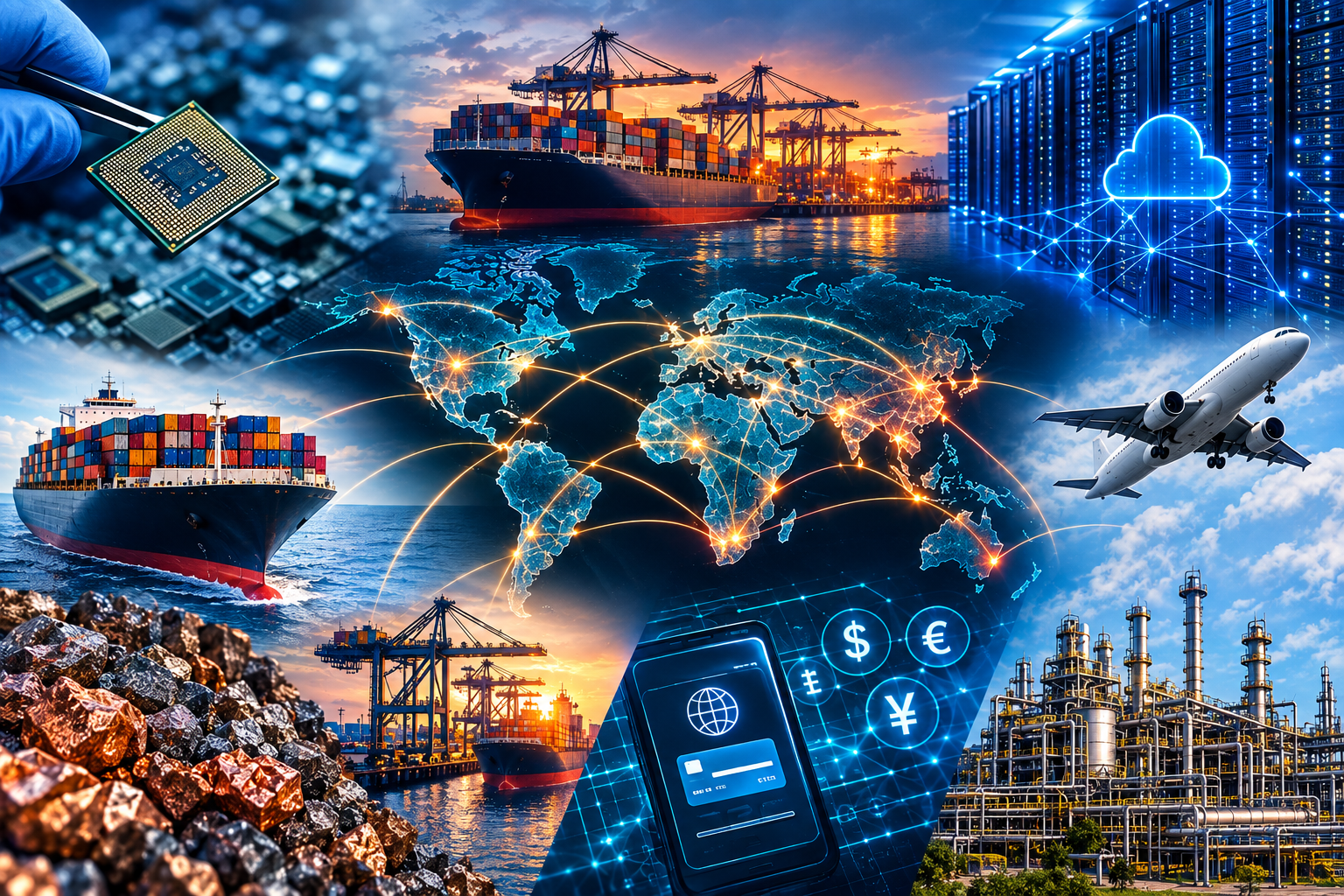
For centuries, power could be drawn on a map.
Territory mattered. Ports mattered. Armies crossed borders, governments defended them, and empires expanded by acquiring more land.
The map of power today is harder to see.
Some of its most important borders run through semiconductor factories, shipping lanes, payment systems, mineral-processing plants, data networks and air corridors.
The modern struggle for influence is increasingly about something more subtle than possession.
It is about access.
Access to energy.
Access to technology.
Access to markets.
Access to transportation.
Access to finance.
Access to the materials required to build the next generation of machines.
This week’s meeting between U.S. President Donald Trump and Chinese President Xi Jinping illustrates the transformation unusually well.
The two leaders are not meeting primarily to negotiate territory. Their agenda spans trade, artificial intelligence, rare earth minerals, Taiwan and Iran. Washington and Beijing are also considering whether to extend a tariff truce scheduled to expire in November.
At first glance, these subjects appear unrelated.
They are not.
Each concerns the ability of one country to influence another by controlling access to something difficult to replace.
Consider rare earths.
These obscure elements sit inside electric motors, electronics, aircraft, energy systems and advanced military technologies. Their strategic importance bears little relationship to the tiny quantities in which many of them are used.
China accounted for approximately 91 percent of global refined magnet rare-earth production in 2024 and an even greater share of permanent magnet production, according to the International Energy Agency. Recent export restrictions have demonstrated how quickly a narrow point in a global supply chain can affect industries thousands of kilometers away.
This is economic geography in a new form.
A country does not need to control another country’s territory if it controls something that country cannot easily manufacture without.
The same logic appears in semiconductors.
Advanced computing increasingly depends upon a remarkably complex chain involving chip designers, fabrication plants, specialized manufacturing equipment, software and critical materials spread across several countries.
Artificial intelligence may appear weightless because its products arrive through screens, but underneath the algorithms is an enormous physical system of chips, electricity, minerals, factories and data centres.
The digital world has geography after all.
Energy provides another example.
For decades, strategic thinking focused on oil fields. Today, attention increasingly extends to the routes through which energy travels.
The Strait of Hormuz is not valuable because of its physical size. It is valuable because an enormous volume of global energy passes through a very narrow maritime corridor.
Recent tensions involving Iran have again demonstrated how geography can function as leverage when global systems depend heavily upon a small number of routes. Iran and the United States remain far apart in negotiations to end their conflict, even as both sides continue diplomatic contacts.
A similar logic now applies to aviation.
New U.S. pressure against Iranian airlines has led to flight cancellations, while Iran has warned neighboring countries against restricting Iranian aircraft. What might once have been treated as a technical matter of commercial aviation has become part of geopolitical bargaining.
Airspace itself can become leverage.
None of this means military power has become irrelevant.
It means military power now operates inside a much larger architecture of dependence.
A modern state can possess formidable armed forces while remaining vulnerable because it depends upon another country for essential minerals, computer chips, medicines, fuel, telecommunications equipment or industrial components.
That changes the meaning of national security.
Security can no longer be measured only by the number of aircraft, ships or missiles a country possesses.
It also depends upon whether hospitals can obtain medicine during a crisis.
Whether factories can obtain components.
Whether farmers can obtain fertilizer.
Whether electricity grids have fuel.
Whether communication networks continue functioning.
Whether supply chains have alternatives when one route suddenly closes.
That is where geopolitics begins to intersect directly with human wellbeing.
A disruption that begins in a diplomatic dispute can eventually arrive at a kitchen table as higher food prices, at a factory as layoffs, or at a hospital as shortages.
Ordinary people live at the end of systems they rarely see.
This is particularly important for countries across the Global South.
Many developing nations spent decades being told that globalization would make production more efficient by allowing countries to specialize and rely upon international markets.
Economically, that logic often worked.
Strategically, however, extreme dependence can become vulnerability.
The lesson emerging from recent crises is not necessarily that every country should manufacture everything itself. That would be prohibitively expensive and, in many cases, impossible.
The more realistic goal is resilience.
Multiple suppliers.
Multiple trade routes.
Regional manufacturing.
Strategic reserves.
Domestic capabilities in areas considered essential.
Partnerships broad enough that disagreement with one powerful country does not immediately become economic paralysis.
This may help explain why so many governments are pursuing relationships that once would have appeared contradictory.
A country can trade with China, cooperate militarily with the United States, purchase energy from the Gulf, participate in institutions led by the West and simultaneously seek stronger relationships across Asia or the Global South.
That is not necessarily ideological confusion.
It can be strategic diversification.
The old international system often imagined countries arranging themselves into relatively stable camps.
The emerging system is more fluid.
Countries increasingly want options.
And options are becoming a form of sovereignty.
This transformation creates risks of its own.
If every country begins treating trade, finance, technology and infrastructure primarily as instruments of geopolitical pressure, the global economy becomes less efficient and more fragmented.
Costs rise.
Innovation can slow.
Smaller countries can find themselves pressured from multiple directions.
The very networks built to connect humanity can become tools through which states constrain one another.
That is the paradox of interdependence.
Connection creates prosperity because countries rely upon one another.
But reliance also creates leverage.
The challenge for the coming decades will therefore not be simply to reduce dependence.
It will be to prevent dependence from becoming domination.
That requires thinking about resilience differently.
Human civilization has built extraordinary systems capable of moving food, medicine, energy, information and technology around the planet with remarkable speed.
Those systems represent one of globalization’s greatest achievements.
Their weakness is concentration.
When too much of something essential passes through one factory, one country, one shipping route or one technology platform, efficiency can quietly become fragility.
The geopolitical map of the twenty-first century therefore cannot be understood only by looking at borders.
Look instead at the pathways.
Where does the energy move?
Where are the minerals refined?
Where are the chips manufactured?
Where does the data travel?
Where are the medicines produced?
Which routes have substitutes, and which do not?
Those lines may tell us more about the future distribution of power than many of the borders printed on our maps.
The next era will not belong simply to the countries that possess the most.
It will be shaped by those capable of remaining connected without becoming helplessly dependent.
Because in an interconnected world, power is increasingly measured not only by what a nation controls.
It is measured by what the rest of the world cannot easily do without.

