

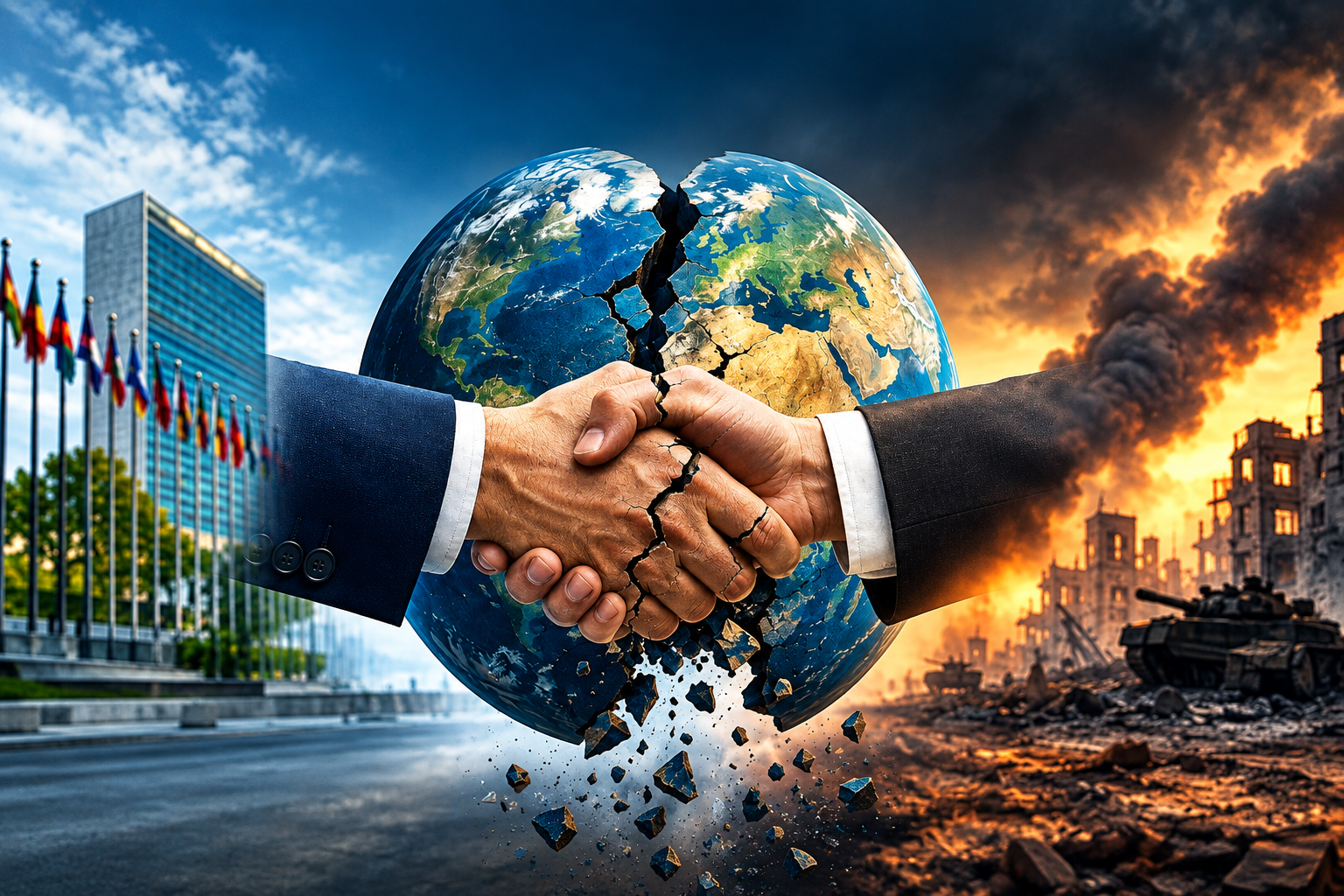
Every civilization has an invisible infrastructure.
It cannot be photographed. It cannot be stored in a vault. It cannot be defended by an army.
Yet when it begins to collapse, everything built above it becomes vulnerable.
That infrastructure is trust.
Trust is what allows strangers to live together, economies to function, governments to operate, and societies to confront problems larger than any individual.
Without it, even the most advanced civilization becomes fragile.
The defining crisis of our era is not simply that humanity faces too many problems. It is that we are losing the ability to solve them together.
Across the world, confidence in institutions has declined. People question governments, media, corporations, scientific authorities, and international organizations. Some skepticism is healthy. Accountability is necessary. No institution should exist beyond scrutiny.
But a society cannot function when skepticism becomes permanent disbelief.
When every fact becomes a battlefield, every solution becomes suspicious, and every crisis becomes an opportunity for division, collective action begins to break down.
This is the paradox of our time.
Humanity has never possessed greater knowledge, yet we struggle to agree on basic reality.
We have never been more connected, yet many societies have become more isolated from one another.
We have created technologies capable of solving extraordinary problems, yet we increasingly lack the shared trust required to use them responsibly.
The consequences are visible everywhere.
Public health emergencies become battles over credibility.
Climate change becomes a conflict over motives rather than a challenge requiring cooperation.
Humanitarian crises become competing narratives instead of shared human responsibilities.
Artificial intelligence becomes a race for dominance instead of a conversation about how technology should serve humanity.
The problem is not that disagreement exists.
Disagreement is the foundation of progress.
The danger comes when societies lose the belief that people with different views can still build something together.
History shows that civilizations are not weakened only by external threats. They are weakened when the systems connecting people begin to lose legitimacy.
That lesson matters because the challenges ahead are larger than any nation.
Climate instability, technological disruption, global health threats, and economic inequality will not be solved through isolation. They will require cooperation between people and nations that do not always agree.
The strongest societies of the future will not simply be those with the most resources or the most powerful technology.
They will be those capable of maintaining trust while navigating uncertainty.
Because trust is not weakness.
Trust is what allows strength to be directed toward creation rather than destruction.
The future of humanity will not be determined only by what we can build.
It will be determined by whether we can still believe in enough of each other to build it together.
Julia El-Haj is a global health strategist and founder of Hermetica Health. Her writing explores the intersection of human systems, public health, conflict, and cooperation, examining how narratives, institutions, and power structures shape human wellbeing and global resilience.

