

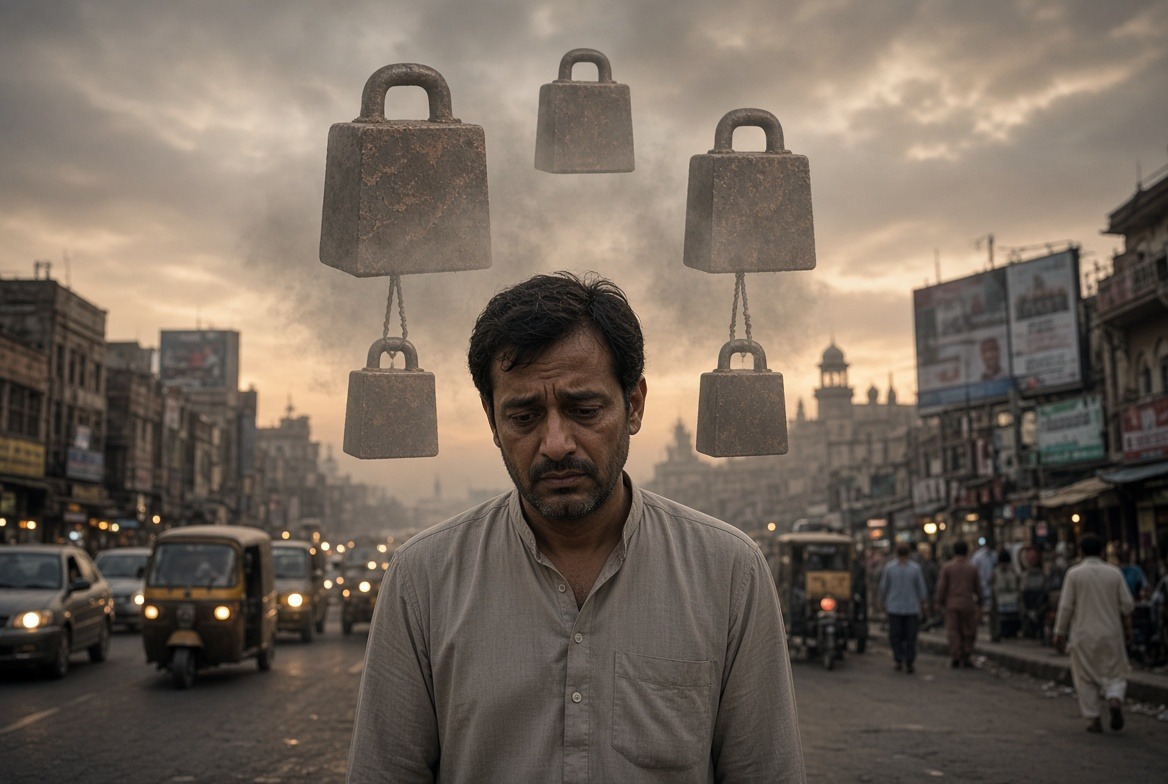
There was a time when being middle class in Pakistan meant living modestly but with dignity. A family could hope to buy fruit regularly, send its children to a decent school, pay electricity bills and fill the car with petrol without calculating every rupee.
That promise is rapidly disappearing.
Today, a family can have a respectable income on paper and still struggle to afford what should be considered a normal life. Fruit has become a luxury. Good private schooling is increasingly out of reach. Electricity bills consume an alarming share of household income, while petrol prices repeatedly squeeze transport and household budgets.
This is not simply inflation. It is a collapse in purchasing power.
The most vulnerable are not necessarily those officially classified as poor. There is another group that receives far less attention: families that have slipped from financial stability into permanent anxiety. They may still have a house, a job and a monthly salary, but they can no longer afford the standard of living they once considered normal.
Pakistan’s economic pain is also revealing a striking imbalance. The poor survive through limited incomes, informal support and, in many cases, assistance from others. The affluent can absorb price increases. The middle class is trapped between the two. It earns too much to qualify for meaningful support and too little to comfortably absorb rising costs.
This is where government policy matters.
Taxes are increasing, energy costs remain painfully high, and complicated subsidy mechanisms offer little comfort to an ordinary citizen trying to understand why the monthly bill keeps rising.
The government may describe economic indicators as improving, but people judge the economy differently: Can I afford my electricity bill? Can I buy fruit? Can I educate my children? Can I travel to work without worrying about fuel costs?
These are the real economic indicators of a household.
The confusion surrounding taxation is another source of public frustration. Consumers encounter different tax treatment depending on whether they pay by card or cash, and practices appear to vary between businesses and sectors. A customer should not need an accountant to understand why the price of the same meal changes depending on the payment method.
If the state wants more documentation, taxation and digital payments, it must create a system that is transparent, consistent and easy to understand.
The deeper problem, however, is the perception of two different Pakistans.
In one Pakistan, families are cutting household spending, postponing medical treatment, moving their children to cheaper schools and reconsidering whether they can afford basic necessities. In the other, the privileges associated with political and official power appear untouched by the austerity expected from everyone else.
That contrast is politically explosive.
Citizens are repeatedly asked to sacrifice. They are told to pay more taxes, accept higher electricity prices, tolerate expensive fuel and adjust their lifestyles for the sake of the national economy.
But where is the equivalent sacrifice from those governing the country?
Government expenditure, official privileges, protocols and administrative extravagance deserve the same scrutiny demanded of ordinary taxpayers. Public anger grows when citizens see displays of luxury and grandeur while being told that the country cannot afford relief for struggling households.
The issue is not whether public officials deserve reasonable salaries or security. They do. The issue is whether public office should come with a lifestyle disconnected from the economic reality of the people paying for it.
A bureaucrat receiving a substantial salary is one matter. A state structure carrying additional official vehicles, fuel, residences, security, staff, protocol and other benefits is another. The public has every right to ask what these privileges cost and whether they are justified.
The same principle applies to political families and public ceremonies. When ordinary Pakistanis are struggling to pay school fees and electricity bills, extravagant displays associated with the country’s political elite inevitably become symbols of inequality.
This is why corruption is not merely a legal or financial issue. It is an economic one.
Every rupee wasted, misused or extracted through corruption ultimately increases the burden on citizens who are already paying more for less. Corruption eats away at a country slowly — like termites consuming the foundations of a house while everyone upstairs pretends the building is fine.
Pakistan does not merely need higher taxes. It needs fairer taxation.
It does not merely need higher revenues. It needs disciplined government spending.
It does not merely need subsidies. It needs simple, transparent and targeted relief.
And above all, it needs an economic system in which sacrifice is not demanded exclusively from the people at the bottom and in the middle.
The middle class is not asking for luxury. It is asking for normality.
A parent wants to buy fruit for the family without hesitation. A mother wants to send her children to a decent school. A worker wants to pay the electricity bill without fearing the next one. A salaried person wants to know that working harder will actually improve the family’s life.
These are not extravagant demands.
They are the minimum expectations of a functioning society.
If government policy continues to push ordinary middle-class families downward while the privileged remain insulated from the consequences, Pakistan will not simply have a poverty problem.
It will have a middle-class collapse.
And when the middle class loses hope, economic statistics alone cannot convince people that everything is going well.
By Faisal Waqas
He is an MPhil in Mass Communication, senior journalist and digital media specialist.
With over 14 years of experience, he covers current affairs, governance and social issues.
His writing focuses on public interest, accountability and the everyday realities of Pakistanis.

