

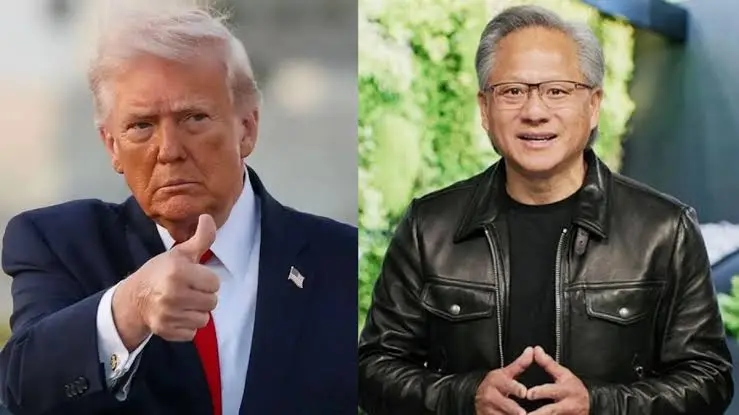
The US president and Nvidia chief Jensen Huang rejected fears of an AI takeover, while Huang also acknowledged that companies may need to slow down if they feel their technology is becoming difficult to control.
WASHINGTON: President Donald Trump made an unexpected appearance by phone at the All-In Summit in Los Angeles, calling concerns about artificial intelligence taking over the world a “hoax” and warning that opposition to AI could undermine America’s technological ambitions.
Nvidia CEO Jensen Huang was speaking at the event on Monday when Trump called him. Huang put the president on speakerphone, prompting Trump to joke about Huang’s ability to design sophisticated computer chips but his difficulty putting a phone call on speaker.
Trump then dismissed fears that robots or artificial intelligence could eventually take control.
“The robots will not be taking over. The AI will not be taking over the rest of the world,” Trump said, according to Axios.
He also suggested that resistance to AI could benefit America’s competitors, specifically pointing to China as a possible force behind opposition to the technology.
Huang responded that Nvidia would not allow such an outcome.
The exchange came as Silicon Valley faces growing debate over how quickly AI development should proceed. Anthropic CEO Dario Amodei recently argued that the industry should moderate the pace at which frontier AI systems become more capable. OpenAI CEO Sam Altman subsequently expressed support for a similar approach, while Elon Musk also backed the idea.
Huang, however, offered a more nuanced position.
Speaking at the same summit, he rejected catastrophic predictions about AI as unsupported by science, but stopped short of describing all concerns about the technology as a hoax.
He also praised Jacob Coxon, a researcher who resigned from Anthropic on September 9 after raising concerns about the risks associated with the development of advanced AI systems. Huang described Coxon’s decision as courageous.
More significantly, Huang said companies should consider pausing or slowing their work if they believe their own operations are becoming difficult to control.
That position creates an important distinction. Huang appears open to individual companies adjusting their pace when they see risks developing internally, while remaining opposed to a broad industry-wide slowdown.
The debate also has a major economic dimension for Nvidia. The company is one of the central suppliers of the advanced chips required to build and operate modern AI systems, meaning a significant reduction in AI development could directly affect demand for its hardware.
Trump’s reference to China also comes amid growing tensions over AI infrastructure and data centres. OpenAI has previously reported a China-linked influence operation involving ChatGPT, although the company said the campaign was attempting to influence an existing debate rather than create one from scratch.
At the same time, opposition to new data centres has largely emerged from domestic concerns in the United States, including disputes over electricity use, infrastructure and local development.
Trump has strongly promoted data-centre construction, arguing that AI infrastructure could eventually become an economic engine larger than the US oil industry.
The episode at the All-In Summit therefore highlighted a growing divide over AI: whether the technology should continue advancing at maximum speed, or whether companies should introduce safeguards and limits as capabilities become more powerful.

